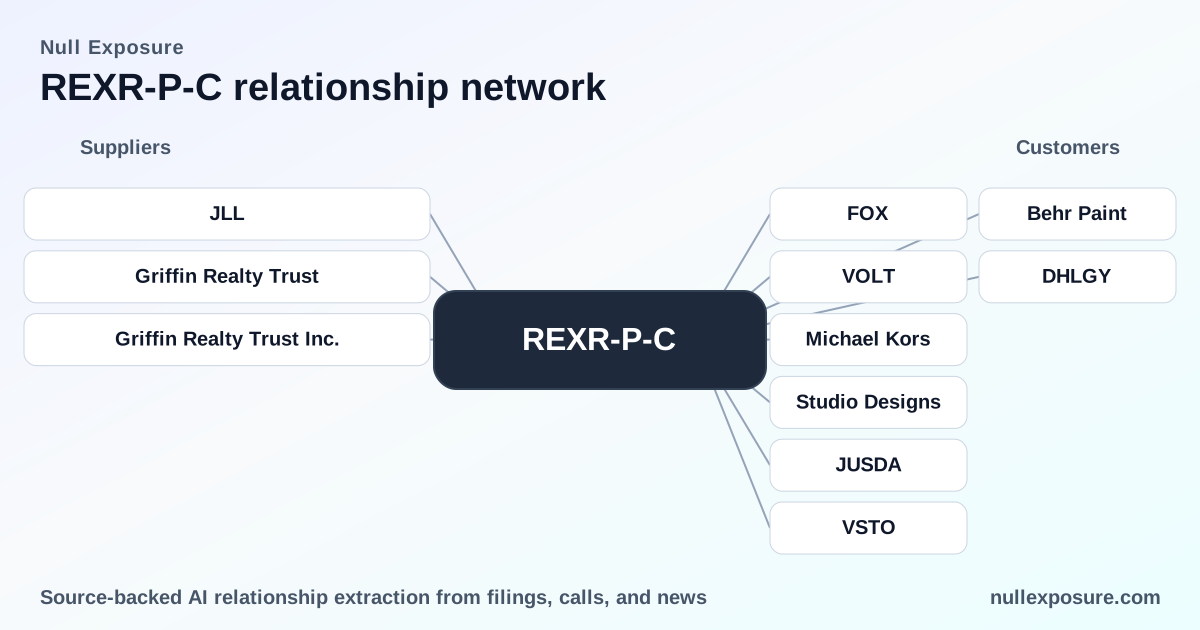
Rexford Industrial Realty (REXR‑P‑C): Tenant relationships that drive income and valuation
Rexford Industrial Realty operates and monetizes by owning and leasing infill industrial and light‑industrial properties across Southern California, capturing strong e‑commerce and last‑mile demand through long‑dated leases with logistics, retail and manufacturing tenants; income derives primarily from stable rental cash flows and lease renewals on strategically located assets, with accretive acquisitions and sale‑leaseback activity supporting NAV growth for preferred and common equity holders. For investors evaluating REXR‑P‑C, the tenant book is the principal source of cashflow durability and reversion upside.
If you want a concise, research‑grade view of Rexford’s customer portrait, start here: tenant concentration and renewal cadence are the key risk/return levers. For a direct look at our platform and tools, visit https://nullexposure.com/.
Why tenant relationships matter more than headline NAV
Rexford’s model is not a broad industrial portfolio — it is a focused, Southern California infill platform where each anchor tenant materially influences cash flow stability and valuation multiples. Lease renewals, sale‑leasebacks and strategic acquisitions referenced in public reporting illustrate a market‑oriented, active asset management posture: Rexford both buys occupied properties and negotiates anchor renewals to protect occupancy and achieve rental uplifts. That contracting posture is active and relationship‑driven rather than passive, which supports premium valuation in tight infill submarkets.
Operating model signals investors should track
- Contracting posture: proactive asset rotations, including buying occupied properties and entering sale‑leaseback arrangements, show a growth‑oriented procurement strategy that preserves cash flow while increasing footprint.
- Concentration: a relatively small number of large tenants (logistics, retail, national distributors) can drive volatility on renewal outcomes; large tenant renewals materially affect near‑term cash flows.
- Criticality: tenants like logistics providers and national distributors are operationally critical to Rexford’s industrial assets, giving the REIT leverage in renewals and tenant improvements negotiation.
- Maturity and renewal cadence: recent renewals and sale‑leasebacks in 2021–2025 show an experienced leasing team executing on retention and re‑pricing, which supports the preferred stock’s income profile.
(Company constraints reporting provided with this review contained no explicit, separate constraints; these operating signals are company‑level interpretations of observed relationship activity.)
Tenant roll call — line‑by‑line read
Below are every customer relationship referenced in the reviewed results, with a concise takeaway and the source for verification.
Fox — The Real Deal (Jan 17, 2023)
Rexford acquired the Fox (Fox Racing) site in Irvine, a 6.4‑acre location Fox has occupied since the property was developed in 2012, representing an acquisition of an occupied headquarters that preserves immediate cash flow. According to The Real Deal (Jan 17, 2023), Fox’s long tenancy underwrites the transaction’s income profile.
FOX — The Real Deal (Jan 17, 2023)
An identical mention of FOX in the same Real Deal piece confirms the company’s longstanding occupancy at the Irvine site, reinforcing that the purchase captured an in‑place corporate tenant. See The Real Deal (Jan 17, 2023).
Hertz — Investing.com transcript (Q3 2025, South Africa edition)
Rexford discussed the Hertz location at 9000 Airport Boulevard in earnings commentary, indicating the asset was part of its operational portfolio and connected to a sale‑leaseback narrative. Refer to the Q3 2025 earnings‑call transcript distributed on Investing.com.
Tireco — SimplyWall.st commentary (FY2026)
Rexford renewed its largest tenant, Tireco, ahead of schedule, which highlights a successful large‑tenant retention that shields near‑term cash flow and occupancy statistics. SimplyWall.st’s FY2026 summary reports this renewal event.
Hertz (sale‑leaseback) — Investing.com transcript (Q2 2025, UK edition)
Management stated, “We acquired this property from Hertz back in 2023. This was a sale leaseback,” confirming Rexford executed a sale‑leaseback with Hertz in 2023 that converted an owner‑occupied asset to an income‑producing lease. See the Q2 2025 transcript on Investing.com.
Tyco — InsiderMonkey earnings call transcript (Q1 2026)
Rexford included the renewal of Tyco at a 1.1 million sq ft Production Avenue asset in its renewal disclosures, indicating a substantial corporate tenant commitment that bolsters the Inland Empire portfolio’s cash flow. Refer to the Q1 2026 earnings transcript on InsiderMonkey.
VOLT — Orange County Business Journal (2021 recap)
Rexford’s 2021 acquisition activity included a purchase that encompassed the Orange headquarters for Volt Information Sciences Inc. (VOLT), showing Rexford’s willingness to buy office‑campus‑style properties adjacent to industrial clusters to optimize capital deployment. See the Orange County Business Journal coverage of the 2021 transactions.
Volt Information Sciences Inc. — Orange County Business Journal (2021 recap)
A second entry reiterates that Volt’s Orange headquarters was part of the 2021 $192 million trio of Central Orange County properties acquired by Rexford, underscoring how corporate office occupants were bundled into portfolio purchases. See OCBJ’s 2021 reporting.
Herbalife — Investing.com transcript (Q3 2025, South Africa edition)
Herbalife operates at 950 West 190th Street, cited during earnings commentary as an example of a corporate tenant within Rexford’s asset mix, providing predictable lease income for that asset. See the Q3 2025 transcript on Investing.com.
Studio Designs — The Real Deal (Jul 29, 2022)
Rexford acquired a building at 6027 Bandini Boulevard that was fully leased to Studio Designs, an import services firm serving e‑commerce furniture customers, capturing logistics demand from online retail supply chains. Refer to The Real Deal (Jul 29, 2022).
Hertz — Investing.com transcript (Q3 2025, Australia edition)
A duplicate transcript entry references the same Hertz site at 9000 Airport Boulevard, reinforcing the sale‑leaseback and operational importance of that asset in investor presentations. See the Q3 2025 transcript on Investing.com (Australia edition).
Tire co — InsiderMonkey earnings call transcript (Q1 2026)
Management emphasized the relative size and impact of the Tire co renewal, signaling this tenant’s material contribution to portfolio NOI and the importance of its early renewal. See InsiderMonkey’s Q1 2026 earnings call transcript.
Herbalife — Investing.com transcript (Q3 2025, Australia edition)
A second Investing.com transcript entry cites Herbalife’s location at 950 West 190th Street, again surfacing in management commentary and affirming that recurring tenant mentions reflect asset significance. See the Q3 2025 transcript on Investing.com (Australia edition).
Fox Racing — Orange County Business Journal (Mar 2023 coverage of acquisition)
OCBJ reported Rexford paid $40 million for the Fox Racing headquarters in Tustin, confirming a material, cash‑producing acquisition that added an in‑place corporate tenant to the roster. See the OCBJ article on the Fox Racing purchase.
VSTO — Orange County Business Journal (Mar 2023)
The VSTO ticker/name appears in OCBJ coverage referencing the Fox Racing acquisition and the broader 2021 property purchases, reflecting how corporate HQ assets are folded into Rexford’s holdings. See OCBJ’s reporting.
JUSDA — Los Angeles Business Journal (2021 CRE awards, FY2021)
Gateway Pointe was fully leased at sale to three tenants including JUSDA, indicating Rexford’s acquisition strategy of purchasing fully‑leased, multi‑tenant assets to secure immediate cash flow. See the LA Business Journal advertorial on the Gateway Pointe transaction.
Michael Kors — Los Angeles Business Journal (2021)
Michael Kors was one of the tenants fully leasing Gateway Pointe at the time of sale, demonstrating renter diversity that supports occupancy metrics in acquired properties. Refer to LA Business Journal (FY2021).
Behr Paint — Orange County Business Journal (2021 recap)
Behr Paint’s Santa Ana headquarters was among properties Rexford paid for in the 2021 Central Orange County purchases, illustrating portfolio diversification into large, single‑tenant office/industrial hybrids. See OCBJ’s 2021 transaction summary.
DHL — Los Angeles Business Journal (2021)
DHL was identified as a logistics tenant at Gateway Pointe when Rexford acquired the asset, representing strategic alignment with national logistics operators that underpin industrial REIT income. See the LA Business Journal piece on Gateway Pointe (FY2021).
DHLGY — Los Angeles Business Journal (2021)
The DHLGY designation repeats the DHL inclusion in Gateway Pointe’s tenant roster in the LA Business Journal coverage, supporting the logistics tenant characterization at acquisition. See LA Business Journal (FY2021).
Key takeaways for REXR‑P‑C investors
- Rexford executes an active, relationship‑driven leasing strategy: acquisitions are frequently of occupied properties and are accompanied by sale‑leaseback transactions that convert single assets into long‑term cash flow for the REIT.
- Large tenant renewals (Tireco, Tyco, Hertz) are value drivers: these renewals materially affect near‑term NOI and therefore the preferred stock’s income profile.
- Tenant mix blends logistics, corporate HQs and e‑commerce service providers, which delivers rental stability in infill Southern California submarkets but concentrates exposure to local economic cycles and renewal outcomes.
- Earnings commentary and regional press together create consistent signals: management frequently cites specific tenants in call transcripts and local outlets, indicating those relationships are central to investor communications.
For a more detailed portfolio‑level analysis and tenant concentration scoring, see our research hub at https://nullexposure.com/.