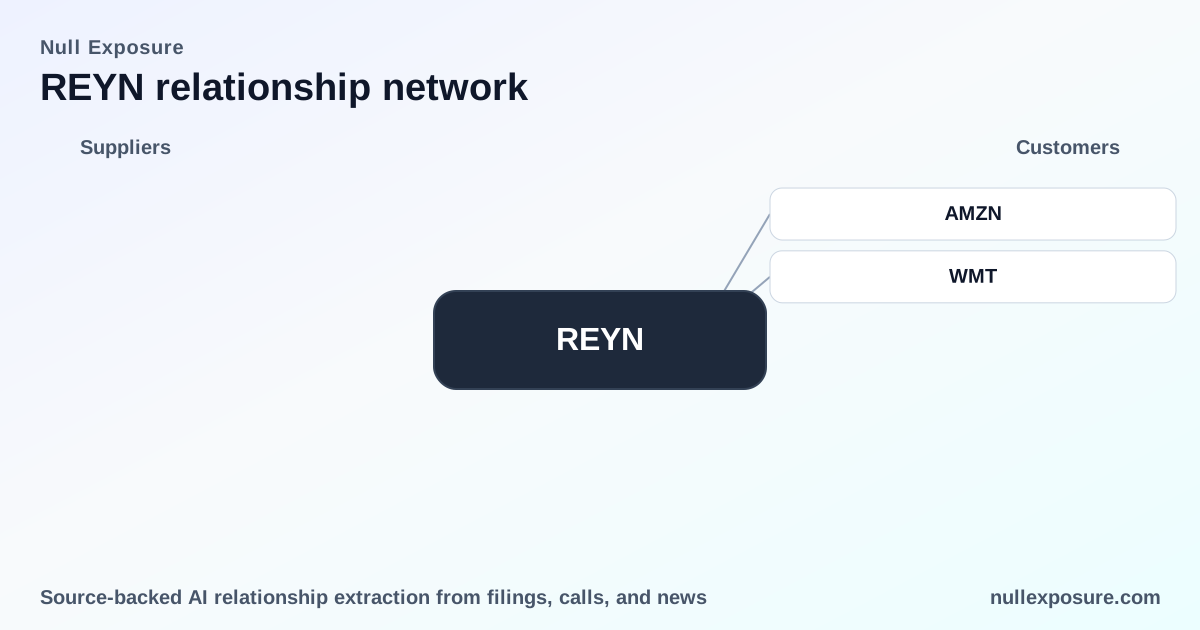
REYN Customer Map: How Reynolds Commercializes Shelf Presence and Where the Revenue Flows
Reynolds Consumer Products generates cash by manufacturing and selling branded and private‑label kitchen, waste and storage goods to a concentrated set of large retailers; the company monetizes through high‑volume, low‑margin retail relationships and a mix of branded and store‑brand agreements that capture both product margin and scale-driven distribution economics. Investors should view Reynolds as a North America‑centric consumer packaged goods business whose profitability depends on a few large retail partners and a hybrid contracting posture (transactional for branded products; multi‑year for some private label agreements). Learn more at https://nullexposure.com/.
How Reynolds runs its customer engine — commercial posture and structural risks
Reynolds sells both branded products (Reynolds Wrap, Reynolds Kitchens, etc.) and store‑brand products to major retailers. The company discloses that branded sales are generally governed by informal trading policies while store brands sit under one‑year or multi‑year agreements, creating a commercial mix that is both transactional and contractual. That operating profile produces three investment‑grade takeaways:
- Concentration: Reynolds relies on a small number of large customers for most revenue — its top ten customers represented 74% of sales in 2025, and the single largest customer accounted for 48% in each of 2023–2025 — which elevates counterparty risk and negotiating leverage dynamics.
- Geographic focus: Sales are overwhelmingly North American (99% of total sales in 2025), which intensifies exposure to U.S. retail trends, labor and input‑cost cycles.
- Contract maturity and role: The company acts principally as a seller of core household products with active, large‑enterprise counterparties; contracts skew short (annual) for most arrangements but longer where store‑brand manufacturing is involved.
These characteristics define Reynolds’ commercial bargaining power, working capital cadence, and sensitivity to retail promotional activity. For institutional research and operating teams evaluating counterparty exposure, the combination of high concentration, North‑America focus and mixed contract tenors is the dominant framework for scenario analysis. If you want a deeper view of counterparty dynamics, visit https://nullexposure.com/ for expanded relationship analytics.
Relationship-by-relationship: who buys what and where
Below I enumerate every retailer relationship referenced in recent coverage and filings. Each entry is a concise, plain‑English summary with the original source noted.
Amazon
Reynolds distributes branded products through Amazon’s marketplace channels, with new product rollouts such as the Reynolds Wrap “Hearts Fun Foil” explicitly listed as available on Amazon in FY2026 press coverage. According to a SahmCapital news release (April 16, 2026), the rollout names Amazon alongside Walmart and Target as nationwide retailers for the product (https://www.sahmcapital.com/news/content/reynolds-wrap-introduces-new-hearts-fun-foil-adding-a-heartfelt-touch-to-everyday-moments-2026-04-16).
AMZN (inferred symbol)
Multiple press reports and syndicated feeds tag Amazon by ticker when describing Reynolds’ online distribution, reinforcing that Amazon is treated as a major e‑commerce channel for Reynolds’ branded SKUs in FY2026. Finviz and other news aggregators carried the same product availability note in March–April 2026 (see finviz coverage, May 2026: https://finviz.com/news/345197/reynolds-wrap-introduces-new-hearts-fun-foil-adding-a-heartfelt-touch-to-everyday-moments).
Amazon.com
Specific product placements for Reynolds Kitchens items (for example, parchment cooking bags) were documented as available on Amazon.com in March 2026 press coverage, confirming Reynolds’ use of Amazon’s direct retail storefront in addition to broader marketplace listings. Finviz reported the product availability on March 10, 2026 (https://finviz.com/news/319228/reynolds-kitchens-parchment-cooking-bags-named-2026-product-of-the-year-in-kitchen-essentials).
Target
Target is repeatedly cited as a national retail partner for new Reynolds product introductions and rollouts, with company releases noting that items such as Countertop Prep Paper and Reynolds Wrap variants will be available in Target stores and online in FY2026. A PR Newswire release (May 2026) and follow‑on coverage list Target among the targeted retail channels (https://www.prnewswire.com/news-releases/the-reynolds-kitchens-brand-turns-any-countertop-into-a-no-mess-workspace-with-new-countertop-prep-paper-302722773.html).
TGT (inferred symbol)
News feeds streaming the same PR material tag Target with its ticker, reinforcing the retailer’s standing in Reynolds’ top distribution partners for FY2026 product launches. SahmCapital and quantisnow articles in April–May 2026 replicate the Target placement language (see SahmCapital, Apr 16, 2026: https://www.sahmcapital.com/news/content/reynolds-wrap-introduces-new-hearts-fun-foil-adding-a-heartfelt-touch-to-everyday-moments-2026-04-16).
Walmart
Walmart is documented as a national retail partner carrying Reynolds-branded products, and specific SKUs (e.g., Countertop Prep Paper and Reynolds Kitchens cooking bags) were called out as available in Walmart stores and on Walmart.com in FY2026 communications. PR Newswire and Finviz coverage from March–May 2026 list Walmart alongside Amazon and Target as primary retail distribution outlets (PR Newswire May 2026: https://www.prnewswire.com/news-releases/the-reynolds-kitchens-brand-turns-any-countertop-into-a-no-mess-workspace-with-new-countertop-prep-paper-302722773.html; Finviz Mar 10, 2026: https://finviz.com/news/319228/reynolds-kitchens-parchment-cooking-bags-named-2026-product-of-the-year-in-kitchen-essentials).
Walmart.com
Reynolds’ products are sold through Walmart’s online storefront as well as in‑store inventory; press reporting on product‑of‑the‑year recognitions explicitly lists Walmart.com in the FY2026 press coverage, confirming Reynolds’ omnichannel placement with Walmart (Finviz, March 10, 2026: https://finviz.com/news/319228/reynolds-kitchens-parchment-cooking-bags-named-2026-product-of-the-year-in-kitchen-essentials).
WMT (company name / ticker variant)
Syndicated news items also reference Walmart by ticker (WMT) when describing Reynolds’ distribution strategy for FY2026 product launches, reflecting how market feeds normalize retailer references across outlets. See finviz coverage (March–May 2026) for the consolidated reporting (https://finviz.com/news/345197/reynolds-wrap-introduces-new-hearts-fun-foil-adding-a-heartfelt-touch-to-everyday-moments).
Investment implications and what to watch next
- Concentration risk is the headline: with the largest customer supplying roughly half of revenues and the top ten representing three‑quarters of sales, changes in promotional intensity, private‑label wins/losses, or pricing pressure at a single major retailer can move EBITDA materially.
- Contract mix shapes cash flow volatility: branded sales are transactional and often negotiated annually, while store‑brand manufacturing locks in multi‑year volumes; this duality reduces margin predictability but preserves volume.
- North America exposure amplifies domestic retail cycles: near‑term inflation, freight, and promotional environments in the U.S. will disproportionately affect Reynolds’ topline and working capital.
For operating teams and buy‑side analysts focused on counterparty risk, the obvious surveillance priorities are: retailer assortment changes, large customer contract renewals, and promotional cadence across Walmart, Target and Amazon. For ongoing monitoring and relationship dashboards, visit https://nullexposure.com/ for expanded coverage and tracking tools.
Key takeaway: Reynolds’ commercial value derives from scale with a small number of large retail partners — that scale drives cash flow but concentrates negotiation and execution risk into a handful of relationships.