Regions Financial Corporation (RF): Customer Relationships, Roles, and Strategic Implications for Investors
Regions is a regional bank holding company that monetizes through net interest margin on loans funded primarily by deposits, plus fee income from wealth, capital markets, mortgage and trustee services. Regions converts a large, stable deposit base into diversified lending and capital‑markets activity—commercial lending, mortgage origination and securities underwriting/trustee work—while supplementing income with wealth and fee businesses. Learn more at https://nullexposure.com/.
How Regions operates with customers: a concise investor thesis
Regions’ financial model is built on deposit-funded lending and fee-generating capital markets and trust services. Deposits fund roughly 92% of average earning assets, making funding stability a core competitive advantage, while Regions’ subsidiaries deliver transaction and advisory services that broaden revenue away from pure interest income. Geographic focus across the Southeast, Midwest and Texas produces scale in retail/commercial banking while capital markets activity connects Regions to institutional issuers nationwide.
Operating-model signals that shape customer relationships
The company disclosures and news reporting surface several characteristics that matter for credit and strategic analysis:
- Funding and criticality: Deposits are central — they provide 92% of average earning assets, which makes deposit retention and local franchise strength critical to earnings and liquidity management (Regions FY2024 10‑K).
- Revenue mix and segment focus: Interest income is the single largest revenue source, with the Services/Wealth/Capital Markets segments contributing meaningful fee income and cross-sell opportunities.
- Counterparty breadth: Regions serves individuals, government entities, mid‑market corporates, non‑profits and small businesses — a diversified counterparty base that reduces single‑segment concentration risk.
- Contract posture and maturity: The company uses short‑term leasing and transactional arrangements; leases under 12 months are not capitalized on the balance sheet, indicating an operational posture that relies on off‑balance-sheet and short‑term contractual flexibility.
- Relationship roles: Regions acts as lender, arranger, trustee, underwriter/co‑manager and service provider across its client relationships, demonstrating an integrated commercial banking and capital markets platform.
- Geographic concentration: Primary operations sit in the South, Midwest and Texas, with specialist offices in major finance centers for national capabilities.
These signals point to a funding‑stable regional bank that offsets interest‑rate and margin exposure with diversified fee businesses and capital‑markets engagement.
Customer and counterparty relationships observed in the public record
Below I list the relationships detected in filings and news items, each with a concise plain‑English summary and source reference.
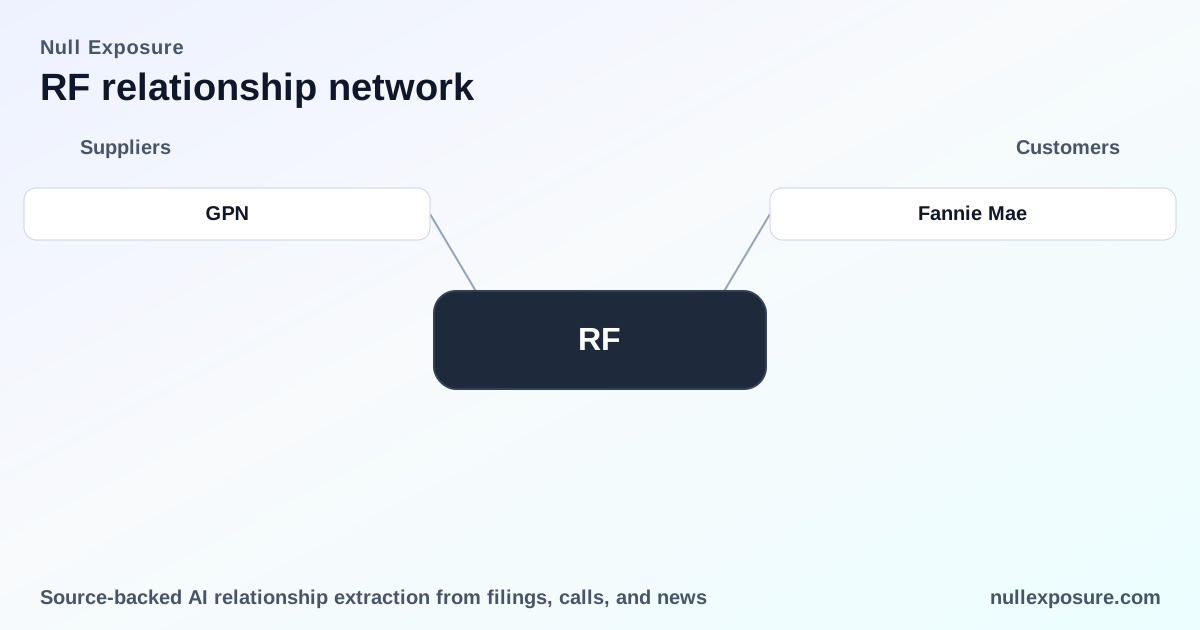
Fannie Mae
Regions sells commercial loans to Fannie Mae through the DUS lending program and other platforms, indicating active secondary market loan sales and credit distribution for commercial mortgage exposure. Source: Regions FY2024 Form 10‑K (rf-2024-12-31).
INN‑P‑E (Summit Hotel Properties)
Regions Bank signed an amendment to Summit Hotel Properties’ 2024 term loan as part of a financing update, demonstrating Regions’ role as a lender and administrative agent in hotel sector financing. Source: TradingView news (May 3, 2026) — Summit Hotel Properties financing announcement (https://www.tradingview.com/news/tradingview:8e2e8323397b6:0-summit-hotel-properties-updates-multiple-financing-agreements-with-major-lenders/).
PEB‑P‑E (Pebblebrook Hotel Trust)
Regions Bank served as Senior Managing Agent on a $450 million term loan for Pebblebrook, highlighting Regions’ capacity to lead and structure large hotel‑sector syndicated facilities. Source: Yahoo Finance / CityBiz reporting (March 10, 2026) (https://finance.yahoo.com/news/pebblebrook-hotel-trust-closes-450-120000087.html; https://www.citybiz.co/article/805748/pebblebrook-hotel-trust-refinances-near-term-debt-secures-450m-term-loan/).
CPT (Camden Property Trust)
Regions Securities LLC acted as a Senior Co‑Manager on Camden Property Trust’s $600 million senior unsecured notes offering, confirming Regions’ investment‑banking distribution role in large REIT securities transactions. Source: StockTitan / AIjourn / Yahoo Finance coverage (March 9, 2026) (examples: https://www.stocktitan.net/news/CPT/camden-property-trust-prices-600-million-4-900-senior-unsecured-da3jyloqg74y.html).
USPH (U.S. Physical Therapy)
Regions Capital Markets acted as joint lead arranger and syndication agent on a $450 million credit facility, demonstrating participation in healthcare sector leveraged finance and syndicated lending. Source: Pulse2 / Intellectia.ai reporting (May 4, 2026) (https://pulse2.com/u-s-physical-therapy-450-million-credit-facility-strengthens-growth-and-capital-flexibility/).
RF‑P‑C (Ascentium Capital acquisition mention)
Regions’ strategic actions included the acquisition of equipment‑financing firm Ascentium Capital, noted for back‑end technology that supports Regions’ lending operations—an operational move to scale specialty finance capabilities. Source: Banking Dive coverage (FY2021 context referenced in March 2026 article) (https://www.bankingdive.com/news/right-sizing-takes-a-different-shape-depending-on-the-bank/595788/).
CDR‑P‑C (Cedar Realty Trust)
Regions Capital Markets was named a Co‑Lead Arranger in an amended term loan for Cedar Realty Trust, reflecting repeated engagement with REIT credit facilities as arranger and syndication partner. Source: CityBiz (March 9, 2026) (https://www.citybiz.co/article/138261/cedar-realty-trust-names-jennifer-bitterman-chief-financial-officer/).
GEL (Genesis Energy)
Regions Bank served as trustee on Genesis Energy’s $750 million senior notes offering (supplemented March 4, 2026), showing the bank’s trustee and indenture services in energy sector capital markets work. Source: Investing.com / press coverage (May 3, 2026) (https://www.investing.com/news/sec-filings/genesis-energy-completes-750-million-senior-notes-offering-due-2034-93CH-4542376).
AHCO (AdaptHealth)
Regions Bank appeared as administrative agent and participant in AdaptHealth’s $1.10 billion facility replacement, indicating Regions’ role in healthcare equipment and services financing syndicates. Source: TradingView (May 2, 2026) (https://www.tradingview.com/news/tradingview:8c1cfef7e5359:0-adapthealth-secures-1-10-billion-credit-facility-led-by-bank-of-america-replaces-2021-loan/).
AROC (Archrock)
Regions Bank served as trustee for Archrock’s indenture, confirming trustee-level engagement for industrial gas and energy issuers. Source: TradingView (March 9, 2026) (https://www.tradingview.com/news/tradingview:621ca161da3e7:0-archrock-signs-indenture-with-regions-bank/).
ADC (Agree Realty)
Regions Securities LLC acted as co‑manager on Agree Realty’s $400 million senior unsecured notes, reinforcing the firm’s recurring role in REIT capital markets placements. Source: PR Newswire (March 9, 2026) (https://www.prnewswire.com/news-releases/agree-realty-announces-pricing-of-400-million-of-5-600-senior-unsecured-notes-due-2035--302455815.html).
SSTI (SoundThinking)
SoundThinking leases office space in the Regions Bank Tower for a three‑year renewable term, demonstrating Regions’ commercial property relationships and local market presence in Orlando. Source: The Globe and Mail press item (March 10, 2026) (https://www.theglobeandmail.com/investing/markets/markets-news/GlobeNewswire/36667811/soundthinking-opens-new-alert-review-center-in-orlando-establishing-permanent-hub-for-safepointe-operations/).
What these relationships reveal for investors
Regions functions as a full‑service regional bank and capital markets franchise: it originates and sells mortgage assets (e.g., DUS loans to Fannie Mae), underwrites and co‑manages REIT and corporate note offerings, arranges syndicated credit facilities in healthcare and hotel sectors, and provides trustee and indenture services for energy and industrial issuers. That breadth supports fee diversification while keeping interest income from loan books as the core earnings engine.
Key investment considerations:
- Strength: Broad capital markets activity demonstrates a viable fee‑revenue pipeline and institutional distribution capabilities beyond retail banking.
- Risk: Funding concentration in deposits (92% of earning assets) increases sensitivity to regional deposit flows and local economic cycles; preserving deposit stickiness is essential.
- Operational posture: Short‑term contract use and off‑balance-sheet lease treatment add flexibility but require active liquidity management.
- Counterparty diversification: Serving individuals, government, mid‑market corporates and non‑profits reduces single‑counterparty concentration risk, while engagement with REITs and hospitality links earnings to cyclical sectors.
For deeper diligence on specific engagements or to map relationship exposure across Regions’ segments, visit https://nullexposure.com/.
Bottom line
Regions leverages a deposit‑centric balance sheet to underwrite, arrange and service a wide set of corporate and institutional financings while maintaining large retail and wealth franchises. The bank’s customer relationships—ranging from Fannie Mae mortgage conduits to trustee roles for energy issuers and lead arranger work in healthcare and lodging—underscore a business model that pairs steady interest margins with scalable fee businesses. Investors should weigh the resilience of the deposit base and regional economic exposure against the upside of diversified capital markets revenue.