RF-P-C (Regions Financial) — customer relationships that read like community banking, not corporate dependency
Regions Financial Corporation operates as a traditional bank holding company that monetizes through deposit-taking, lending spreads, fee income and trust/brokerage services; RF-P-C represents a preferred equity tranche in that capital structure rather than an operating subsidiary. For investors and operators evaluating customer relationships tied to RF-P-C, the public record shows Regions positioning its brand through community partnerships and educational support rather than through large, revenue-critical enterprise contracts—an important signal about concentration and operational dependency.
Explore the full dataset and company profile at https://nullexposure.com/.
How these relationships fit the operating model
Regions is a regional bank that builds retail and commercial pipelines through brand visibility, community engagement and local sponsorships. The two customer relationships surfaced in the search are marketing and community-oriented rather than large commercial or technology procurement arrangements. That classification implies a low level of critical vendor dependency for Regions’ day-to-day operations and suggests these ties function chiefly as customer-acquisition and brand-reputation channels.
- Contracting posture: Publicly visible engagements are promotional and sponsorship-based; they do not indicate long-term, high-penalty vendor contracts.
- Concentration: The sample shows dispersed, low-dollar community partners rather than concentrated enterprise customers.
- Criticality: These relationships are non-critical to core banking throughput and do not imply single-point operational risk.
- Maturity: The relationships are mature in the sense of standard sponsorship and community programs for regional banks; they are recurring brand initiatives rather than novel strategic alliances.
The relationships you need to know (two items)
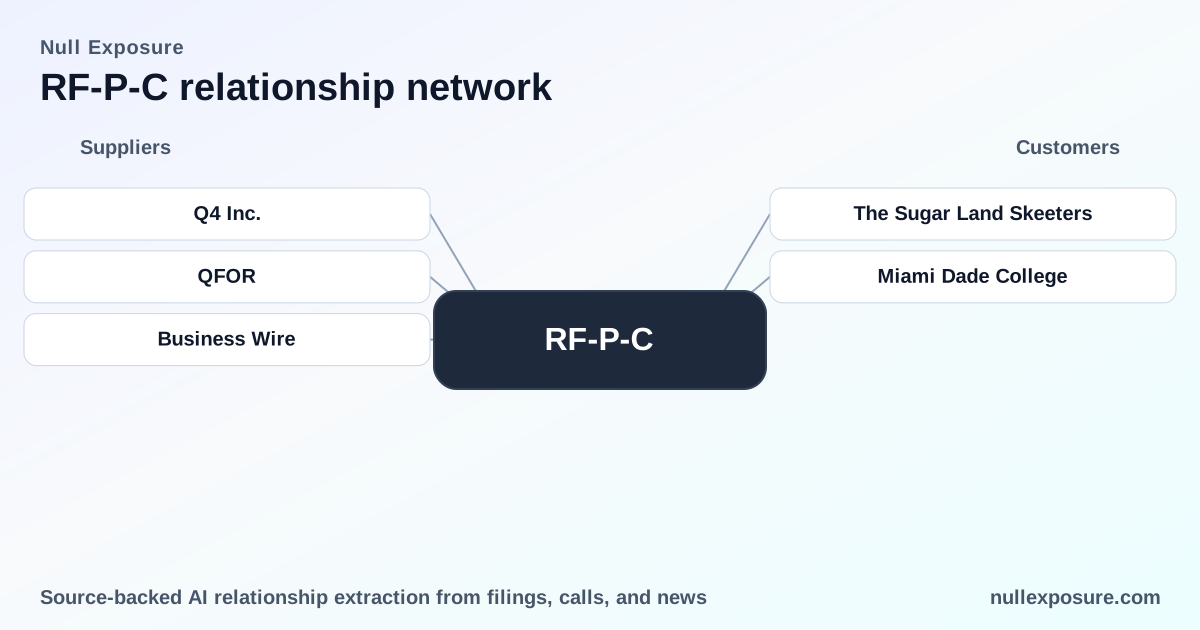
The Sugar Land Skeeters — Official Banking Partner
Regions Bank is listed as the Official Banking Partner of the Sugar Land Skeeters, a minor-league baseball organization. This is a classic local-market sponsorship intended to increase brand visibility and deposit relationships in the Sugar Land / Houston suburban market (reported FY2021). Source: Regions’ partnership announcement on the Skeeters’ official site and press channel (milb.com, reported 2026-03-10 — https://www.milb.com/news/skeeters-announce-regions-bank-as-official-banking-partner).
Miami Dade College — scholarship and community engagement support
Miami Dade College documents that Regions Bank has funded financial scholarships for students as part of its community engagement efforts, reflecting charitable and workforce-development initiatives rather than commercial lending or treasury services (documented FY2020). Source: Miami Dade College faculty/staff news/profile page referencing Regions’ scholarship support (news.mdc.edu, reported 2026-03-10 — https://news.mdc.edu/chris-cruzpino/).
Why these particular relationships matter to investors
Both relationships are brand- and community-focused, which is consistent with a regional bank strategy to capture retail deposits, cross-sell consumer and small-business products, and reinforce local market goodwill. For holders of RF-P-C, the implications are straightforward:
- Revenue impact is indirect. Sponsorships and scholarship programs do not generate material fee or interest income directly, but they support lower-cost deposit acquisition over time.
- Credit and counterparty risk are minimal. Neither relationship represents a material receivable or loan that would appear on Regions’ balance sheet as concentrated credit exposure.
- Reputational management is active. These engagements indicate ongoing investment in community reputation, which is valuable for deposit stability in regional markets.
Key takeaway: these public relationships reflect marketing and CSR execution rather than revenue-critical commercial contracts.
Constraints and what the public record signals about contracting
The available relationship data for RF-P-C lists no explicit contractual constraints or vendor limitations. This absence is itself a company-level signal: there are no recorded contractual restrictions, exclusivity clauses, or regulatory encumbrances tied to the customer relationships surfaced in this search. Treat this as indicative of a typical retail-bank approach to sponsorships and outreach—low contractual complexity and low operational lock-in.
Because no constraints are recorded, investors should interpret public relationships as tactical and flexible rather than long-term, high-risk contractual commitments.
Risk considerations for investors and operators
Even with low operational criticality, these relationships matter in the aggregate for regional deposit flows and brand health. Consider:
- Reputational risk: Localized controversies or failures in community programs can have outsized local deposit implications in affected markets.
- Marketing ROI: Sponsorships and scholarships require ongoing funding; assess Regions’ marketing spend discipline relative to deposit acquisition costs.
- Geographic exposure: Community partnerships concentrate effort in discrete local markets; weakness in those markets (economic, demographic) can blunt the effectiveness of brand investments.
Major relationship takeaway: these connections reduce customer acquisition friction but do not introduce commercial concentration or structural counterparty risk to RF-P-C.
Practical next steps for due diligence
For buy-side analysts and bank operators evaluating RF-P-C, prioritize the following:
- Monitor Regions’ disclosures for material commercial relationships or partnership announcements beyond marketing and CSR.
- Review deposit growth trends in the relevant local markets tied to sponsorships (e.g., Sugar Land/Houston, Miami) to infer ROI on these engagements.
- Track any regulatory filings or investor presentations that quantify community-investment budgets or program effectiveness.
If you want a consolidated view of customer relationships, community programs, and partner disclosures tied to Regions, see the public profile at https://nullexposure.com/ for the full relationship feed and time-stamped source links.
Bottom line
The customer relationships surfaced for RF-P-C are emblematic of a regional bank’s community-led growth playbook: visible, local, and low-risk from a credit and operational dependency standpoint. For preferred holders, these ties reinforce deposit stability potential without introducing material concentration risk—information that anchors a conservative assessment of relationship-driven downside exposure.