RF Industries (RFIL): Customer Relationships, Concentration, and the 5G Upside
RF Industries designs, manufactures, and sells interconnection products and systems to communications, aerospace, and industrial customers, monetizing through direct sales and a network of independent warehousing distributors who resell its cables, connectors, and enclosure systems. The business converts engineering-led product lines—RF and fiber cable assemblies, connectors, and integrated enclosures—into recurring B2B revenue, with a meaningful channel component that accounts for roughly a third of sales. For a concise view of the coverage and signals behind these customer relationships, visit https://nullexposure.com/.
How RF Industries wins customers and captures margin
RF Industries operates as a niche industrial supplier with two complementary commercial levers: direct OEM sales into large enterprise customers and a broad independent distributor footprint that smooths demand and extends reach. Sales through independent distributors represented about 28% of net sales in FY2025, while the remainder flows through the company’s in-house sales team and direct OEM contracts. According to company disclosures for fiscal years ended October 31, 2025 and 2024, the firm conducts all operations in the U.S. and derives modest export revenue—primarily to Canada—accounting for roughly 8–9% of net sales.
The company has pursued a modest vertical integration strategy to support higher-margin system sales, particularly in the 5G infrastructure market. The acquisition of specialty telecom suppliers has been positioned to complement RFIL’s integrated enclosure product offering and to supply RF and fiber cable assemblies that enable system-level wins.
Explore the underlying evidence and relationship signals at https://nullexposure.com/.
Customer relationships that matter (and what they mean)
Below I cover the relationships surfaced in public documents and the company’s filings. Each relationship is summarized in plain English and tagged to the public source.
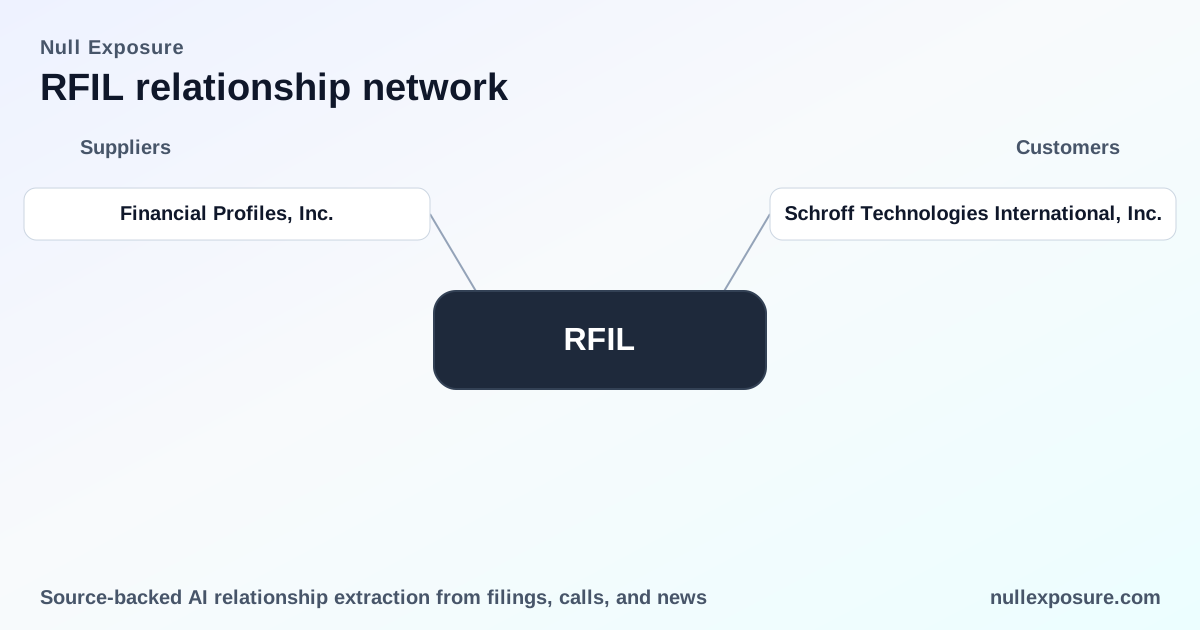
Schroff Technologies International, Inc.
RF Industries announced the acquisition of Schroff Technologies to integrate high-quality RF and fiber cable assemblies with its 5G enclosure product line, creating a vertical supply capability intended to benefit shared customers by combining enclosure systems with cable assembly expertise. This strategic combination positions RFIL to sell more integrated solutions to telecom equipment providers. According to a GlobeNewswire press release announcing the 2019 transaction, RF Industries cited the acquisition as complementary to its integrated 5G enclosure offering (GlobeNewswire, November 2019).
(That GlobeNewswire release is the single relationship item surfaced in the reviewed results; it documents the strategic tie between RFIL and Schroff.)
Company-level constraints that shape customer dynamics
The public filings and disclosures reveal several structural constraints that define how RF Industries contracts with, depends on, and serves its customer base:
- Large-enterprise focus: The company directly supplies large national telecommunication equipment and solution providers who incorporate RFIL products into their own offerings. This positioning gives RFIL access to scale buyers but also brings enterprise-level procurement pressure on pricing and terms (company filing language).
- Geographic concentration in North America: Operations are U.S.-based, with export sales representing about 8–9% of net sales and the majority of exports going to Canada, indicating limited geographic diversification (FY2025 and FY2024 disclosures).
- Revenue concentration and receivables risk: For the year ended October 31, 2025, one wireless provider customer represented approximately 10% of total sales and about 26% of net accounts receivable, while an aerospace customer represented less than 10% of sales but about 18% of receivables—signs of concentrated counterparty credit exposure.
- Distribution-dependent go-to-market: Sales through independent warehousing distributors accounted for approximately 28% of net sales in FY2025, signaling a hybrid channel model where distributors materially affect top-line stability and inventory flow.
- Contracting posture and relationship maturity: Distributors and some customers are longstanding, but written agreements for major customers carry no minimum purchase obligations, creating potential churn risk even where relationships are mature and active.
These constraints collectively imply a business that can win scaled OEM placements but operates with meaningful counterparty concentration and limited contractual lock‑ins, increasing sensitivity to demand shocks at a small number of large buyers.
What investors should watch next
RF Industries presents a mixed risk/reward profile tied to its role as a component and systems supplier to telecom and aerospace markets.
- Concentration risk is material. One wireless provider accounting for 10% of sales and a quarter of receivables is a single-event vulnerability to revenue and working capital if deliveries slow or terms shift (company FY2025 filing).
- Channel and margin dynamics matter. With distributors making up ~28% of sales, changes in distributor inventories or purchasing cadence will directly swing quarterly revenue; the Schroff integration is intended to increase system-level sales and potentially lift margins if cross-sell succeeds.
- North American dominance limits geographic diversification. Export sales are small and concentrated in Canada, keeping growth tied to regional demand cycles.
- Valuation and upside. The market currently prices RF Industries as a small-cap industrial—Market Capitalization around $151 million with trailing metrics showing low reported EPS and a wide spread between trailing PE and forward PE (company metrics). The firm’s 5G enclosure plus integrated cable assembly strategy presents a credible path to higher system revenue if enterprise customers accept integrated solutions.
Bottom line: risk-managed growth with targeted upside
RF Industries is a specialized supplier that monetizes through product and system sales to large enterprise OEMs and distributors, and it has intentionally reinforced its product stack via acquisitions such as Schroff Technologies to pursue integrated 5G opportunities. Key investor considerations are customer concentration, channel dependence, and the company’s ability to convert acquisitions into sustained system sales. Watch receivables concentration, distributor order patterns, and cross‑sell progress from the Schroff integration as primary indicators of execution.
For further research and to trace the underlying source evidence and relationship signals in one place, visit https://nullexposure.com/.