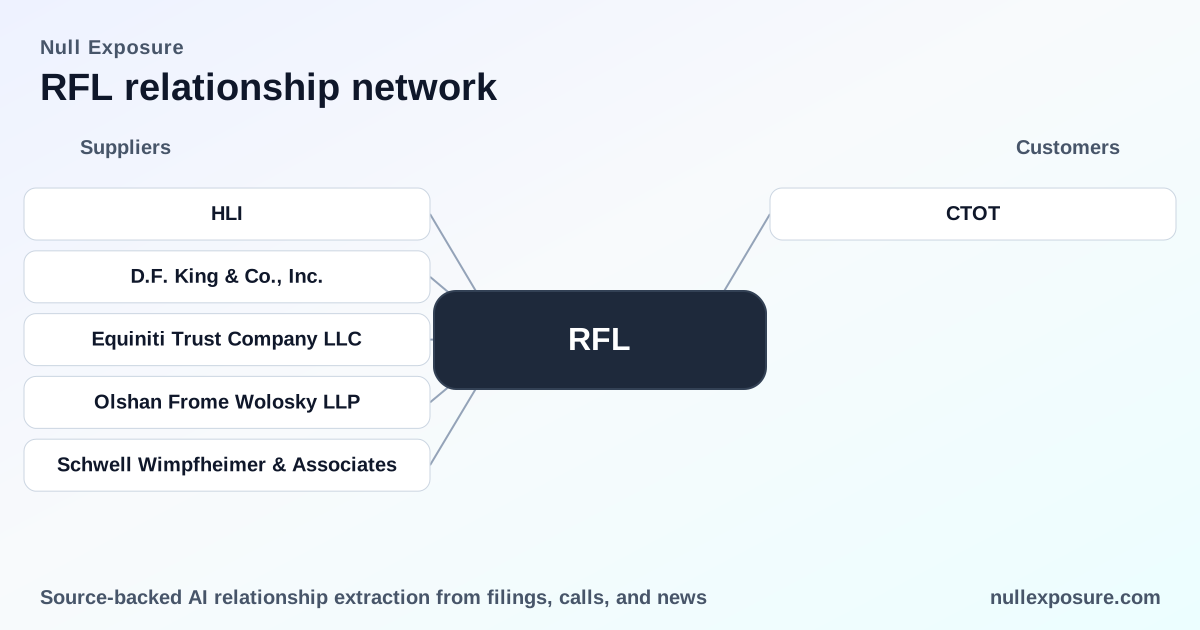
Rafael Holdings (RFL): concentrated receivables, portfolio operating complexity, and where the customer risk lives
Rafael Holdings operates as a diversified holding company with healthcare, infusion technology, chemical (Cyclo/cyclodextrin) and real estate lines; it monetizes through a mix of product sales (notably cyclodextrin and related fine chemicals), license and asset transactions, lease income and recoveries or realizations from portfolio company receivables and investments. Investors should price RFL as a hybrid operating-investment vehicle whose near-term earnings are driven as much by the treatment of intercompany and related-party receivables and acquisition accounting as by recurring product revenue. For quick access to the company’s relationship mapping and signals, visit NullExposure.
Understanding the customer and related-party ledger is central to valuing RFL: a handful of counterparties represent material portions of revenue and receivables, and recent filings show both large recoveries and material impairments that swing reported results.
What the company sells, and how that creates counterparty exposure
Rafael’s commercial profile blends legacy product sales (cyclodextrins and other fine chemicals) with holdings in pharmaceutical portfolio companies and real estate leases. Revenue drivers are uneven: Cyclo product sales for research and specialty uses now represent a substantial share of reported revenue after the Cyclo merger, while real estate contributes lease income and the healthcare/infusion segments generate primarily US-based sales. Rafael lacks a fully integrated sales and marketing organization and relies on distributors and third parties to commercialize technology, which creates contractual dependency on a small set of buyers and partners.
Operationally, that profile creates three structural exposures:
- Concentration risk: a small set of customers/tenants historically account for a very large share of revenue and receivables, making short-term results sensitive to individual counterparties.
- Receivables and related-party risk: the company records recoveries, allowances and impairments for receivables tied to portfolio companies and related entities; these items materially affect reported losses or gains in any fiscal year.
- Contracting and go-to-market posture: RFL outsources distribution and licensing in key markets and often monetizes technologies through asset sales and licensing rather than direct commercialization.
Customer and related-party relationships on the tape
Below are every relationship record surfaced in the review set, presented with concise plain-English takeaways and the reporting source.
Cornerstone Pharmaceuticals, Inc. — ADVFN / Globe Newswire (FY2026)
Cornerstone was the subject of a FY2026 impairment: the filing records an impairment of cost-method investment and loan losses related to Cornerstone totaling $114.2 million, indicating a significant write-down against the company’s investment exposure. This is reported in an ADVFN/Globe Newswire filing cited for FY2026.
RP Finance LLC — ADVFN / Globe Newswire (FY2026)
RP Finance LLC is reflected as a related-party debtor; the FY2026 disclosure shows a small net receivable after allowances (net balance shown as $7,500), with allowances recorded historically. The same ADVFN/Globe Newswire filing documents the related-party receivable treatment for FY2026.
Rafael Pharmaceuticals — PR Newswire/ADVFN excerpt (FY2026)
Rafael Holdings discloses amounts due from Rafael Pharmaceuticals on the balance sheet (line items reported as nominal balances such as $160 and $3,300 in the referenced disclosure), reflecting continuing intercompany receivable activity reported in the relevant filing. The PR Newswire/ADVFN excerpt captures these FY2026 ledger items.
Cornerstone / CTOT — FinancialContent / Pasadena Star-News release (FY2025)
Rafael reported a $31.3 million recovery of receivables from Cornerstone in the prior year, which materially reduced net loss comparisons for FY2025; this recovery is called out in the company’s FY2025 financial communication republished by FinancialContent and Pasadena Star-News.
CTOT — ManilaTimes / GlobeNewsWire (FY2025)
A FY2025 investor release republished in ManilaTimes/GlobeNewswire attributes year‑over‑year improvements in net loss in part to the $31.3 million recovery from Cornerstone, plus acquisition-related in‑process R&D and other items tied to consolidation activity after the March 2025 acquisition.
Cornerstone — QuiverQuant (press release republish, FY2025)
QuiverQuant’s republication of Rafael’s FY2025 results highlights the same $31.3 million receivable recovery from Cornerstone, reinforcing that recoveries—alongside acquisitions and unrealized gains—drove the fiscal performance narrative for FY2025.
(Each of the Cornerstone/CTOT entries above reflects the company’s repeated public disclosures across outlets for FY2025 and FY2026; the multiple source entries in the record set all reference the same recovery/impairment dynamics but from different publication outlets.)
Constraints and what they signal about RFL’s operating model
The consolidated constraint evidence provides company-level signals that explain how RFL manages customers and risk:
- Geographic footprint is concentrated but internationally relevant. Revenue streams for the Infusion Technology and Healthcare segments are generated entirely or primarily in North America, while real estate revenue cites tenants located in Israel; corporate statements also recognize the need for global payor coverage for pharmaceutical commercialization, so the business operates with a regional concentration plus global commercialization considerations.
- Revenue concentration is acute and material. Filings state that historically one third‑party customer and a small number of tenants and related parties accounted for a majority of revenue and a large share of receivables, which establishes high customer concentration as a structural risk to cash flow and earnings volatility.
- Relationship roles are diverse at the company level. Disclosures identify Rafael and its portfolio companies acting as seller, licensor, distributor, buyer and lessor across different lines; the company also reports indemnity obligations towards customers and distributors.
- Commercial posture is outsourcing-heavy. The company lacks a full sales and marketing infrastructure for pharmaceuticals and relies on third-party distributors and licensing to execute commercialization, which increases operational dependence on external partners.
- Maturity and contractual timelines are mixed. Recent acquisitions (e.g., the Cyclo merger in 2025) have introduced immediate revenue shifts and consolidation effects, while real estate leases have explicit expirations in the mid-2020s; this combination produces near-term accounting volatility tied to acquisitions, recoveries and lease roll-offs.
Investor takeaway: these constraints indicate a company whose earnings are sensitive to counterparty credit and the accounting outcomes of acquisition and consolidation, rather than purely steady organic growth.
What investors need to watch next
- Monitor accounts receivable composition and any further recoveries or impairments tied to Cornerstone/CTOT and related parties, as these entries swing reported profitability materially. The FY2025 recovery ($31.3M) and the FY2026 impairment ($114.2M) are both examples of swings to model.
- Track geographic sales concentration and distributor agreements in the U.S., since the Infusion Technology and Healthcare revenues are largely North American and the company outsources distribution.
- Watch for changes in related-party lending or allowances (e.g., RP Finance LLC balances) and any new disclosures around indemnities or licensing milestones that would impact cash conversion.
For ongoing coverage and relationship mapping tailored to institutional due diligence, visit NullExposure for immediate access to the compiled signals and original source references.
Rafael Holdings is a compact, concentrated business whose market value will continue to reflect how management resolves intercompany claims, executes on recent acquisitions and converts Cyclo-related product demand into repeatable, third‑party cash flow. Investors should underwrite RFL with a clear view of counterparty concentrations and contingency outcomes rather than assuming stable, diversified revenue streams.