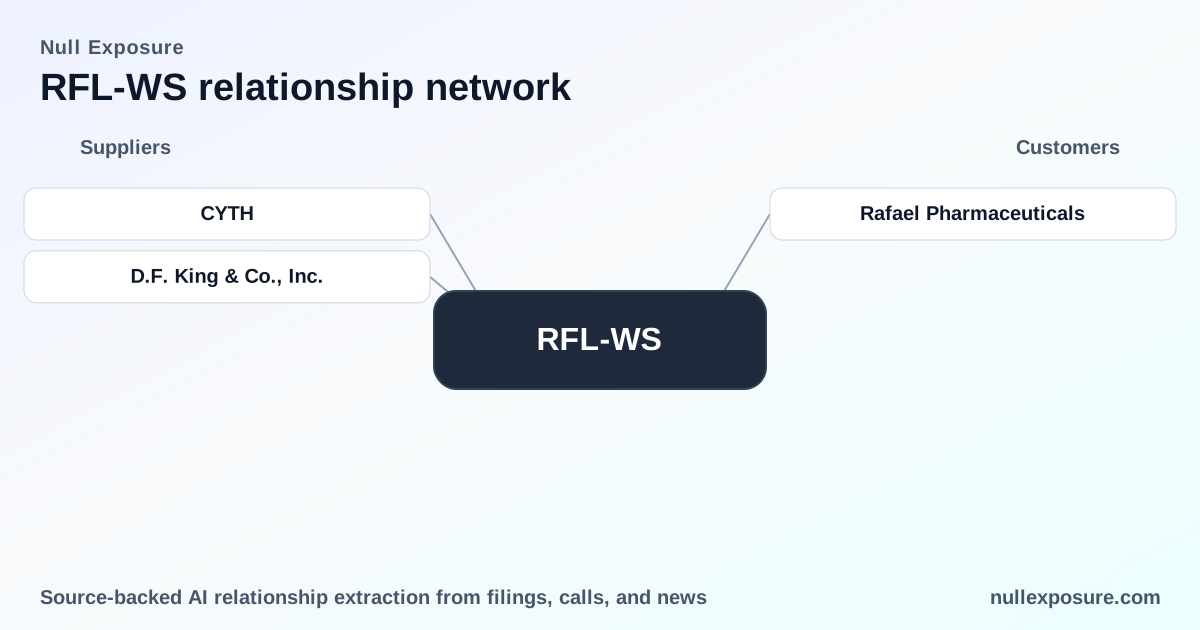
RFL-WS: A focused customer trace that informs balance-sheet risk
RFL-WS offers investors exposure to the underlying Rafael enterprise through a contractual and receivable-driven revenue footprint rather than broad retail or recurring subscription sales. The public trail is limited but concrete: the company records intercompany or partner receivables—a monetization pattern consistent with licensing, collaboration payments, or settlement flows from biopharma partnerships. Investors should value RFL-WS with attention to counterparty credit, receivable liquidity, and customer concentration rather than high-volume top-line growth.
If you want a systematic read on customer-level balance-sheet exposures across securities like RFL-WS, visit https://nullexposure.com/ for broader coverage and tools.
One clear customer relationship — what it is and why it matters
There is a single, documented customer trace in the public results set: Rafael Pharmaceuticals. The record is concise but directional: a line item labeled “Due from Rafael Pharmaceuticals” appears in the FY2019 disclosure, followed by the numbers “120 280.” That notation signals an outstanding receivable or settlement balance recorded by the reporting entity in its FY2019 financial materials. A BioSpace report covering Rafael Holdings’ first quarter of fiscal 2020 results captured this line when it was made public; the item was indexed on March 10, 2026. According to that BioSpace article, the FY2019 disclosure includes the receivable notation linking Rafael Pharmaceuticals and the reporting company.
- BioSpace, “Rafael Holdings Reports First Quarter Fiscal Year 2020 Results,” reporting a FY2019 disclosure line item first indexed March 10, 2026.
Relationship detail: Rafael Pharmaceuticals — concise investor take
Rafael Pharmaceuticals shows up as a counterparty with a recorded receivable on the company’s FY2019 statements, labeled “Due from Rafael Pharmaceuticals 120 280,” which indicates an outstanding balance or series of balances reported by the company. This line was captured in the BioSpace coverage of Rafael Holdings’ Q1 FY2020 results and represents the only customer-level public trace in our review. (Source: BioSpace, FY2019 disclosure captured in Q1 FY2020 results report, indexed March 10, 2026.)
What the single-customer trace implies for how the company operates
- Contracting posture: The presence of a receivable line indicates the company operates with bilateral settlement mechanics—payments flow between corporate entities or partners rather than through mass-market channels. This is consistent with operation as a collaborator/licensor or as an operator with intercompany transfers that create on-balance-sheet receivables.
- Concentration: Publicly visible customer concentration is high: only Rafael Pharmaceuticals is recorded in the accessible customer trail. For investors, concentration risk becomes a primary valuation factor because a small set of counterparties can drive short-term cash flow volatility.
- Criticality: A recorded receivable signals that cash is tied up in counterparty settlement processes; if these balances represent material portions of working capital, counterparty credit and delay in collection could directly influence liquidity. The public excerpt does not disclose currency units or materiality thresholds, so treat the existence of the receivable as a directional signal of dependence on partner cash flows.
- Maturity and historical footprint: The trace points to activity tied to FY2019 disclosures and was surfaced in a Q1 FY2020 results communication—this reflects an operational relationship that goes back multiple reporting periods rather than a single transient transaction.
These operating-model readings are company-level signals inferred from the public record; they are not specific contractual terms tied to a named constraint, as no explicit contractual constraints were provided in the source material.
Risks and valuation consequences investors should weigh
- Counterparty credit risk is elevated because collections are dependent on one documented partner relationship. If Rafael Pharmaceuticals’ ability to pay deteriorates, receivable recovery timelines and provisions will pressure cash flow.
- Transparency risk: The public trail is thin—only a single line item is visible—so investors face uncertainty about the scale, frequency, and nature of customer payments beyond the recorded receivable.
- Liquidity and working capital sensitivity: Receivables create a direct connection between partner cash flows and available liquidity; valuation models should incorporate scenarios for collection delays, write-offs, or accelerated cash conversion to stress-tested cashflow projections.
- Concentration-driven volatility: With limited public customer breadth, any change in the Rafael Pharmaceuticals relationship will have outsized earnings and balance-sheet impact.
Practical next steps for analysis
- Review the full FY2019 and Q1 FY2020 filings and the BioSpace coverage to confirm the context, units, and any footnote disclosures that explain whether the receivable is intercompany, trade receivable, or related-party balance. (Source reference: BioSpace coverage of Rafael Holdings’ Q1 FY2020 results.)
- Probe counterparty health and payment history for Rafael Pharmaceuticals via credit checks, press reports, and subsequent filings to determine recovery probability and collection timing.
- Model scenarios that stress receivable recovery by applying longer days-sales-outstanding (DSO) and incremental allowance assumptions to gauge liquidity sensitivity.
If you need a consolidated view of customer traces across related securities and the ability to run scenario analyses quickly, start here: https://nullexposure.com/.
Bottom line for investors
The public customer footprint for RFL-WS is narrowly visible and characterized by an explicit receivable from Rafael Pharmaceuticals recorded in FY2019. That single data point drives a set of company-level signals—notably contractual settlement orientation, high apparent customer concentration, and balance-sheet sensitivity to counterparty collections. For investment analysis, prioritize due-diligence on the Rafael Pharmaceuticals payment profile and model for the earnings and liquidity impact of slower or impaired collections. Robust valuation requires converting this single receivable signal into probabilistic cash-flow outcomes rather than assuming diversified or transactional revenue streams.
Source highlight: BioSpace coverage of Rafael Holdings’ Q1 FY2020 results, which captured the FY2019 “Due from Rafael Pharmaceuticals 120 280” disclosure (indexed March 10, 2026).