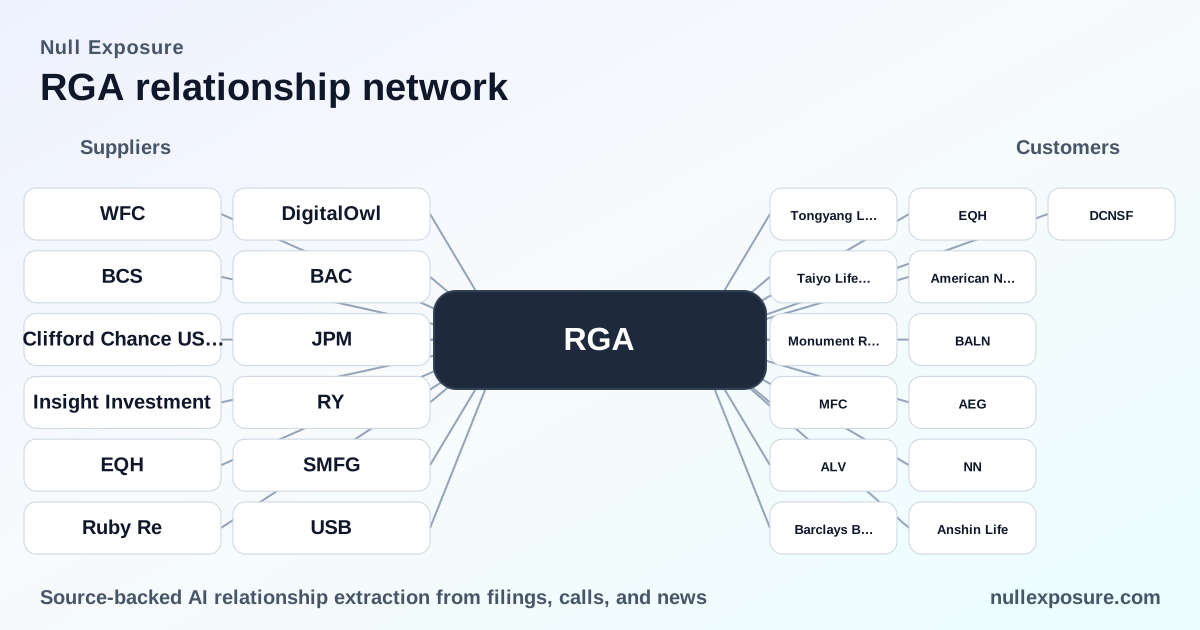
RGA’s client map: where reinsurance risk, capital and scale meet
Reinsurance Group of America (RGA) operates as a global reinsurer and provider of financial solutions, monetizing through ceded premiums, investment spread on retained assets, and fee income from asset‑intensive and longevity transactions. RGA underwrites long-duration life and annuity risks, short-duration morbidity/business lines, and structures capital‑relief transactions for large insurers, converting underwriting expertise into recurring spread and transactional fee economics.
Explore RGA’s counterparty relationships and corporate signals to assess revenue concentration, deal maturity and strategic risk — or visit the Null Exposure homepage for a deeper analysis of counterparties and deal flow: https://nullexposure.com/.
How RGA’s operating model shows up in counterparties and contracts
RGA’s business blends long‑tail insurance obligations with shorter, asset‑intensive deals. Company-level disclosures and filings indicate a mix of long‑term traditional life reinsurance (policies measured in decades) and shorter-duration treaties or financial reinsurance arrangements that produce fee income and investment spread. The firm serves the largest life insurers globally and generates material revenue from a relatively small cohort of very large clients; in 2024 the five largest clients represented a meaningful share of premiums while 40 other clients each generated >$100m in premiums. This combination creates high revenue concentration, long contract persistence, and strategic criticality — RGA is a service provider to large insurers and a seller of capital and risk transfer solutions.
Key operating constraints and implications (company signal):
- Contracting posture: Mix of long-duration treaties (10–30+ years) and short-duration treaties/financial transactions; product tenure affects capital deployment and profitability timing.
- Counterparty concentration: High concentration among very large insurers; top clients materially influence premium flows and capital needs.
- Global footprint: Active across North America, EMEA, APAC and Latin America; geographic diversification reduces single-country exposure but creates regulatory and currency complexity.
- Role breadth: RGA functions primarily as a service provider (reinsurer) and also as a seller of fee‑based financial products and asset‑intensive solutions.
- Materiality and spend: Large spend bands are common; many counterparties sit in the $100m+ premium class, underpinning RGA’s scale economics.
If you want a structured counterparty dossier or a sortable view of these relationships, see our homepage for client-level intelligence: https://nullexposure.com/.
Relationship roll call — what each counterparty engagement tells investors
-
Taiyo Life Insurance Company — RGA agreed to reinsure statutory reserves for Taiyo Life, reflecting RGA’s role in transferring reserve risk for Japan-based life insurers. (ReinsuranceNews, March 10, 2026)
-
Tongyang Life Insurance Company, Ltd — An RGA subsidiary will reinsure a KRW 200 billion in‑force block via coinsurance, demonstrating RGA’s appetite for Asian fixed-block transactions. (Insurance Business, March 10, 2026)
-
EQH-P-C (Equitable preferred series C) — Reporting around a 2025 reinsurance deal, Equitable’s preferred securities commentary references the RGA transaction as a source of capital relief and earnings volatility reduction. (InsuranceNewsNet, FY2025 disclosure)
-
Monument Re Limited — Monument completed the transfer of a legacy €1.4bn reinsurance portfolio to an RGA Americas subsidiary, showcasing RGA’s capacity to absorb legacy portfolios tied to annuity and life liabilities. (ReinsuranceNews, March 10, 2026)
-
Manulife Financial Corporation (MFC) — Manulife announced a $5.4bn reinsurance agreement with RGA that included $2.4bn of long‑term care reserves, underscoring RGA’s role in large, cross‑border LTC and longevity transfers. (PR Newswire, FY2024)
-
MFC / The Manufacturers Life Insurance Company (Manulife) — Historically, RGA Canada has reinsureed longevity risk on in‑force Canadian group payout annuities for Manulife, indicating an ongoing long-term partnership in annuity risk transfer. (Artemis, FY2019)
-
EQH-P-A (Equitable preferred series A) — Equitable’s FY2026 statement notes the Individual Life reinsurance with RGA closed in Q3 2025, freeing >$2bn of capital and cutting mortality exposure by 75%. (Yahoo Finance, FY2026)
-
Aegon (AEG) — RGA provided longevity reinsurance in multi‑billion euro capacity for Aegon, reflecting large‑scale European longevity risk appetite. (Artemis, FY2022)
-
NN / NN Life — RGA completed a longevity reinsurance transaction covering €4bn of reserves for NN Life, the largest Dutch insurer, illustrating RGA’s leadership in pension and longevity solutions in EMEA. (Artemis, FY2022)
-
Allianz Suisse Versicherungs‑Gesellschaft (ALV) — RGA entered an asset‑intensive deal covering US$350m of Swiss disability annuity liabilities for Allianz Suisse, showing competence in niche disability/annuity reinsurance. (Insurance Business, FY2025)
-
Baloise Belgium (BALN) — RGA completed an asset‑intensive transaction for Baloise Belgium, covering ~57,000 life policies with reserves near €900m — a demonstration of large continental European asset‑heavy transfers. (Insurance Business, FY2025)
-
Equitable (EQH) — Multiple announcements show RGA reinsured approximately $32bn of in‑force life liabilities for Equitable, redeploying capital and materially reducing Equitable’s mortality risk. (ReinsuranceNews; multiple FY2025–FY2026 press reports)
-
American National Insurance Company — RGA agreed to reinsure a diversified block of life insurance business through coinsurance with American National, highlighting continued U.S. coinsurance activity. (Insurance Business, FY2024)
-
Citizens, Inc. (CIA) — Citizens reported lower commission expense tied to a coinsurance agreement with RGA Reinsurance Company, indicating RGA’s involvement in commission‑sharing structures with regional insurers. (NewsfileCorp press release, FY2025)
-
Barclays Bank UK Retirement Fund — RGA provided a UK £5bn longevity swap to Barclays’ retirement fund, showcasing RGA’s capacity to transact material pension longevity derivatives. (Artemis, FY2020)
-
HMN (Horace Mann) — RGA previously reinsured a $2.9bn Horace Mann annuity block, an example of RGA’s portfolio transfer activity in the U.S. annuity market. (ThinkAdvisor, FY2019)
-
Anshin Life — RGA expanded partnership with Anshin Life on whole life reinsurance in Japan, reinforcing RGA’s strategic presence in Asia life markets. (Insurance Business, FY2025)
-
John Hancock — RGA and John Hancock announced a reinsurance agreement in late 2024, indicating ongoing engagement with large U.S. retail life franchises. (RTTNews calendar/press, Nov 2024)
-
Dai‑ichi / DCNSF — RGA and Dai‑ichi expanded their reinsurance partnership with a new transaction, signaling continued collaboration in Japan’s life market. (Insurance Business, FY2025)
Strategic takeaways for investors and operators
- Scale and specialization: RGA’s client roster includes major global insurers and pension funds, which positions the company to win large, capital‑intensive transactions that smaller reinsurers cannot easily underwrite.
- Concentration risk is real: A handful of very large counterparties drive material revenue; monitoring those relationships and deal cadence is essential to forecast premium and capital flows.
- Contract mix tempers earnings profile: The mix of long-duration traditional treaties and shorter, fee-based financial deals creates both predictable spread and episodic earnings volatility when large transactions close.
- Geographic diversification is strategic but complex: Asia, EMEA, North America and Latin America coverage broadens opportunity but introduces regulatory, currency and longevity‑model heterogeneity.
Final note
RGA’s market position is defined by large counterparty relationships, long contract tenors and a dual role as risk manager and capital solution provider. For investor due diligence or competitive analysis across counterparties, explore our client intelligence hub at Null Exposure: https://nullexposure.com/.