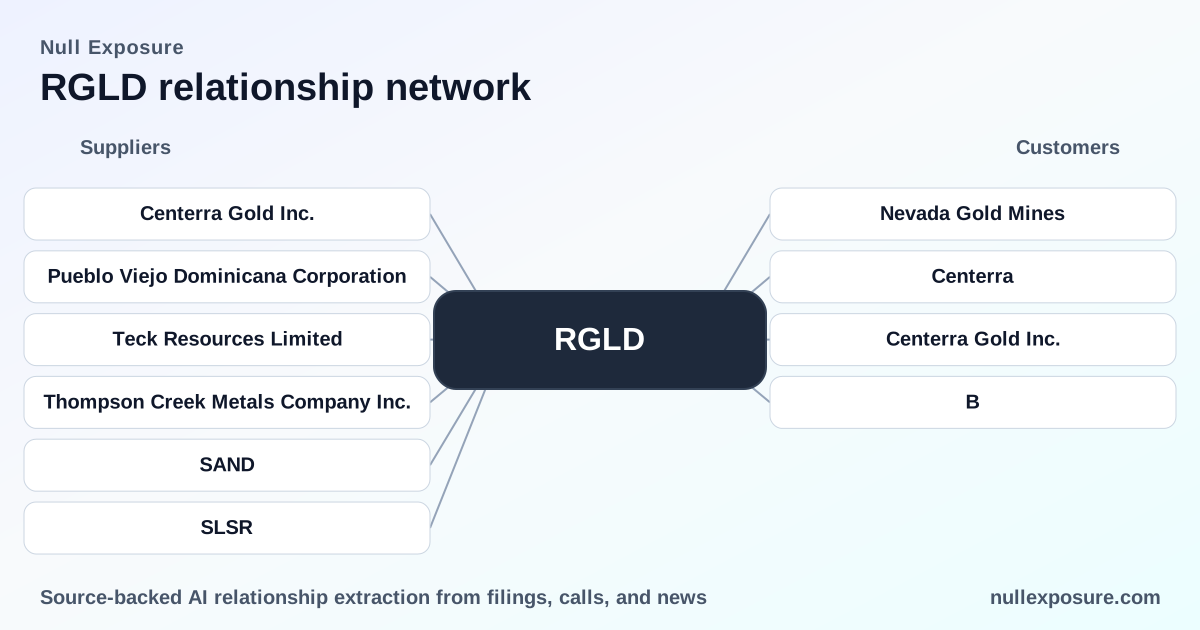
Royal Gold (RGLD) — customer map and what it means for investors
Royal Gold acquires and manages precious‑metal streams, royalties and related interests and monetizes those purchases through ongoing receipts of metal flows and structured financing to operators and developers. The company books revenue when metal is produced and transfers control to operators, collects cash from streaming/royalty entitlements and occasionally extends financing tranches tied to project milestones; that combined model generates high-margin cash flow and concentrated counterparty exposure. For a focused, operator‑level view of RGLD’s customer relationships and the investment implications, read on. For a broader view of our sourcing and analytic approach visit https://nullexposure.com/.
The operating model in plain language
Royal Gold’s business is a capital‑intensive, non‑operating mining financier: it pays for the right to a portion of production (royalties and streams) or provides financing in exchange for future metal receipts or structured economics. Revenue is realized only when operators produce metals, and Royal Gold’s accounting concludes that control of the metal transfers to the operator at production, which makes the operator the company’s customer. According to Royal Gold’s 2024 Form 10‑K, that accounting posture is explicit and shapes cash flow timing and counterparty risk.
Key firm‑level characteristics that drive valuation and risk:
- Contracting posture: Royal Gold typically recognizes receipts at production and uses short‑dated spot‑based forward sales for metal disposition; the company’s internal disclosures describe sale contracts that commonly run from ten days to three months. This creates predictable but short‑dated market exposure on realized metal sales.
- Customer concentration: A small number of operators and a few producing properties drive a large share of revenue — Royal Gold reported that four properties accounted for ~55% of FY2024 revenue.
- Counterparty criticality and credit: Because revenue depends on operator production, Royal Gold’s cash flows are directly tied to operator execution, permitting, and operational stability; the company also engages in financing arrangements that create lender‑style counterparty exposures.
- Maturity and geographic diversification: While many major royalty interests are mature producing assets, Royal Gold also holds interests outside the U.S. (Canada, the Dominican Republic, Chile) and deploys staged financing into development projects.
Bottom line: Royal Gold is a cash‑flow centric financier of mines; investors should value the company as a diversified portfolio of production exposures plus bespoke financing, with concentrated operator risk and short‑term metal sale mechanics.
What the 2024 10‑K documents about revenue drivers
Royal Gold’s FY2024 filings quantify concentration and naming of principal operators. The company notes that four properties — Mount Milligan, Pueblo Viejo, Cortez and Andacollo — generated approximately 55% of 2024 revenue, with Mount Milligan alone contributing roughly 26% of revenue. The same filing lists named operators that individually contributed more than 10% of revenue for FY2024. According to the 2024 Form 10‑K, these disclosures are the primary evidence investors should use to understand counterparty exposure and revenue volatility.
Customer relationships: line‑by‑line coverage
Below are one‑to‑two sentence summaries for every relationship item found in the source results.
Nevada Gold Mines
Nevada Gold Mines represented 11.0% of Royal Gold’s total revenue in FY2024, with a reported contribution of 79,473 (as presented in the 2024 Form 10‑K). According to the company’s 2024 Form 10‑K, Nevada Gold Mines is a material producing counterparty in the RGLD portfolio (FY2024).
Centerra Gold Inc.
Royal Gold entered a Cost Support Agreement with Centerra dated February 13, 2024 intended to incent continued investment and value maximization at the Mount Milligan project. The agreement and its purpose are described in Royal Gold’s 2024 Form 10‑K (reference: Cost Support Agreement, Feb 13, 2024).
Centerra
Centerra accounted for about 25.9% of Royal Gold’s revenue for FY2024, with a disclosed contribution of $186,039 (FY2024 Form 10‑K). The 2024 Form 10‑K lists Centerra among the operators contributing greater than 10% of total revenue (FY2024).
Solaris Resources Inc. (SLS)
A May 2026 news report at InvestingNews noted that Solaris secured EIA technical approval, unlocking the second tranche of US$50 million under a financing agreement with RGLD Gold AG, a wholly owned subsidiary of Royal Gold — demonstrating RGLD’s use of staged project financing in addition to royalties/streams (InvestingNews, May 2026).
CTGO (Contango)
A 2016 Petroleum News article cited operational collaboration and technical expertise provided by Royal Gold to a joint venture, with a company representative noting encouragement about drilling results and Royal Gold’s technical support. The report underscores Royal Gold’s hands‑on role in some joint ventures (Petroleum News, Nov 2016).
B
Royal Gold reports that Barrick contributed $84,961 (11.8%) of total revenue in FY2024; the 10‑K also lists the four top properties contributing 55% of revenue (Form 10‑K, FY2024). That excerpt is presented in Royal Gold’s FY2024 filing.
Barrick Gold
Royal Gold’s 2024 Form 10‑K identifies Mount Milligan, Pueblo Viejo, Cortez and Andacollo as the four properties that produced approximately 55% of 2024 revenue; Mount Milligan is a material site operated under arrangements with Barrick and affiliated operators. The Form 10‑K provides the property‑level revenue breakdown (FY2024).
Barrick
The 2024 Form 10‑K lists Barrick as an operator that contributed greater than 10% of Royal Gold’s total revenue in FY2024, reflecting Barrick’s recurring role in the company’s production portfolio (Form 10‑K, FY2024).
Constraints and what they signal at the company level
Royal Gold’s text excerpts supply two clear company‑level signals:
- Royal Gold uses short‑term average spot rate forward contracts to price and sell metals, typically spanning ten days to three months depending on delivery frequency, which produces short‑dated market exposure on sold metals (company disclosure).
- Royal Gold’s accounting posture is that it transfers control of metal production to the operator at the point of production, making the operator the company’s customer, which structurally aligns cash flow timing and counterparty risk to operator execution (company disclosure).
These constraints imply that investors should treat Royal Gold as a capital allocator to producing and near‑producing assets with short settlement windows for metal sales and concentrated counterparty dependence.
Investment implications and takeaways
- Concentration risk is material. More than half of FY2024 revenue came from four properties and two named operators (Centerra and Barrick/Nevada Gold Mines), so operational setbacks at a handful of operators will drive earnings volatility.
- Cash flow is operator‑driven. Royal Gold’s topline is conditional on third‑party production and on milestone‑linked financing tranches; underwriting of operator execution and political/geographic risk is core to credit assessment.
- Short market exposure on sales reduces long‑dated price hedging risk but increases sensitivity to spot price swings at realization.
- Financing role expands credit exposure. The Solaris example shows RGLD extends structured financing that effectively creates lender‑like counterparty concentration beyond pure royalty receipts.
For a practical next step, investors and operators should combine the 2024 Form 10‑K operator breakdown with project‑level production forecasts and contract terms to model cash‑flow sensitivity. For further coverage and an analytical dashboard of counterparties, visit https://nullexposure.com/.
Royal Gold is a high‑quality royalty and streaming franchise whose valuation depends as much on operator execution and contract mechanics as on metal prices; investors should price in concentrated counterparty risk and the company’s short‑dated sale mechanics when setting target returns.