RGNX: How REGENXBIO Converts Platform IP into Concentrated, High‑value Customer Flows
REGENXBIO operates a platform business that licenses its NAV AAV gene‑delivery technology to large pharma partners and collects royalties, upfronts and milestone payments. The company monetizes primarily through licensing agreements (exclusive worldwide licenses and sublicenses), milestone triggers tied to clinical progress and product sales royalties—augmented by opportunistic monetizations such as royalty sales. For investors, the thesis is straightforward: value is driven by partner execution (not in‑house commercial scale) and by the timing and size of license fees, milestones and royalty receipts. For a concise commercial map of this exposure, visit https://nullexposure.com/.
Platform economics: licensing, royalties and occasional monetizations
REGENXBIO’s business model is a classic biotech‑platform play: it develops and patents the NAV AAV vectors, then licenses that IP to larger developers who run pivotal trials and commercial launches. Revenue flows are lumpy and partner‑dependent:
- Contracting posture: Monetization is dominated by licensing agreements and sales‑based royalties rather than direct product sales.
- Concentration: One partner is the critical revenue source, producing extreme revenue concentration.
- Geography and scope: Licenses are often exclusive and worldwide, allowing partners global commercialization rights and sublicensing.
- Capital management: The company supplements cash by selling royalty interests and taking large upfronts from strategic partners.
These characteristics create a binary investment profile: upside tracks partner clinical and commercial success, while downside is concentrated if the lead partner underperforms.
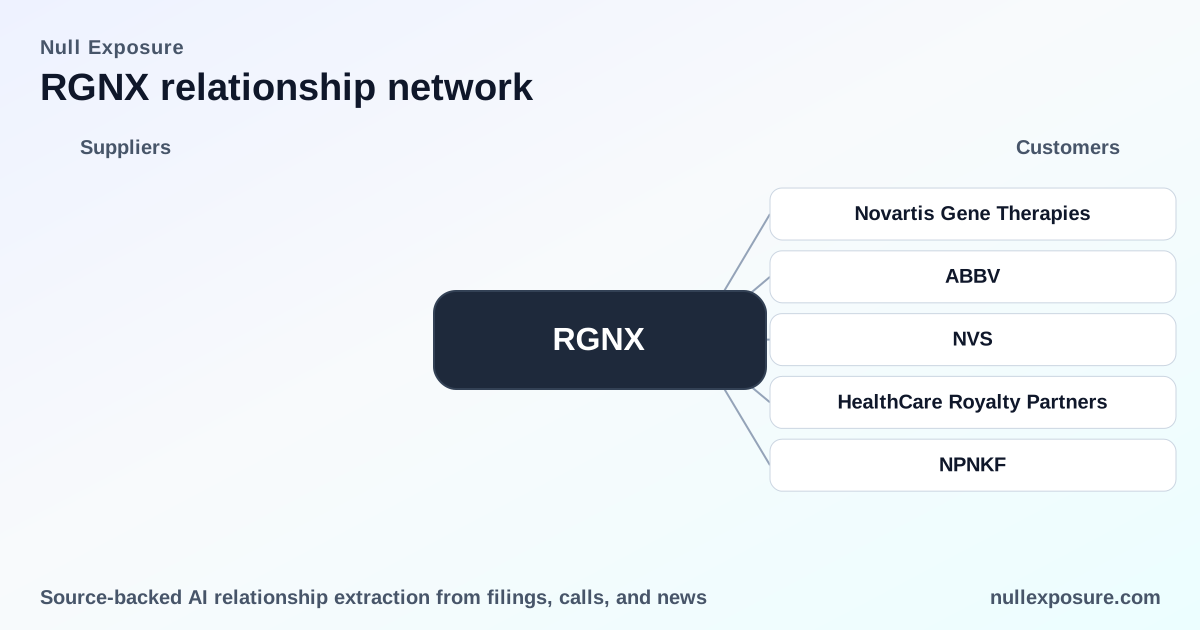
The customer roll call — every partner cited in the record
Below are the customer relationships identified in public filings and recent coverage, each summarized in plain English with a source note.
Novartis Gene Therapies — the revenue engine
Novartis Gene Therapies accounted for approximately 98% of REGENXBIO’s total revenues in 2024, reflecting exclusive, worldwide licensing of the NAV platform and the commercial success of Zolgensma, which uses REGENXBIO’s AAV technology. According to REGENXBIO’s 2024 Form 10‑K, this single partner concentration drove nearly all reported revenue in FY2024. (Source: REGENXBIO 2024 Form 10‑K)
Novartis (news coverage of licensed products and IP scope)
Novartis is repeatedly referenced in news coverage as the commercial operator of products built on REGENXBIO’s platform—most notably Zolgensma—and holds global licensing rights for AAV‑based SMA therapies under agreements that reference REGENXBIO IP. Industry reporting highlights the volume of patients treated using REGENXBIO’s AAV platform under Novartis commercialization. (Source: market press coverage including Yahoo Finance and GlobeNewswire, March–May 2026)
AbbVie — milestone pathway tied to NAV‑based clinical progress
AbbVie is a development partner in NAV‑platform programs; company commentary indicates that first patient dosing in the NAVIGATE pivotal study for diabetic retinopathy will trigger a $100 million milestone from AbbVie, an example of large, event‑based payments that materially uplift REGENXBIO’s near‑term cash profile when achieved. (Source: Q4 2025 earnings call transcript, InsiderMonkey, March 2026)
HealthCare Royalty Partners (HCR) — royalty monetization buyer
REGENXBIO executed a royalty monetization that generated $145 million in net proceeds through a transaction with HealthCare Royalty Partners, reflecting the company’s strategy to monetize future royalty streams for near‑term liquidity. The relationship is structured as a sale of royalty rights under the Novartis license. (Source: Q4 2025 earnings call transcript and prior disclosures, InsiderMonkey coverage, March 2026)
Nippon Shinyaku — strategic upfront license payment
Nippon Shinyaku provided a $110 million upfront payment in 2025 under a strategic license arrangement, demonstrating REGENXBIO’s ability to extract large, one‑time payments from regional partners for rights to deploy NAV technology in specific territories or indications. (Source: Q4 2025 earnings call transcript, InsiderMonkey, March 2026)
What the public constraints reveal about the operating model
The public record provides consistent signals around how REGENXBIO runs its business:
- Licensing as the core contract type. The company routinely grants exclusive, worldwide licenses to its NAV platform and selectively licenses IP to large biotech and pharma firms; this is the primary commercial instrument for monetization. (Company filings and license disclosures)
- Global scope of partner rights. Several agreements explicitly grant worldwide commercial licenses, concentrating global commercial risk with large partners rather than REGENXBIO itself. (License language cited in filings)
- Critical revenue concentration. The company’s top partner represents critical revenue concentration—nearly all revenue in recent years originates from a single partner. This elevates counterparty and execution risk. (10‑K revenue disclosure)
- Active, multi‑stage partnerships. Relationships are active across discovery, clinical development and commercialization phases, generating a mix of upfronts, milestones and ongoing royalties rather than steady, predictable revenue. (Filing descriptions and recent product commercialization history)
- Large spend bands and monetizations are routine. The company has collected nine‑figure upfronts and sold royalty streams in the hundreds of millions, signaling material cash inflows tied to partner deals and monetization decisions. (Transaction and license fee disclosures)
- Role clarity where disclosed. Where the record names counterparties explicitly: Novartis is a named licensee of the NAV platform and HCR executed a royalty purchase agreement and therefore is a buyer of royalty rights. (License and royalty agreement excerpts)
Investment implications — risks you must price in
- Concentration risk is the dominant valuation lever. With one partner generating the majority of revenue, any change in that partner’s commercial or regulatory trajectory directly impacts REGENXBIO’s top line.
- Binary milestone risk and event timing. The earnings stream depends on discrete clinical and regulatory events (e.g., AbbVie milestone triggers), so near‑term cash and valuation multiples will oscillate with trial readouts and milestone receipts.
- Liquidity smoothing via monetizations. REGENXBIO has reduced near‑term cash volatility by selling royalty interests and taking large upfronts; these transactions shore up runway but transfer upside to buyers.
- IP and sublicensing upside. The company retains optionality by continuing to license NAV to multiple strategic partners, generating future large payments if pipeline programs advance.
For a practical read on partner‑level exposures and to map counterparty concentration into risk‑adjusted cashflow scenarios, see our analytical tools at https://nullexposure.com/.
Bottom line
REGENXBIO is a platform licensor whose value is levered to partner execution: large upfronts, milestones and royalties generate significant cash when partners succeed, but revenue concentration and event‑driven receipts create asymmetric risk for investors. The public record—10‑K disclosures and multiple Q4 2025 commentary—documents high‑value deals with Novartis, AbbVie, Nippon Shinyaku and monetization activity with HealthCare Royalty Partners; each relationship materially shapes near‑term cash and long‑term optionality.
For model-ready counterparty mappings and to track changes in these relationships over time, visit https://nullexposure.com/.