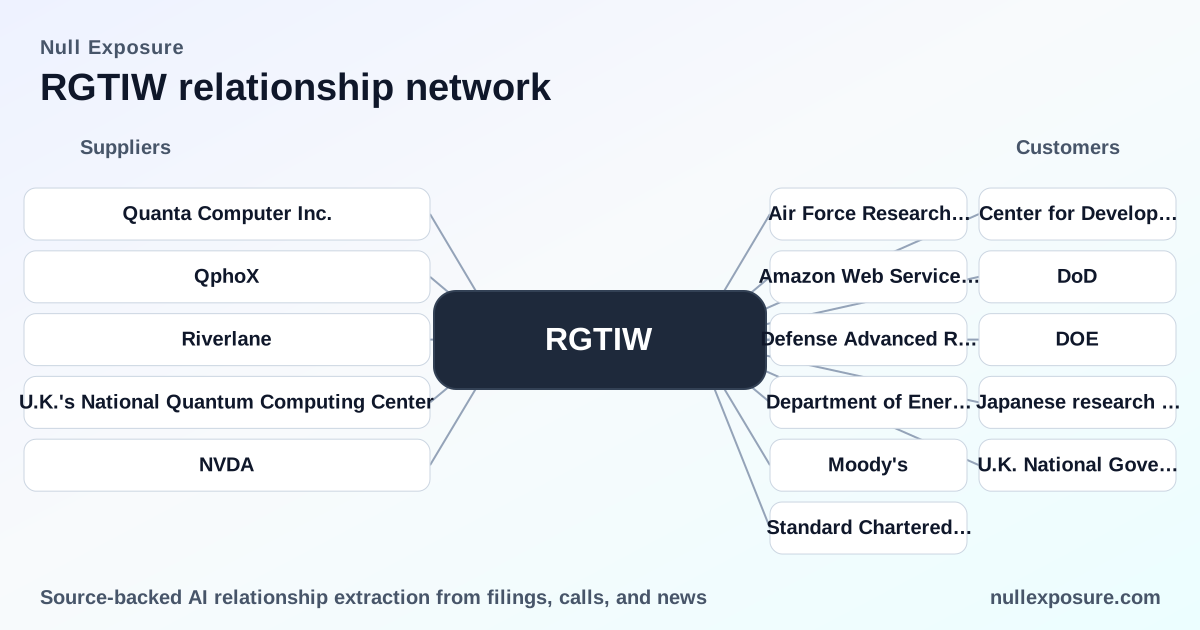
Rigetti (RGTIW) — Customer Map and Commercial Implications for Investors
Rigetti monetizes its quantum stack through three clear channels: Quantum Computing as a Service (QCaaS) subscriptions and usage hours, point-of-sale QPU and component sales, and multi-year development contracts and services supported by an on‑site wafer fab (Fab‑1). These revenue streams produce a mix of recurring cloud cashflows and lumpy hardware orders, with the public sector representing a dominant buyer class and international expansion driving geographic diversification. For deeper commercial diligence visit https://nullexposure.com/.
Why the customer list matters to valuation and risk
Customer composition is a primary lens into Rigetti’s revenue quality. High government concentration implies large, multi-year contracts but also political and procurement exposure; enterprise customers and cloud partners enable scale but push Rigetti to compete on both performance and commercial integration. The company’s operating model blends subscription economics with one‑off hardware sales, so revenue visibility differs by contract type and customer mix.
- Subscription and usage revenue produces ratable, predictable recognition over terms ranging from monthly to two years.
- Spot hardware sales generate immediate cash but are lumpy and tied to product delivery and acceptance milestones.
- Development contracts are multi‑year and bespoke, increasing stickiness but requiring R&D and execution capacity.
If you want a concise market‑facing summary for portfolio models, see more at https://nullexposure.com/.
Customer relationships: granular view
Below is a relationship-by-relationship synthesis drawn from Rigetti’s public filings and the 2025 Q4 earnings call. Each line is a plain-English summary with the source noted.
-
Air Force Research Laboratory (AFRL) — Rigetti lists AFRL among U.S. government partners and customers in its 2024 Form 10‑K, indicating AFRL participates in the company’s defense and research engagements. (Source: Rigetti 2024 Form 10‑K)
-
Amazon Web Services (AWS) — AWS is named as a commercial partner/customers in the 2024 Form 10‑K, reflecting cloud distribution ties that extend Rigetti’s reach through third‑party cloud marketplaces and resale channels. (Source: Rigetti 2024 Form 10‑K)
-
Defense Advanced Research Projects Agency (DARPA) — DARPA is specifically cited in the 2024 Form 10‑K as a U.S. government customer; this positions Rigetti within government R&D programs where milestone funding and technology demonstration are primary drivers. (Source: Rigetti 2024 Form 10‑K)
-
Department of Energy (DOE) — DOE is named in the 2024 Form 10‑K and again during the 2025 Q4 earnings call where management discussed Fab‑1 foundry use; DOE is therefore a recurring public‑sector buyer and collaborator across both reporting and operational disclosures. (Sources: Rigetti 2024 Form 10‑K; Rigetti 2025 Q4 earnings call)
-
Moody’s — Moody’s is listed among commercial enterprise customers in the 2024 Form 10‑K, signaling early adoption from financial services for quantum‑assisted modeling and analytics. (Source: Rigetti 2024 Form 10‑K)
-
Standard Chartered Bank — Identified as a commercial customer in the 2024 Form 10‑K, Standard Chartered represents banking sector interest in Rigetti’s computing and algorithmic capability. (Source: Rigetti 2024 Form 10‑K)
-
Center for Development of Advanced Computing (C‑DAC), India — Rigetti disclosed in the 2025 Q4 earnings call an $8.4 million order from C‑DAC for a 108‑qubit on‑premises quantum computer, scheduled for H2 2026 delivery, marking a notable international hardware sale. (Source: Rigetti 2025 Q4 earnings call)
-
DoD (Department of Defense) — On the 2025 Q4 earnings call management stated Fab‑1 is made available as a foundry to select customers including the DoD, confirming defense procurement and manufacturing relationships beyond software and cloud services. (Source: Rigetti 2025 Q4 earnings call)
-
Japanese research organization (unnamed) — Management announced a purchase order for a Novera QPU to be delivered in April 2026 to a Japanese research organization, reflecting Asia‑Pacific demand for on‑premise systems. (Source: Rigetti 2025 Q4 earnings call)
-
U.K. National Government — Rigetti’s 2025 Q4 comments indicate Fab‑1 foundry services are offered to the U.K. National Government, establishing another sovereign‑level manufacturing and procurement connection. (Source: Rigetti 2025 Q4 earnings call)
What the company‑level constraints tell investors
Rigetti’s public disclosures contain several operating signals that are material to revenue durability and execution risk:
-
Contracting posture: The business mixes long‑term development contracts, subscription (QCaaS) arrangements and usage‑based billing, alongside spot hardware sales for QPUs. This creates blended revenue visibility where subscription and multi‑year contracts provide predictability while QPU sales are episodic.
-
Counterparty concentration and criticality: Government customers dominate revenue (public filings show government sales comprised ~89.4% of 2024 revenue), which yields large contract sizes and programmatic funding but concentrates political and procurement risk. Large enterprises provide diversification and pathway to commercial scale.
-
Geographic diversification: Rigetti reports meaningful non‑U.S. revenue (Europe and Asia) and maintains personnel across the U.S., UK, Australia, and Canada, indicating a global go‑to‑market strategy that reduces single‑market dependence but raises export control and compliance complexity.
-
Role and vertical integration: Rigetti is vertically integrated—it operates Fab‑1 and sells hardware, services, and software—so capital intensity and supply‑chain control are central to its execution. Management explicitly offers Fab‑1 foundry services to DOE, DoD, and the U.K. National Government, underscoring the company’s manufacturing role in strategic programs. (Source: Rigetti 2025 Q4 earnings call; 2024 Form 10‑K)
-
Segment mix and maturity: Revenue streams cover hardware, services, and software, with QPU commercialization only beginning in 2023 and early hardware orders in 2025–2026; this indicates a company transitioning from R&D to early commercial sales.
Investment implications — key takeaways
- Revenue quality is bifurcated: expect recurring QCaaS dollars alongside volatile, large contract and hardware receipts. Model cashflows accordingly.
- Government dependency is both a strength and a risk: public‑sector demand funds scale and R&D but concentrates counterparty risk and ties revenue to budget cycles.
- Manufacturing gives control and margin opportunity but requires capital and increases operational risk; Fab‑1’s role with DOE/DoD/UK is strategically material.
- International orders (India, Japan, Europe) validate product market fit outside the U.S. and provide growth runway if execution holds.
For a strategic customer‑level view that informs modeling and counterparty risk scoring, explore our investor resources at https://nullexposure.com/.
Bold decisions require precise inputs; Rigetti’s customer map supplies both the upside of large program wins and the downside of concentrated government exposure. Investors should weigh subscription durability against hardware lumpiness and manufacturing commitments when pricing RGTIW warrants in a portfolio context.