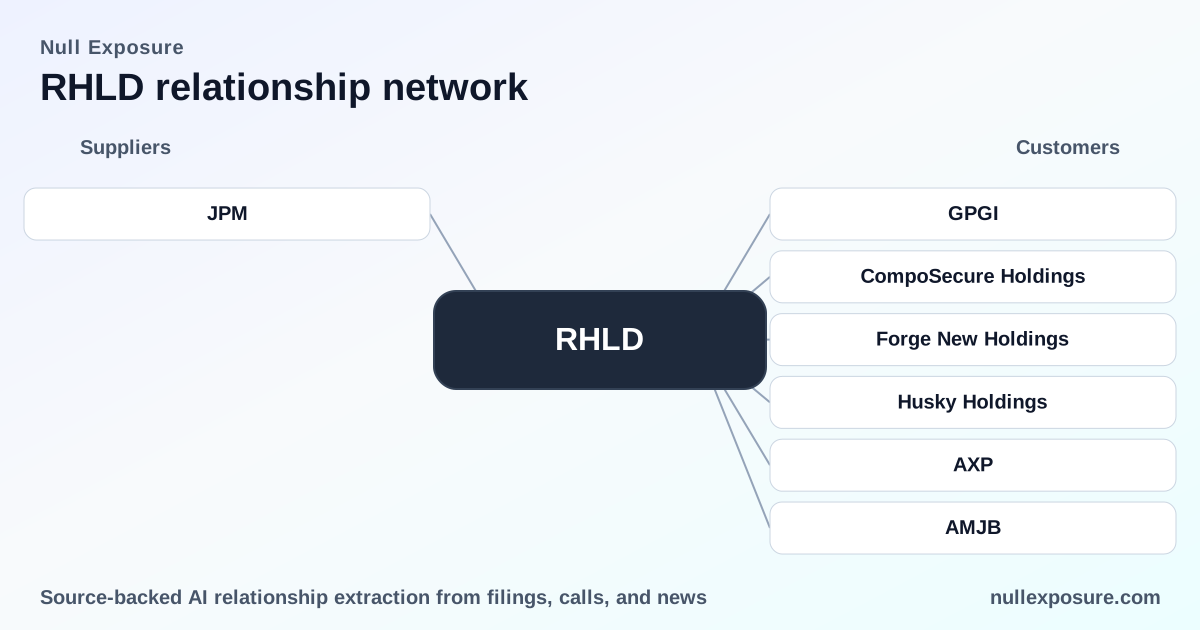
RHLD’s customer map: who Resolute manages, how it collects fees, and what that implies for investors
Resolute Holdings Management, Inc. (NYSE: RHLD) operates as an alternative operating management platform that monetizes by charging management fees and overseeing the day‑to‑day operations, capital allocation, and M&A activity of controlled and managed businesses — most materially the CompoSecure platform and the rebranded GPGI enterprise. Revenue is fee‑driven and concentrated around a small set of managed operating companies, making RHLD’s growth and margin profile tightly linked to the performance and contractual scope of those management agreements. For a concise platform view and ongoing signal monitoring, visit https://nullexposure.com/.
How RHLD actually makes money — the operating model in plain English
RHLD’s business model is service‑oriented and centralized: the company does not primarily sell products to end customers but sells management expertise and infrastructure to operating companies it controls or manages. Fees are earned through formal management agreements and are supplemented by consolidation of operating results when RHLD controls a target. The company’s P&L is therefore a function of (1) the scale of the managed business, (2) the structure and duration of management contracts, and (3) the customer concentration and geographic footprint of the underlying operating subsidiaries.
- Contracting posture: evidence points to a mix of long‑term definitive management agreements (notably with CompoSecure) and other relationships that are described as short‑term in pockets; overall RHLD’s posture is tilted toward multi‑year arrangements that embed fee predictability.
- Concentration and criticality: high concentration — RHLD’s results are substantially dependent on one major managed platform (CompoSecure/GPGI), and two end customers historically accounted for more than 10% each of that operating company’s revenue.
- Maturity and embedding: several of RHLD’s managed businesses maintain long, embedded customer relationships (CompoSecure’s issuer relationships), which increases predictability but also concentrates risk.
Relationship roster — who RHLD manages and why each one matters
GPGI / GPGI, Inc.
Resolute is the operating manager responsible for providing management services to GPGI, Inc.; the company announced shared executive appointments and management responsibilities in early 2026. According to a GlobeNewswire press release (March 10, 2026), Resolute and GPGI share executive leadership and management services tied to the operating businesses. (GlobeNewswire / March 10, 2026)
CompoSecure (CMPOV / CompoSecure Holdings)
CompoSecure is the foundational operating platform RHLD manages and from which RHLD earns material management fees; the CompoSecure Management Agreement has an initial 10‑year term with automatic successive ten‑year renewals, embedding a long‑term fee stream. RHLD’s 2024 Form 10‑K and subsequent investor communications identify incremental management fees tied to CompoSecure and describe the long‑term management arrangement. (RHLD Form 10‑K, FY2024; investor release(s), FY2026)
CompoSecure Holdings / CompoSecure Holdings L.L.C.
Resolute manages CompoSecure Holdings directly and is required under accounting rules to consolidate the operating results of CompoSecure Holdings (and its subsidiaries) following the spin‑off and execution of the management agreement, making RHLD’s reported results substantially dependent on CompoSecure’s performance. This consolidation requirement is described in RHLD’s FY2024 filing and FY2026 results commentary. (RHLD Form 10‑K FY2024; Markets Business Insider / SahmCapital, March–May 2026)
GPGI Holdings, L.L.C.
As part of the corporate structuring around the spin‑off and management arrangements, RHLD executed a management agreement with GPGI Holdings, L.L.C., which triggers consolidation of those subsidiaries under U.S. GAAP and amplifies RHLD’s exposure to operating performance at the consolidated level. (Markets Business Insider / SahmCapital, FY2026)
Husky Holdings LLC / Husky Holdings
Resolute entered into a management agreement with Husky Holdings LLC effective January 2026 and will manage day‑to‑day operations and strategy for Husky and its subsidiaries; RHLD stated that this agreement is expected to meaningfully increase fee revenue and profitability in 2026. (Markets Business Insider / SahmCapital, March–May 2026; TradingView press note, March 2026)
Forge New Holdings
RHLD signed a Management Services Agreement with Forge New Holdings in connection with the closing of the Husky transaction, extending RHLD’s remit to manage newly acquired businesses under its platform model. (TradingView news item, March 2026)
CompoSecure rebrand and platform description (as referenced by CMPOV/CMPOV reporting)
Multiple market notices and coverage describe CompoSecure’s rebranding and recapitalization activity (including capital raises and note financings) and explicitly state RHLD manages the platform that is purpose‑built to acquire, own, and scale high‑quality businesses. These reports underscore RHLD’s role as the operational manager for the platform and its strategic intent to scale via acquisitions. (QuiverQuant / Intellectia.ai / trading coverage, March 2026)
American Express
Two of CompoSecure’s largest customers are American Express and JPMorgan Chase; American Express is explicitly identified in RHLD’s FY2024 filings as one of the top two customers that drove more than 10% of CompoSecure’s revenue. This concentration at the client level translates into customer exposure for RHLD via its management fees and consolidated results. (RHLD Form 10‑K FY2024)
JPMorgan Chase / AMJB
JPMorgan Chase is listed alongside American Express as a top customer for CompoSecure and thus is an indirect economic exposure for RHLD via the manufacturing revenue of CompoSecure. The FY2024 filing names these two institutions as the largest end customers for the underlying operating business. (RHLD Form 10‑K FY2024)
What the relationship mix implies for investors
- Predictable but concentrated fee revenue: the long‑term CompoSecure Management Agreement creates a reliable fee baseline, but RHLD’s P&L is concentrated on a small number of managed businesses and their end customers.
- Operational leverage to portfolio growth: RHLD’s model profits from scaling the managed platform through M&A and additional service agreements (e.g., Forge/Husky), translating technology and operating expertise into higher management fees as the platform grows.
- Geographic breadth with issuer concentration: CompoSecure’s customer base is global across North America, EMEA, APAC and LATAM, reducing geographic single‑market risk, while issuer concentration (two customers >10%) increases counterparty risk at the revenue line.
- Embedded customer relationships increase defensibility: CompoSecure’s long‑standing issuer relationships are a competitive advantage for RHLD’s managed platform and position fees as sticky revenue streams.
Final read for investors
RHLD is a management‑fee business built on a centralized, highly concentrated operating platform. The economics are favorable when the managed operating companies scale and their customer bases remain stable, but investors must weigh concentration risk and consolidation exposure in any valuation. For ongoing monitoring and signal aggregation on RHLD’s counterparty map and management agreements, see https://nullexposure.com/.
For direct access to the underlying filings and press releases referenced above, RHLD’s FY2024 Form 10‑K and the March–May 2026 investor communications provide the primary source record used in this review.