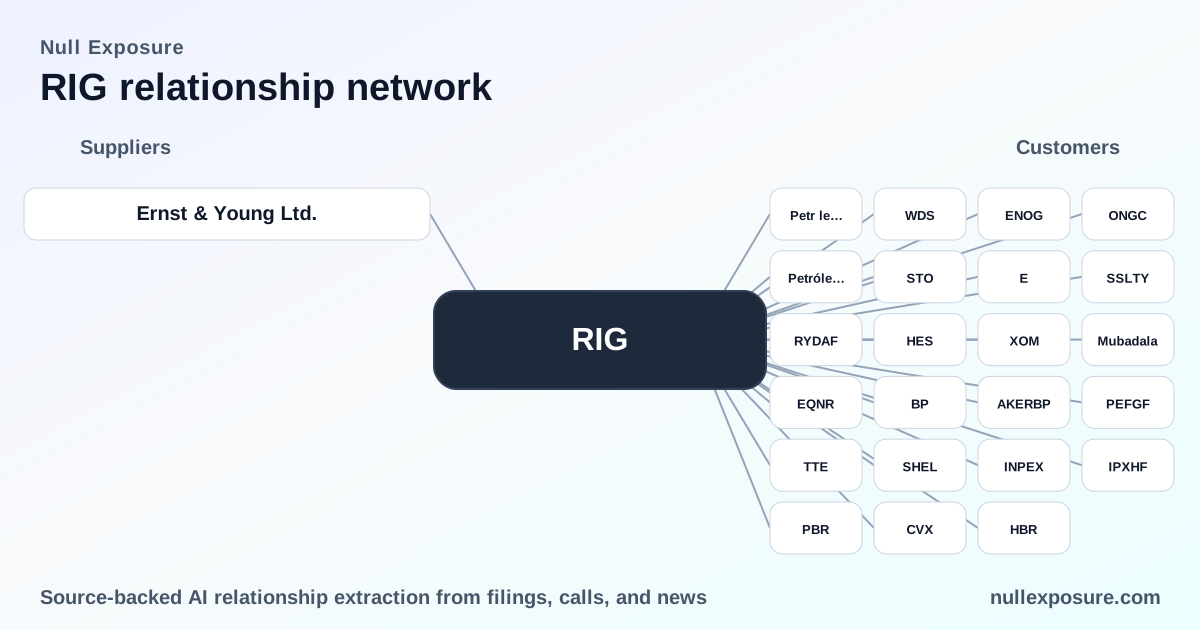
Transocean (RIG): Customer Relationships, Concentration and Contracting Dynamics
Transocean monetizes a mobile offshore drilling fleet by contracting high‑specification rigs to integrated oil majors, national oil companies and large independents on dayrate, backlog‑driven contracts; revenue converts through rig utilization and multi‑year firm commitments that build a predictable backlog and recurring cash flow when markets are active. For investors, the core thesis is simple: Transocean’s value derives from (1) high‑spec fleet utilization under long‑duration dayrate contracts, (2) concentration with a handful of large counterparties that drive most revenue, and (3) global mobility that lets the company redeploy assets where dayrates and tendering activity are strongest. Visit https://nullexposure.com/ for more company‑level signal aggregation.
How Transocean contracts and where that matters
Transocean operates as a services seller of offshore contract drilling; its commercial model embeds a set of characteristics that directly inform revenue visibility and counterparty risk:
- Long‑term, backlog‑driven contracting is the default commercial posture; customers sign extended commitments to secure high‑spec rigs well in advance.
- Usage‑based, dayrate economics govern cash flow: rigs are paid predominantly on dayrates, with lower or zero revenue during interruptions or idled periods.
- Counterparties are large enterprises and governments — Transocean’s receivables and contracts are concentrated with integrated majors and government‑owned producers.
- Global and mobile footprint: rigs are redeployable, creating geographic optionality but also exposure to tender cycles across regions.
- Service segment focus: corporate reporting centers on a single contract‑drilling services segment, so revenue swings map directly to fleet utilization and dayrates.
These operating signals explain why backlog announcements, blend‑and‑extend negotiations and multi‑year contract awards are immediate stock drivers.
(If you want a consolidated watchlist of Transocean counterparties and filings, see https://nullexposure.com/ for comparable coverage.)
Customer roster — line‑by‑line relationship inventory
Below is a concise, source‑linked pass through every relationship item in the record set. Each line summarizes the explicit disclosure or press report tied to that record.
- Petr leo Brasileiro S.A. — Listed in Transocean’s FY2024 10‑K as one of three most significant customers, representing 21% of consolidated operating revenues for the year ended December 31, 2024 (Transocean 2024 Form 10‑K).
- Petróleo Brasileiro S.A. — The FY2024 10‑K repeats Petrobras as a 21% revenue contributor, confirming Petrobras’ materiality to Transocean’s revenue base (Transocean 2024 Form 10‑K).
- RYDAF — The FY2024 10‑K identifies RYDAF in the same list of top customers alongside Shell and Equinor, reflecting the document’s customer concentration disclosure (Transocean 2024 Form 10‑K).
- Equinor ASA — Reported in the FY2024 10‑K as a top customer at 13% of FY2024 revenues, underscoring Equinor’s strategic role in the company’s Norwegian and harsh‑environment programs (Transocean 2024 Form 10‑K).
- Shell plc — Disclosed as Transocean’s largest single customer at 27% of FY2024 consolidated operating revenues in the 2024 Form 10‑K (Transocean 2024 Form 10‑K).
- TotalEnergies SE (TTE) — Cited in the FY2023 disclosure showing TotalEnergies among top customers (2023 comparison) and referenced in subsequent press as a regional operator prize (Transocean 2024 Form 10‑K and industry reports).
- Petrobras (PBR) — Multiple press releases in 2026 confirm Petrobras awarded contract extensions and multi‑year extensions for several ultra‑deepwater drillships (Deepwater Corcovado, Deepwater Orion, Deepwater Aquila), adding hundreds of millions to backlog and extending commitments through 2028–2030 (company release and multiple press reports, April–May 2026).
- Var Energi / Vår Energi ASA (VAR / VAR.OL) — News from April–May 2026 reports a 1,095‑day contract for Transocean Barents at $450,000/day, adding roughly $490M to backlog for Norway work (GlobeNewswire / EnergyDigital, April 2026).
- BP — Industry coverage in March 2026 notes Transocean secured multi‑well programs with BP in Brazil and Australia for Deepwater Mykonos and Deepwater Skyros (news reports, March 2026).
- Beach Energy — A May 2026 note reported redeployment of the Equinox rig to Beach Energy in the Otway Basin, Australia, indicating tactical redeployments to shore up utilization (TS2.tech, May 2026).
- Santos (SSLTY) — Mentioned in Q4 2025 earnings call coverage as a semisubmersible customer with tenders outstanding, implying ongoing tender activity in Australia (Q4‑2025 earnings transcript, March 2026).
- Woodside (WDS) — News coverage ties Transocean rigs (e.g., Deepwater Thalassa) to Woodside drilling campaigns such as Trion, highlighting local logistics and supporting port operations (Euro‑Petrole / Rigzone, 2026).
- Hess (HES) / HES — Press reports show Deepwater Asgard extended in the Gulf of Mexico under contract with Hess, confirming U.S. Gulf awards and extensions (gCaptain / OEDigital, March 2026).
- PBR‑A — A press item in April 2026 references Petrobras’ extension of Deepwater Corcovado through 2030, cited as adding about $445M in backlog (StocksToTrade press release, April 2026).
- Beach / WDS duplicates — Multiple news items assert redeployments and tendering involving these counterparties, consistent with Transocean’s fleet redeployment narrative (market coverage March–May 2026).
- ENI (E) — Management commentary in Q4‑2025 materials anticipates multi‑year program awards in Mozambique from ENI and peers beginning 2027–2028 (earnings call transcript, March 2026).
- Energean (ENOG) — Q4‑2025 call notes expect rig fixtures in Israel to support Energean developments (earnings call transcript, March 2026).
- Exxon (XOM) — Cited alongside ENI and Total as program sponsors in Mozambique and other basins in management’s public remarks (earnings call transcript, March 2026).
- Chevron (CVX) — Management commentary lists Chevron among customers expected to award programs in Nigeria and elsewhere (earnings call transcript, March 2026).
- Aker BP (AKERBP) — Mentioned as a Norwegian award participant supporting utilization of harsh‑environment semisubmersibles through 2028 (earnings call transcript, March 2026).
- ONGC — Management noted tendering activity from ONGC for multiple rigs starting 2027, signaling potential South Asia demand (earnings call transcript, March 2026).
- INPEX — Listed in Q4‑2025 commentary as part of incremental demand in Southeast Asia and Indonesia tenders (earnings call transcript, March 2026).
- Harbour Energy (HBR) — Included in regional demand expectations for Southeast Asia rigs alongside ENI and Mubadala (earnings call transcript, March 2026).
- Mubadala — Cited as part of demand forecast for rigs in Southeast Asia (earnings call transcript, March 2026).
- WDS / WDS duplicates — Multiple press items and call transcripts confirm Woodside programs and that Transocean rigs will support those campaigns (Rigzone, Euro‑Petrole, March 2026).
- Additional market coverage entries (Finviz, SimplyWallSt, TradingView, Benzinga, Splash247, TipRanks, IndexBox, GCaptain, OceanNews, ImarineNews, SahmCapital, Stockstotrade, TheGlobeAndMail, InsiderMonkey, TS2.tech) — These sources collectively document the April–May 2026 round of contract awards, backlog additions (totaling roughly US$1.0–1.6B in aggregated press commentary), and specific rig extensions with Petrobras, Vår Energi and other customers (April–May 2026 press cycle).
(Note: the record set includes multiple duplicate mentions of the same contracts across outlets; each entry above reflects that disclosed relationship and its source reporting window—primarily FY2024 10‑K for concentration metrics and April–May 2026 press coverage for new contract awards.)
What this means for investors and operators
- Concentration risk is material and explicit. The FY2024 10‑K assigns 27% of revenues to Shell, 21% to Petrobras and 13% to Equinor — a small set of counterparties drives the lion’s share of revenue. That concentration amplifies the impact of blend‑and‑extend negotiations and renegotiations on Transocean’s backlog and cash flow (Transocean 2024 Form 10‑K).
- Backlog and multi‑year extensions are the primary de‑risking mechanism. Recent 2026 awards for Deepwater Corcovado, Deepwater Orion, Deepwater Asgard and Transocean Barents add hundreds of millions to backlog and extend high‑spec rigs into 2028–2030, strengthening near‑term visibility (company releases and industry press, April–May 2026).
- Revenue volatility is governed by dayrates and utilization. The company’s usage‑based contracts mean revenue declines if rigs are idle or interrupted; conversely, redeployments and successful tender wins quickly restore cash flow.
- Geographic optionality balances cycle risk but increases operational complexity. Mobility lets Transocean chase higher dayrates globally, but redeployment costs, regulatory approvals and local content requirements create execution risk.
Bottom line
Transocean’s earnings power depends on sustaining high‑spec fleet utilization under long‑duration dayrate contracts with a small set of very large counterparties. The April–May 2026 contract awards materially increased contracted backlog and reduced short‑term cyclicality, but investors must weigh concentrated counterparty exposure and dayrate sensitivity when modeling forward cash flow.
For a persistent feed of counterparty signals and to track evolving contract flows, visit https://nullexposure.com/ for consolidated coverage and vendor‑agnostic signal aggregation.