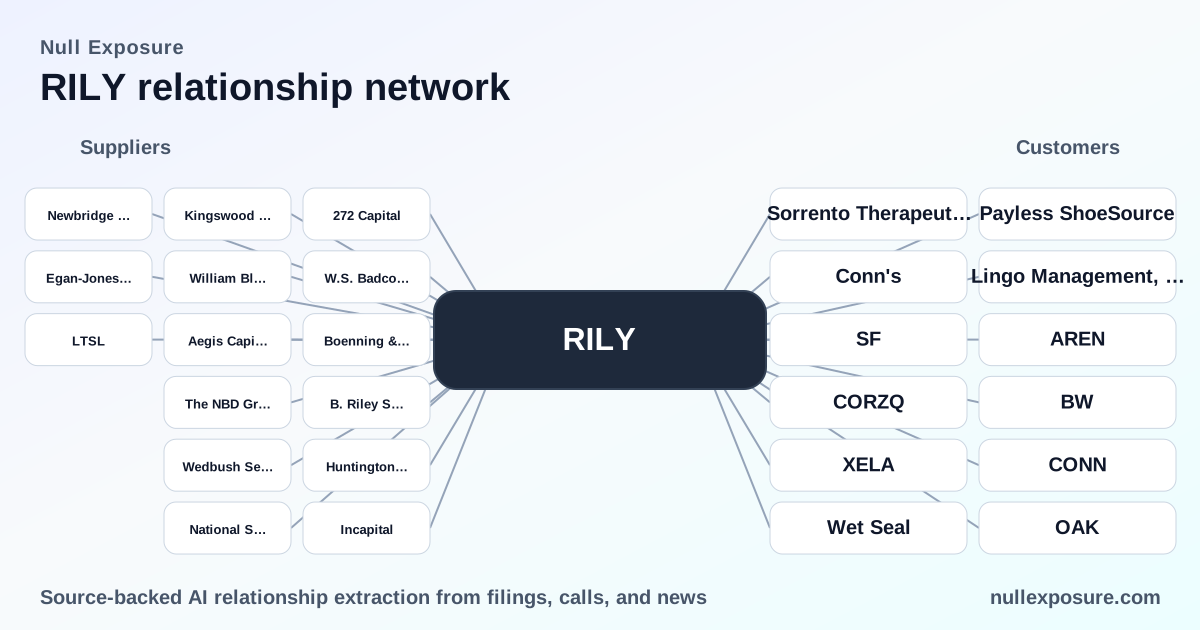
B. Riley Financial (RILY): Customer relationships that drive fee, lending and capital-markets revenue
Thesis: B. Riley monetizes a diversified financial services platform by combining investment banking and capital markets fees, direct lending and financing gains, and advisory/asset-disposition services across corporate, mid‑market and retail clients; the firm’s revenue mix depends on repeat institutional mandates, underwriting desks and balance‑sheet lending that create both recurring fee streams and episodic risk exposures. For an investor, the critical lens is counterparty credit on balance‑sheet loans, concentration in underwriting/ATM mandates, and the operational flexibility of a multi‑segment model. Learn more: https://nullexposure.com/
How to read the customer map: business model implications
B. Riley operates as a hybrid fee-and‑principal firm: services (capital markets, advisory, wealth) produce fee income and recurring mandates; principal finance (loans, preferred equity, guarantees) creates higher‑margin but balance‑sheet‑sensitive returns. The constraints in company disclosures signal a contracting posture that mixes subscription/recurring service economics with spot and usage‑based flows in product segments, a geographic bias toward North America with global pockets, and customer breadth from individuals to large enterprises. These attributes make the business less homogeneous than pure broker‑dealers: revenue is diversified by segment but credit and underwriting concentration remain primary risk vectors.
Key operational characteristics:
- Contracting posture: mix of recurring service contracts and spot/ATM mandates; firm benefits from repeat issuer relationships but retains principal exposures.
- Concentration & criticality: many mandates are mission‑critical for small issuers (ATM, bookrunning, financial sponsor deals), while principal lending concentrates credit risk in stressed names.
- Maturity & optionality: established capital markets franchise with growth optionality via placement and ATM programs, but earnings volatility tracks underwriting and credit cycles.
If you want a structured signal feed on counterparties and balance‑sheet exposures, visit https://nullexposure.com/ for the full mapping.
Relationship roll‑call — one‑line takeaways and sources
Below are every customer relationship reported in the source results; each line is a plain‑English summary with the cited source.
- Conn’s / Conn’s Inc. — B. Riley holds a loan receivable with a principal balance of approximately $93 million and services related receivables; source: FY2024 10‑K (rily‑2024‑12‑31) and InvestmentNews reporting on FY2024.
- Sorrento Therapeutics, Inc. — BRCC, a B. Riley subsidiary, received a preference‑payment demand tied to ~$32,166 paid under a September 2022 bridge loan; source: FY2024 10‑K (rily‑2024‑12‑31).
- Stifel Financial / SF — Stifel completed acquisition of 36 advisors from B. Riley, transferring roughly $4 billion AUM and selling part of employee brokerage; source: InvestmentNews and AdvisorHub (Mar 2026).
- The Wet Seal / Wet Seal Inc. — B. Riley provided debtor‑in‑possession financing, including a $20 million term loan facility in the company’s Chapter 11 process; source: Patch and BuzzFeedNews (2015 filings/news).
- Strawberry Fields REIT (STRW) — B. Riley Securities continues as an agent in the AT‑the‑market issuance agreement for STRW; source: Investing.com (FY2026 SEC filing).
- Atlanticus (ATLC) — B. Riley Securities acted as a book‑running manager for Atlanticus’ offering alongside other banks; source: StockTitan and GlobeNewswire (FY2024 filings).
- Babcock & Wilcox (BW) — B. Riley has guaranteed or is implicated in significant debt arrangements for BW and served as Dealer Manager on cash offers; source: InvestorPlace short‑seller coverage (FY2023) and company notices (FY2025).
- Core Scientific (CORZQ) — B. Riley provided a $42 million loan to Core Scientific per media coverage; source: InvestorPlace (FY2023).
- Exela Technologies (XELA) — Exela had approximately $75 million in outstanding loans from B. Riley as of Q3 2022; source: InvestorPlace (FY2023 reporting).
- Modiv (MDV) — B. Riley acted as book‑running manager for a public offering; source: FinancialContent/BizWire (FY2022).
- VIA Renewables (VIA) — B. Riley Securities served as financial advisor to VIA’s special committee on a transaction; source: FinancialContent/Markets (FY2024).
- Lineage Cell Therapeutics (LCTX) — LCTX sells shares from time to time to B. Riley under an equity sales agreement dated March 22, 2024; source: Investing.com (FY2026 prospectus supplement).
- Sky Harbour Group (SKYH / SKYH‑WS) — Sky Harbour entered an ATM sales agreement with B. Riley as sales agent; source: ADVFN/Investing.com (FY2024–FY2026 filings).
- Hyperfine (HYPR) — Hyperfine amended its ATM sales agreement to add BTIG alongside B. Riley as sales agents; source: Investing.com/TradingView (FY2025–FY2026).
- Arena Group / AREN — B. Riley provided a $98 million loan to Arena Group and acted as sole book‑running manager in later offerings; source: InvestorPlace and StockTitan (FY2023–FY2026).
- Galata (GLTA) — B. Riley Securities served as capital markets advisor and placement agent to Galata around its business combination; source: SiliconCanals and CityBiz (FY2021–FY2023).
- Nektar Therapeutics (NKTR) — B. Riley acted as a manager on a $460 million offering alongside lead managers; source: AspenDailyNews / PR Newswire (FY2026).
- RumbleOn / RDNW — B. Riley Securities acted as exclusive financial adviser and sole debt placement agent for RumbleOn’s business combination; source: AutoRemarketing (FY2021).
- Great American Group / Payless ShoeSource — Great American, a B. Riley subsidiary, operated store‑closing sales for Payless in a joint venture; source: GlobeNewswire (FY2019).
- Arcturus (ARCT) — B. Riley FBR was co‑lead manager on a public offering for Arcturus; source: GlobeNewswire (FY2020).
- LF Capital (LFACW) — B. Riley Securities served as financial advisor to LF Capital on transaction extensions; source: GlobeNewswire (FY2020).
- OKYO Pharma (OKYO) — OKYO transitioned its ATM facility away from B. Riley to Leerink Partners, replacing the prior B. Riley arrangement; source: GlobeNewswire / company press (Feb 2026).
- Gladstone Investment (GAIN) — B. Riley acted as sole book‑running manager on Gladstone’s notes offering; source: GreenBayPressGazette / PR releases (FY2026).
- Ramaco Resources (METCI) — B. Riley served as a joint book‑running manager on Ramaco’s $57 million notes; source: Investing.com / PR Newswire (FY2025).
- Franchise Group (FRGAP) — B. Riley aided in a leveraged buyout and was linked in media to executive transitions and regulatory probes; source: InvestmentNews reporting (FY2021–FY2024).
- Dialectic Capital / Dialectic Capital Management — B. Riley Asset Management acquired rights to manage certain Dialectic hedge funds; source: GlobeNewswire (FY2017).
- Oaktree Capital Management / OAK — B. Riley sold a majority ownership in Great American Group to Oaktree‑managed funds; source: MonitorDaily (FY2024).
- Lingo Management, LLC — B. Riley Principal Investments acted as strategic partner and sponsor in Lingo’s recapitalization; source: Newswire press release (FY2020).
- CISO Global (CISO) — B. Riley provided CISO up to $15 million through a convertible preferred facility and acted as sole placement agent on capital raises; source: GlobeNewswire / Investing.com (FY2025).
- Fidus Investment (FDUS) — B. Riley Securities acted as co‑manager on a $100 million public offering of notes; source: QuiverQuant / GlobeNewswire (FY2025).
- Telos / TLS — B. Riley was among underwriters for the Telos IPO and related syndicate activity; source: MarketBeat (FY2026 filings).
- Lottery.com / LTRY — B. Riley served as financial advisor to Lottery.com in a binding letter of intent acquisition transaction; source: MarketScreener (FY2020).
- Rocky Brands (RCKY) — B. Riley Securities provided a fairness opinion and served as financial advisor to Rocky Brands in an acquisition; source: SGBOnline (FY2021).
- Denali Therapeutics (DNLI) — B. Riley acted as a co‑manager on a public offering for Denali; source: GlobeNewswire (Dec 2025).
- MultiSensor AI (MSAI) — MSAI entered equity financing agreements and a common stock purchase agreement with B. Riley Principal Capital II; source: TipRanks (FY2024–FY2025).
- Ellington Financial (EFC / EFC‑P‑D) — Ellington expanded ATM programs with B. Riley among agents; source: Investing.com (FY2025).
- CION (CION) — B. Riley served as a joint book‑running manager on a CION offering; source: Mexc press release (FY2026).
- Stardust Power (SDST) — The company entered a common stock purchase agreement providing access to up to $10 million from B. Riley Principal Capital II; source: Quantisnow (FY2026).
- Actuate Therapeutics (ACTU) — ACTU entered a $100 million ATM sales agreement with B. Riley and Craig‑Hallum; source: Investing.com (FY2026).
- Carlyle Secured Lending (CGBD) — B. Riley acted as co‑manager on a financing offering; source: Yahoo Finance press (FY2025).
- FuelCell Energy (FCEL) — B. Riley participated as a counterparty/sales agent in open‑market sale agreements alongside major banks; source: TradingView (FY2025).
- Elicio Therapeutics (ELTX) — Elicio launched a $100 million ATM program with B. Riley as a sales agent; source: TradingView (FY2026).
- AST Space Mobile (ASTS) — B. Riley acted as one of multiple sales agents in an $800 million ATM program; source: StockTitan/TradingView (Oct 2025 ATM Program).
- Hycroft (HYMCW) — Hycroft entered an ATM agreement with B. Riley to sell up to $500 million of stock; source: CNBC (FY2022 filing).
- Lineage / LCTX — (additional coverage) Lineage filed a prospectus supplement for up to $60 million under its existing ATM with B. Riley; source: TradingView (FY2026).
- OKYO (additional press) — OKYO’s press release formally notes replacement of B. Riley as ATM agent; source: GlobeNewswire (Feb 2026).
- Other issuer relationships (numerous ATMs, bookruns and advisory mandates) — Multiple public companies (MDV, STRW, HYPR, URG, ACTU, AVBP, METCI, FDUS, GAIN, DNLI, NKTR, ARCT, GLTA, etc.) list B. Riley Securities as book‑running manager, placement agent or ATM sales agent in filings and press releases spanning FY2020–FY2026; sources: GlobeNewswire, Investing.com, PR Newswire, StockTitan and related press (FY2020–FY2026).
(Note: the results include a broad set of discrete press and SEC‑filed engagements where B. Riley acted as underwriter, placement agent, ATM agent, dealer manager or lender; individual source links correspond to the cited items above.)
Portfolio implications for investors and operators
- Credit exposure is the central balance‑sheet risk. Loans to Conn’s, Core Scientific, Exela and similar counterparties are explicit sources of principal risk documented in filings and media.
- Fee diversification is real but issuer‑dependent. B. Riley wins ATM and bookrunning mandates across many small‑cap issuers, creating steady fee flow but concentrated episodic revenue reliant on capital markets activity.
- Operational complexity increases counterparty concentration risk. The firm’s reach into retail wealth, asset disposition (Great American), and manufacturing (Targus) creates cross‑segment interactions that require active capital allocation and risk management.
Final read
B. Riley’s customer map is a mixture of high‑frequency fee mandates and low‑frequency, high‑impact principal credit relationships. For active investors, track quarterly disclosures on loans receivable and Dealer/ATM mandates; for operators, prioritize underwriting discipline and credit loss provisioning. To explore a mapped inventory of counterparties and exposures in a structured format, see https://nullexposure.com/.