RILYG: What B. Riley’s customer footprint says about revenue durability and execution risk
B. Riley Financial operates as a diversified financial and services platform that monetizes through a mix of advisory fees, recurring subscription services, commission and transaction fees, revenue-sharing e‑commerce arrangements, and outright product sales across consumer hardware and communications devices. The firm’s commercial model couples short-term, advisory engagements with longer-duration subscription and platform relationships, creating a revenue mix that is both fee-for-service and transaction-driven—important for assessing the cashflow profile backing the RILYG notes. Learn more about how we map counterparty risk and customer concentration at https://nullexposure.com/.
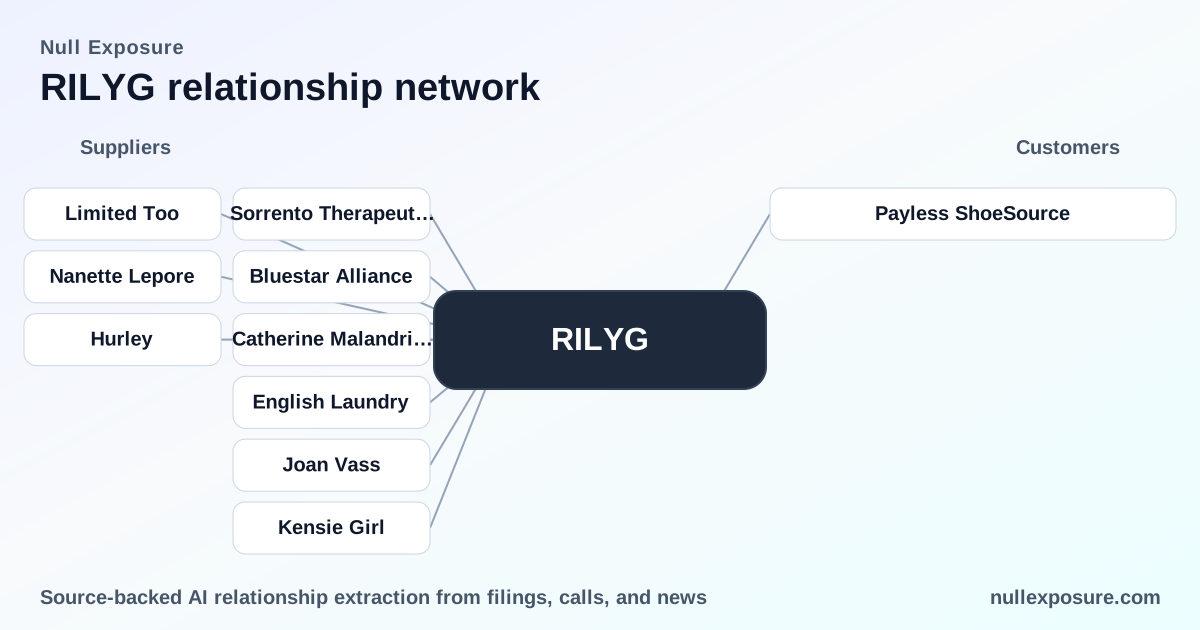
One clear customer relationship in the record — Payless ShoeSource
B. Riley’s interaction with Payless ShoeSource is recorded in media coverage tied to the company’s retail brand activities. According to a Los Angeles Business Journal article covering B. Riley’s acquisition of retail brands (March 10, 2026), Payless had closed all U.S. locations earlier in FY2019 and was among retail assets referenced in that coverage. This signals B. Riley’s role as an acquirer/manager of distressed retail brands and underscores the company’s active asset disposition and retail-restructuring activity. Source: Los Angeles Business Journal coverage of B. Riley’s retail brand acquisitions (March 10, 2026).
How the relationships translate into operating reality
B. Riley’s customer relationships are not homogeneous; the company plays multiple commercial roles across its operating subsidiaries. The constraints extracted from company disclosures describe a firm that:
- Balances recurring subscription revenue with short-term advisory work. The Communications segment delivers subscription services and device sales, while Capital Markets and advisory work are often engagement‑by‑engagement.
- Operates across both transactional and platform models. Nogin’s Commerce-as-a-Service delivers revenue-sharing CaaS contracts; magicJack and Targus product sales are recognized on delivery.
- Targets a broad counterparty set from individuals and small businesses to large financial institutions and non-profits, implying revenue diversification by client type but also the potential for concentration in segments such as financial institutions for consulting services.
These constraints are company-level signals drawn from B. Riley’s filings and segment descriptions, not claims tied to any single relationship.
What the constraints tell investors about business model characteristics
The disclosure-derived signals reveal specific, actionable characteristics of B. Riley’s operating model:
- Contracting posture: mixed maturity. Subscription contracts (Communications, CaaS) provide recurring, predictable cashflows, while short-term advisory engagements and spot device sales generate lumpy, timing-sensitive revenue. The coexistence of these contract types produces partial revenue smoothing but preserves volatility tied to deal flow and retail cycles.
- Concentration and counterparty diversity. The company serves individuals, non-profits, and large enterprises; nonetheless, filings highlight dependence on financial institutions for certain consulting revenues, which is a concentration risk for higher-margin advisory lines.
- Role diversity increases operational complexity. Acting as service provider, reseller/distributor, manufacturer, and seller across segments requires distinct operational capabilities (e.g., inventory management, platform operations, regulated advisory compliance), increasing execution risk but broadening monetization levers.
- Geographic footprint: North America-centric with international exposure. The revenue mix is weighted to North America, with meaningful EMEA, Australia, and Asia contributions in goods sales—this supports dollar-denominated reporting but exposes the company to global supply chain and FX considerations in product lines.
- Segment maturity differs. Financial services and advisory businesses are established fee businesses; CaaS and communications subscriptions reflect more recent platform-oriented revenue that can scale but depends on client retention and platform execution.
Relationship-by-relationship coverage (complete)
- Payless ShoeSource — B. Riley’s involvement with Payless is linked to its activity managing and acquiring retail brands; media coverage notes Payless had closed all U.S. stores earlier in FY2019 and was part of assets handled in B. Riley’s retail brand transactions. Source: Los Angeles Business Journal, coverage of B. Riley retail brand acquisitions (March 10, 2026).
(That completes the set of recorded customer relationships in the provided results.)
Key risk and opportunity themes for RILYG holders
- Risk: revenue volatility from advisory and retail cycles. Short-term engagement work and retail asset turnarounds produce episodic cashflows that can stress near-term liquidity if deal pipelines slow, particularly for instruments maturing like the RILYG notes.
- Opportunity: recurring subscription and platform revenue provide a base. Communications subscriptions and Nogin’s CaaS revenue earn regular fees or revenue shares that underpin a portion of cashflow stability and give management levers to improve margins via scale.
- Execution and integration risk from role diversity. Managing product manufacturing/distribution (Targus, magicJack) alongside advisory and platform services requires effective operational discipline; failures in inventory or platform execution create direct revenue and margin pressure.
- Counterparty concentration on financial institutions for consulting lines. A loss of significant institutional clients could disproportionately affect higher-margin services even while consumer device sales remain intact.
What to watch next — signals that will matter to investors
- Subscription renewal rates and CaaS retention metrics. Stability or expansion here reduces cashflow variance and supports valuation for note investors.
- Deal flow and advisory backlog. Rising M&A advisory activity materially lifts short-term revenues; deterioration will magnify reliance on product and platform revenues.
- Inventory and supply-chain disclosures for Targus and magicJack. Margin pressure or write-downs in hardware lines translate into immediate P&L risk.
- Any further asset acquisitions or retail brand transactions. These activities, including how legacy liabilities are assumed or resolved (as with Payless), reveal balance-sheet and operational implications.
If you want a structured monitoring dashboard or a bespoke alert feed on B. Riley’s customer and counterparty developments, visit https://nullexposure.com/ for coverage options and analytical products.
Bottom line
B. Riley’s customer footprint—illustrated here by the Payless interaction and supported by disclosure-derived contract and segment signals—frames a company that combines recurring subscription and platform income with episodic, high-margin advisory revenues and product sales. That hybrid model creates both stabilizing revenue elements and event-driven volatility, which are the central considerations for evaluating the credit support and risk profile behind the RILYG notes. Investors should price liquidity and execution risk accordingly, while watching subscription retention, advisory deal momentum, and hardware inventory trends as the main near-term drivers of outcome.