RILYN customer footprint: what investors should understand about B. Riley’s counterparty exposure
B. Riley Financial operates as a diversified financial services platform that earns fees and interest across capital markets, wealth management, direct lending, and a set of consumer-facing communications and e‑commerce businesses. The firm monetizes through short-term advisory and underwriting engagements, recurring subscription and usage-based communications revenues, asset management fees, and interest income from direct lending; its consolidated structure produces a mixed revenue stream with service-driven margin potential and pockets of consumer-credit and hardware sales risk.
For active due diligence on customer credit and concentration, review consolidated relationship data and filings at https://nullexposure.com/ for underlying source documents and cross-references.
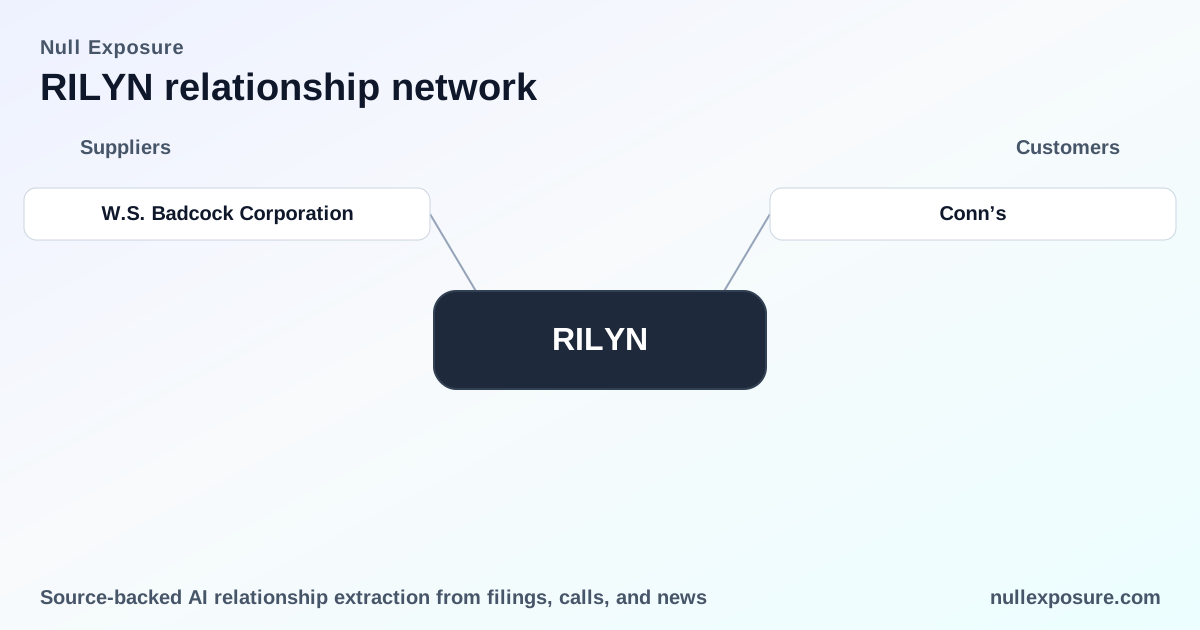
One customer relationship on the public record — Conn’s
Conn’s — a single loan receivable on the books
B. Riley reports a loan receivable with a contractual principal of $93,000 outstanding from Conn’s as of the FY2024 filing, contributing to a loans receivable portfolio whose contractual balance ($448,709) substantially exceeded its aggregate fair value ($90,103). According to the company’s FY2024 Form 10‑K, the contractual principal exceeded fair value by $358,606, highlighting marked discounts in valuation on the loan book. (Source: B. Riley 2024 Form 10‑K, December 31, 2024.)
What the single public relationship implies for investors
Direct lending is concentrated and marked to market
B. Riley’s public disclosure of the Conn’s exposure is a window into the direct‑lending pillar: the firm retains non‑diversified consumer loans that can carry significant fair‑value impairments. The FY2024 figures show meaningful carry‑value gaps in the loan receivable pool, indicating credit stress or conservative valuation assumptions in a consumer segment the company describes as “less than prime.” (Source: FY2024 10‑K, loan receivable and credit quality disclosures.)
Contracting posture: engagement-driven services plus recurring subscriptions
The company’s operating model blends short‑term, engagement‑by‑engagement investment banking contracts with subscription and usage‑based revenue from communications and VoIP businesses (magicJack, UOL and related subsidiaries). This creates a dual revenue pattern: high‑variation advisory fees alongside steadier, but lower‑margin, subscription cash flow. (Source: FY2024 Form 10‑K revenue recognition and segment descriptions.)
Customer mix and concentration profile
B. Riley serves a broad client spectrum—individual consumers, middle‑market companies, large institutions, and non‑profits—which reduces single‑sector concentration but raises heterogeneity in credit and revenue quality across segments. The public Conn’s loan is an example of exposure to a retail/consumer counterparty within a larger, diversified roster of customers. (Source: FY2024 business description and client lists in the 10‑K.)
Geography and revenue dispersion
Operations are primarily North America focused, with foreign subsidiaries contributing roughly $134.5 million (about 16.0%) of total revenues in 2024, underlining modest international exposure and currency/region diversification limits. (Source: FY2024 geographic revenue disclosure.)
Role diversity: service provider plus product sales
B. Riley functions both as a service provider (investment banking, asset management, advisory) and a seller/distributor of consumer hardware and e‑commerce services. The Communications and Consumer Products segments generate subscription, usage, and hardware sales revenues—a mix that affects working capital, inventory, and credit exposure differently than pure services. (Source: FY2024 segment narrative.)
Constraints and operating model characteristics investors must weight
- Contracting posture: The firm’s advisory work is short‑term and event‑driven, creating volatility in fee income; offsetting that are subscription and usage‑based contracts in communications that deliver recurring revenue but are exposed to churn and usage volatility. (Source: FY2024 revenue recognition and segment disclosures.)
- Concentration: Customer composition is broad across individuals, middle‑market firms, and institutional clients, which limits single‑client fee concentration but concentrates credit risk in pockets—direct lending to subprime consumers being a notable example. (Source: FY2024 loan portfolio commentary.)
- Criticality: Several relationships are mission‑critical (capital markets and wealth clients) where service disruption could materially impact revenue; consumer segments are less revenue‑critical per account but aggregate into material exposure via loans and subscription flows. (Source: FY2024 business model description.)
- Maturity: Core capital markets and wealth management businesses are mature and fee‑based, while communications, e‑commerce, and consumer products are operationally different—requiring inventory management and platform operations—adding execution risk to the corporate profile. (Source: FY2024 segment descriptions.)
- Materiality of unsatisfied performance obligations: The filing discloses that the transaction price allocated to unsatisfied performance obligations with duration over one year was not material as of December 31, 2024, signaling limited long‑tail contractual revenue in aggregate. (Source: FY2024 revenue recognition note.)
Risk and opportunity for investors
- Credit and valuation risk: The loans receivable snapshot (Conn’s plus the broader portfolio) shows material fair value markdowns versus contractual balances; investors should treat the direct‑lending book as an active source of mark‑to‑market volatility and potential losses. (Source: FY2024 loan receivable table and disclosures.)
- Revenue diversification benefit: The mix of high‑margin, episodic advisory revenue and predictable subscription/usage revenue provides structural diversification, reducing pure cyclicality linked to capital markets activity. (Source: FY2024 segment revenue descriptions.)
- Operational complexity: Running both capital markets franchises and consumer hardware/subscription businesses increases operational and execution risk, and investors should underwrite management’s ability to sustain margins across these disparate units. (Source: FY2024 business overview.)
For a structured review of counterparties, exposure concentrations, and source documents used in this summary, consult the full relationship index at https://nullexposure.com/. If you want an investor‑grade dossier that maps all customer exposures and contract types across filings, visit https://nullexposure.com/ for detailed filing‑level links and relational analytics.
Key takeaway: B. Riley’s customer base is diversified in type and geography, but the firm carries pockets of high‑credit risk (direct lending to subprime consumers) and operational complexity from mixed hardware and subscription businesses—factors that should shape any credit or equity valuation.