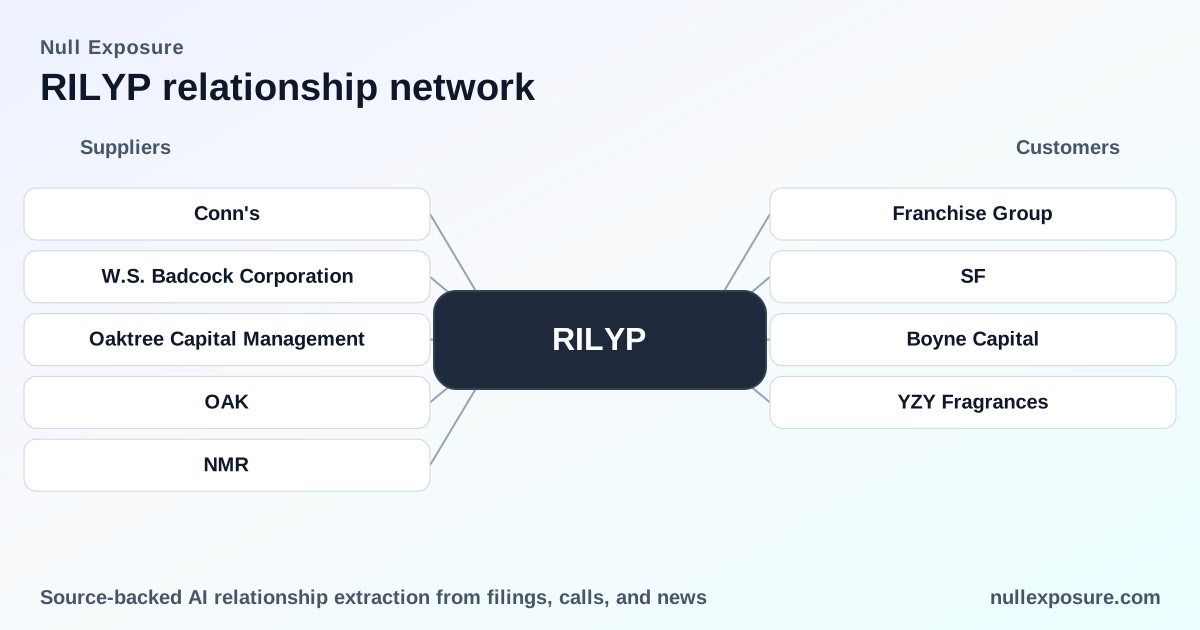
RILYP (BRC Group Holdings / B. Riley): Customer relationships that move capital and risk
B. Riley (listed here as RILYP preferred) operates as a diversified financial-services and consumer-products platform that monetizes through advisory fees, asset-management and custody fees, subscription services in communications, interest and direct-lending margins, and product sales and licensing in its consumer segments. The firm's revenue mix combines recurring subscription and usage-based streams with large, transactional advisory and financing deals, creating asymmetric exposure to both steady fee income and episodic M&A/recapitalization activity. For deeper relationship-level signals and primary-source detail, visit https://nullexposure.com/.
Why customer relationships matter for investors
B. Riley’s economics are driven by two forces: stable, service-oriented contracts (asset management, subscription communications, wealth management) and high-ticket, event-driven transactions (recapitalizations, financing arrangements, asset sales). Customer counterparties range from individuals and small businesses to mid-market companies and institutional buyers, so underwriting must account for heterogenous contract types — subscription, spot hardware sales, usage-based call/traffic charges, and licensing.
Key operational signals: the company reports strong North America concentration, a global footprint in consumer products, and the ability to execute >$100m transactions. These characteristics steer capital-allocation decisions and risk monitoring for investors and operators alike. For additional corporate research and relationship analytics, see https://nullexposure.com/.
Relationship roll call — what each counterparty means for RILYP investors
-
Franchise Group
B. Riley maintained a two‑decade funding and support relationship with entities controlled by Kahn, including Franchise Group; that partnership is central to a shareholder lawsuit alleging undisclosed fraud ties. According to InvestmentNews coverage in March 2026, the case centers on B. Riley’s long-running financial support role. (Source: InvestmentNews, March 10, 2026 — https://www.investmentnews.com/in-plus/regulation-and-legal-cases/shareholder-sues-b-riley-execs-for-allegedly-hiding-partners-294m-fraud-ties/264848) -
SF (inferred symbol SF)
B. Riley reported assets under management of roughly $20.7 billion as of December 31, 2024, and disclosed a material divestiture of a significant portion of those assets to Stifel Financial in 2025; the trading report notes the AUM figure and the subsequent sale. (Source: TradingView coverage of the company’s SEC 10‑K disclosures, FY2025 — https://www.tradingview.com/news/tradingview:4234d3cf1a156:0-b-riley-financial-inc-sec-10-k-report/) -
Stifel Financial Corp.
The firm sold a meaningful portion of AUM to Stifel in 2025, underscoring B. Riley’s capacity to package and transfer managed assets to strategic buyers and shifting fee and balance‑sheet economics. TradingView’s summary of the 10‑K highlights the $20.7 billion AUM figure and the sale to Stifel (FY2025). (Source: TradingView, FY2025 — https://www.tradingview.com/news/tradingview:4234d3cf1a156:0-b-riley-financial-inc-sec-10-k-report/) -
Boyne Capital
B. Riley Securities advised on the recapitalization of YZY Fragrances by Boyne Capital, demonstrating the investment-banking arm’s role in executing sponsor-led recap deals. Ad‑hoc-News reported this advisory role as part of the company’s quarter commentary in early 2026. (Source: ad-hoc-news summary, FY2026 — https://www.ad-hoc-news.de/boerse/news/ueberblick/b-riley-financial-shares-surge-on-quarterly-beat-amid-lingering-concerns/68494008) -
YZY Fragrances
B. Riley Securities acted as advisor on the successful recapitalization of YZY Fragrances, showing the firm’s engagement with consumer-brand restructurings and sponsor financings. The transaction was described in the same ad-hoc-News coverage of the company’s fiscal reporting (FY2026). (Source: ad-hoc-news, FY2026 — https://www.ad-hoc-news.de/boerse/news/ueberblick/b-riley-financial-shares-surge-on-quarterly-beat-amid-lingering-concerns/68494008) -
CISO Global (NASDAQ: CISO)
CISO entered a private financing arrangement with a fund managed by B. Riley Securities Holdings that gives CISO the right to sell up to $15 million of a new convertible preferred series to B. Riley, illustrating the firm’s role as a strategic capital provider to tech and cybersecurity issuers. Quiver Quant reported the arrangement in May 2026. (Source: QuiverQuant news, May 3, 2026 — https://www.quiverquant.com/news/CISO+Global+Secures+%2415+Million+Financing+Arrangement+with+B.+Riley+Securities+to+Accelerate+Cybersecurity+Business+Expansion)
What the constraints tell us about operations and risk posture
-
Contracting posture: mixed-duration and mixed-pricing — subscription and recurring services coexist with spot hardware sales and usage‑based telecom charges, so revenue predictability varies by segment. Communications and UCaaS generate recurring fees, while device sales and product manufacturing are transactional.
-
Counterparty concentration: broad and diverse — customers include individuals, small businesses, non-profits, and mid‑market corporates; this diversity reduces dependence on any single client category but creates differentiated credit and retention dynamics across segments.
-
Relationship role and criticality: B. Riley functions primarily as service provider and advisor, often in agency-like e‑commerce and brokerage roles where it earns defined fees rather than taking inventory risk. The company also plays the role of financier and buyer in structured transactions, placing it in both fee and balance‑sheet risk positions.
-
Geography and maturity: North America is dominant, with complementary EMEA and APAC footprints in consumer products; certain product lines (Targus) are global with wholesale/licensing arrangements, indicating mature B2B distribution channels.
-
Spend and deal scale: company disclosures show capability to execute >$100m transactions (a June 27, 2025 divestiture recorded aggregate cash consideration of $117.8m), signaling capacity to consummate large strategic sales and purchases that materially affect balance-sheet composition.
Investment implications — where to focus diligence
-
Revenue stability versus event risk: subscription and AUM fees provide steady cash flows, while advisory and financing activity drive episodic earnings and reputational risk. Monitor quarter-to-quarter variability in advisory revenue and realized gains on financings.
-
Legal and reputational risk: the Franchise Group shareholder suit tied to long-standing partner relationships is a direct governance and reputational flag; investors should track litigation disclosures and any contingent liabilities. (See InvestmentNews, March 2026.)
-
Balance-sheet and capital deployment: the firm’s willingness to acquire and divest large assets, and to provide direct financing (e.g., CISO arrangement), creates optionality but also exposes the company to credit and market risk; stress-test large bilateral financings in scenario analyses.
-
Counterparty concentration and geography: North American revenue concentration simplifies regulatory and market assumptions but creates regional cyclical exposure; consumer manufacturing and global distribution add diversification benefits but different margin profiles.
Bottom line
B. Riley’s customer relationships span advisory mandates, asset‑management transfers, recapitalizations, and direct financing — a hybrid model that generates recurring fees and high‑margin, event‑driven income but also exposes investors to legal, credit, and execution risk. For an at‑a‑glance relationship map and ongoing primary‑source tracking, explore the research hub at https://nullexposure.com/.
For bespoke relationship analysis or to commission a deeper counterparty risk report, visit https://nullexposure.com/ to start a tailored engagement.