RILYT — What B. Riley’s customer footprint means for note investors
B. Riley Financial Inc. operates as a diversified financial services and commercial platform that monetizes through a mix of fee-based advisory, recurring communications and CaaS (commerce-as-a-service) revenues, product sales, and investment income. The 6.00% Senior Notes due 2028 (RILYT) sit against a business model that blends recurring service contracts with spot product sales and large, discrete transactions — a structure that produces both steadiness in fees and episodic balance-sheet risk from investments and dispositions.
If you are assessing RILYT exposure, focus on two axes: the heterogeneity of customer contracts (subscription, usage and spot revenue profiles) and the legal/partner concentration risks evident in recent reporting. For a deeper view, see our platform at https://nullexposure.com/ for consolidated relationship intelligence.
Legal headline: the Franchise Group link investors must track
A March 10, 2026 InvestmentNews report details a shareholder lawsuit that targets B. Riley’s executive conduct tied to a long-term partnership with an individual named Kahn, noting that B. Riley “provided funding and support to Franchise Group and various entities under Kahn’s control” over two decades. This litigation elevates counterparty and reputational risk tied to a material partner relationship and deserves monitoring by holders of RILYT. (InvestmentNews, March 10, 2026).
All customer relationships surfaced in the record — one clear item
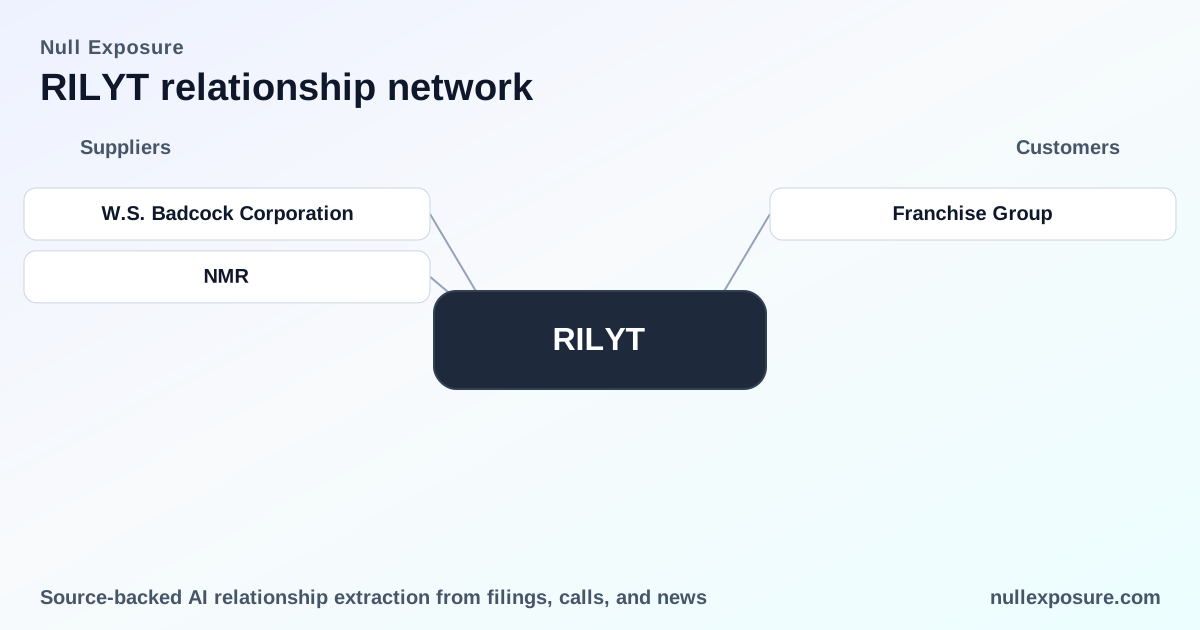
- Franchise Group — InvestmentNews (March 10, 2026) reported a shareholder suit centering on B. Riley’s two-decade partnership with Kahn, asserting B. Riley provided funding and operational support to Franchise Group and affiliated entities. This is the only customer-level relationship flagged in the dataset for RILYT’s customer scope and it is presented as an active, long-standing commercial and financing relationship that is now subject to litigation scrutiny. (InvestmentNews, 2026-03-10)
What the contractual signals say about B. Riley’s operating model
Company disclosures and segment descriptions present a layered contracting posture that directly shapes cash flow predictability and counterparty risk.
-
Contract mix — diversified across revenue recognition styles. B. Riley reports recurring subscription revenues (communications and UCaaS services recognized over time), usage-based income (call termination, prepaid minutes recognized as consumed), and spot, point-in-time sales (consumer hardware shipments recognized at transfer of control). That mix creates both steady annuity-like cash and lumpy, shipment-driven revenue swings.
-
Customer breadth — retail to institutional. The firm serves individuals and families through wealth management, middle-market and corporate clients via investment banking and direct lending, and institutional counterparties for asset management and capital markets work. This reduces single-counterparty revenue concentration but increases operational complexity across service levels and credit profiles.
-
Geographic footprint — largely North America with global reach. Disclosures quantify dominant North American revenue with material activity in EMEA, APAC and LATAM and a global distribution network in consumer products. Revenue generation is predominantly U.S.-centric but operational exposure is international, especially in Targus consumer sales and Nogin e-commerce services.
-
Role and criticality — services plus product distribution. The company operates as a service provider (CaaS, advisory, wealth) on agency or revenue-share models and as a seller/manufacturer/distributor for consumer hardware lines (magicJack, Targus). For investors, this means some revenue lines are mission-critical recurring services subject to client churn risk while others are inventory/seasonality-driven.
-
Contract maturity and scale — a mix of long-term relationships and high-ticket disposals. Dispositions and corporate transactions have produced multi-million and >$100m proceeds in recent periods, indicating material but episodic balance-sheet transactions that affect liquidity and reported proceeds.
Collectively, these signals frame a business that is operationally diversified but sensitive to legal, counterparty and balance-sheet event risk.
Key risk and credit implications for noteholders
-
Operational cash flow stability comes from fee and subscription lines, but service complexity increases execution risk. The presence of subscription and usage-based revenues supports predictable cash generation, yet the company’s reliance on agency revenue and revenue-sharing for its CaaS business concentrates execution risk in platform delivery.
-
Counterparty and reputational risk is elevated where long-term partner relationships exist. The Franchise Group matter — a litigation-driven disclosure — highlights how multi-decade funding relationships can convert into legal exposure that affects investor perceptions and access to counterparties.
-
Liquidity and structural risk arise from episodic asset sales and financings. Recent transactions producing hundreds of millions in proceeds demonstrate access to capital markets and buyers, but such events are non-recurring and can mask underlying operational shortfalls if used to smooth results.
-
Geographic and product diversity help resilience but bring cross-border execution and regulatory considerations. International sales and manufacturing (Targus) alongside U.S.-centric advisory and communications businesses create natural diversification but require layered governance and compliance.
Practical takeaways for investors evaluating RILYT
-
Monitor litigation and partner disclosures, especially the Franchise Group/Kahn matter, for impacts to reputation, counterparty relationships and contingent liabilities. (InvestmentNews, March 10, 2026).
-
Evaluate cash flow segmentation between recurring subscription/usage fees and spot product sales when modeling default probability and recovery, because the former is stickier while the latter is inventory- and demand-sensitive.
-
Stress-test liquidity under scenarios that remove one-time asset-sale proceeds, given recent history of large disposals and financings that materially altered cash balances.
-
Watch client concentration at the segment level (financial institutions, mid-market borrowers, large e-commerce accounts) even if single-customer concentration is not evident at the consolidated level.
For a consolidated view of B. Riley’s relationship map and to monitor litigation and counterparty signals relevant to RILYT, visit https://nullexposure.com/ — the platform organizes relationship-level intelligence alongside financial and legal events.
Bottom line
B. Riley’s business combines stable fee streams with episodic transactional risk — a duality that supports coupon coverage in ordinary cycles but demands vigilance on legal and partner concentration events. The Franchise Group lawsuit is the most visible customer-related risk in the recent record and should be factored into credit assessment and event-driven monitoring for RILYT holders.