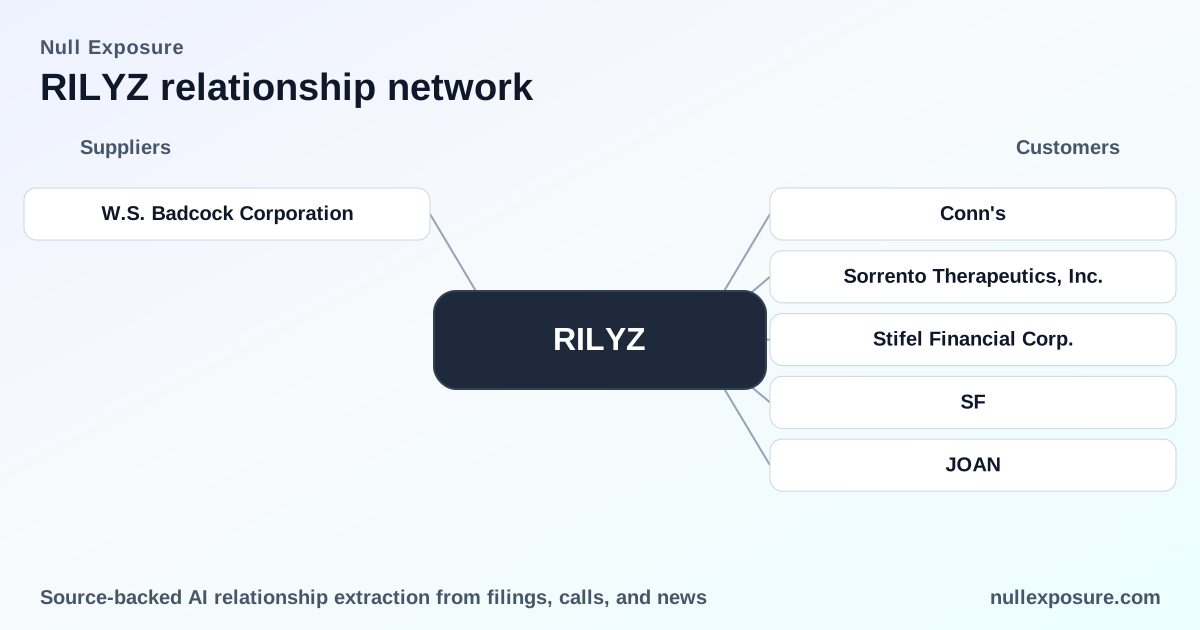
RILYZ Customer Map: Who’s on the Other End of B. Riley’s Ledger
Thesis — B. Riley (RILYZ) operates a diversified financial services and product platform that monetizes through a mix of fee-based services (wealth management, investment banking, consulting), direct lending, commerce-as-a-service revenue shares, and sales of hardware and consumer products. Investors should value the company as a portfolio of operating businesses where cash generation and credit exposure are determined by segment mix and contract type rather than a single recurring subscription model. For deeper relationship-level signal work, visit https://nullexposure.com/.
How RILYZ actually makes money — a reminder for allocators
B. Riley’s revenue base is multi-modal: recurring services (wealth management, CaaS engagements, institutional brokerage fees), transaction or event-driven fees (investment banking, restructuring advisory), and point-of-sale hardware revenue (consumer electronics and devices). The FY2024 filings show that Communications and E‑Commerce produce subscription-like, ratable revenue while the Consumer Products business records point-in-time sales on device and accessory shipments. The firm also originates loans and holds receivables that convert its advisory flow into credit assets.
- Contracting posture: a hybrid of subscription/service agreements and spot sales; CaaS contracts are structured as net-fee agency relationships while device sales are point-in-time recognition (FY2024 10‑K).
- Concentration and counterparty mix: customers include individuals, mid-market corporates, institutions, non-profits and retailers. Revenue is North America‑heavy but with measurable EMEA and APAC exposure (FY2024 10‑K).
- Criticality and maturity: professional services lines are sticky and higher-margin; consumer hardware is lower-margin and more cyclical. Direct-lending and receivable holdings introduce credit risk that behaves like a loan book.
These are company-level signals drawn from the FY2024 10‑K and supplemental earnings commentary.
The customer relationships that matter (each filing entry covered)
Below I walk through every customer/partner mention from the available results, with a plain-English summary and the filing or call that documents it.
Stifel Financial Corp. (10‑K disclosure)
B. Riley executed a definitive agreement on October 31, 2024 to sell a portion of its W‑2 Wealth Management business to Stifel Financial Corp., signaling a structural re‑allocation of its wealth-management footprint and recurring fee base. According to RILYZ’s FY2024 10‑K filing, this is a formal divestiture of part of the W‑2 advisory operations (FY2024 10‑K, filed Dec 31, 2024).
SF (earnings call mention)
The Q4 2024 earnings call reiterated the signing of a definitive agreement to sell part of the traditional W‑2 Wealth Management business to “SF,” the call’s shorthand for Stifel, confirming management’s view that the transaction was a material strategic move for the segment. Management discussed this transaction publicly in the 2024 Q4 earnings call (2024Q4 earnings call).
Stifel Financial Corp (earnings call mention)
In the earnings call, management named Stifel Financial Corp explicitly as the buyer of a portion of the W‑2 Wealth Management business, aligning the 10‑K disclosure with conference‑call commentary and indicating immediate market messaging around the deal. This detail is recorded in the Q4 2024 earnings call transcript (2024Q4 earnings call).
Conn’s (10‑K disclosure)
RILYZ holds a direct loan receivable with $93,000 principal outstanding from Conn’s, and an additional two loans serviced by Conn’s with a fair value of $6,082; these amounts reflect the company’s exposure to retail financing and servicer relationships in its loan portfolio. The FY2024 10‑K documents these receivables and the servicing arrangement (FY2024 10‑K, filed Dec 31, 2024).
Sorrento Therapeutics, Inc. (10‑K disclosure)
A wholly owned subsidiary, BRCC, received a demand asserting that approximately $32,166 in payments made by Sorrento Therapeutics under a September 30, 2022 bridge loan are avoidable as preferential transfers in Sorrento’s Chapter 11 case, creating a legal claim against amounts previously advanced. The FY2024 10‑K details this bankruptcy-related demand (FY2024 10‑K, filed Dec 31, 2024).
JOAN (earnings call mention)
Management referenced a partnership result in which RILYZ successfully bid in a bankruptcy process to manage the liquidation of more than 800 stores, using the shorthand “JOAN” on the Q4 2024 earnings call to describe the client case under management. The Q4 2024 earnings call highlights benefits realized from that partnership (2024Q4 earnings call).
JOANN (earnings call mention)
The company specifically identified JOANN (the fabric and craft retailer) on the Q4 2024 earnings call as the bankruptcy engagement where RILYZ was selected to manage liquidation across the retailer’s 800‑plus stores, underscoring the Financial Consulting segment’s revenue visibility from restructuring mandates. This was discussed in the Q4 2024 earnings call (2024Q4 earnings call).
Note: The SF/Stifel and JOAN/JOANN entries reflect duplicate mentions across the 10‑K and the earnings call; I list each source instance so investors can see both the formal filing disclosure and the management commentary.
Constraints that shape valuation and operational risk
Several company-level signals in the FY2024 disclosures affect how to model RILYZ’s revenue durability and credit risk:
- Contract mix: subscription-style revenues in Communications and ratable recognition in CaaS contrast with point-in-time product sales in Consumer Products, producing differing cash flow stability across segments (FY2024 10‑K).
- Revenue geography: North America drives the majority of sales, but EMEA and APAC contributions are meaningful for the Consumer Products and Communications segments, adding FX and regional demand noise (FY2024 10‑K).
- Role heterogeneity: RILYZ operates both as a seller of goods and as a service provider/agent; CaaS engagements are net-fee arrangements while product lines require inventory and channel management (FY2024 10‑K).
- Counterparty breadth: customers range from individuals and small businesses to institutions and mid‑market borrowers, creating a diversified but complex credit profile (FY2024 10‑K).
These constraints are company-level characteristics derived from the FY2024 filings and should inform discount-rate selection, scenario stress testing, and loss assumptions on receivables.
What investors should watch next
- Track completion and integration of the Stifel transaction: sale proceeds, recurring fee transfer, and any client retention conditions will materially rebase the Wealth Management segment.
- Monitor litigation outcomes on Sorrento demand — a small nominal amount but indicative of risk in lending and bankruptcy exposure.
- Watch receivable performance from Conn’s‑serviced loans and liquidation mandates like JOANN for near-term fee realization and cash conversion.
If you want a focused relationship-risk report or portfolio mapping for RILYZ customers, see our research hub at https://nullexposure.com/.
Bottom line
B. Riley’s cash flows are a patchwork of recurring services and event-driven revenue, with strategic divestitures (Stifel) and active restructuring engagements (JOANN) shaping near‑term margins and risk. The mix of contract types — subscription, agency CaaS, and spot product sales — requires investors to apply segment‑specific revenue durability assumptions and to model credit exposures from its receivable and lending positions separately.