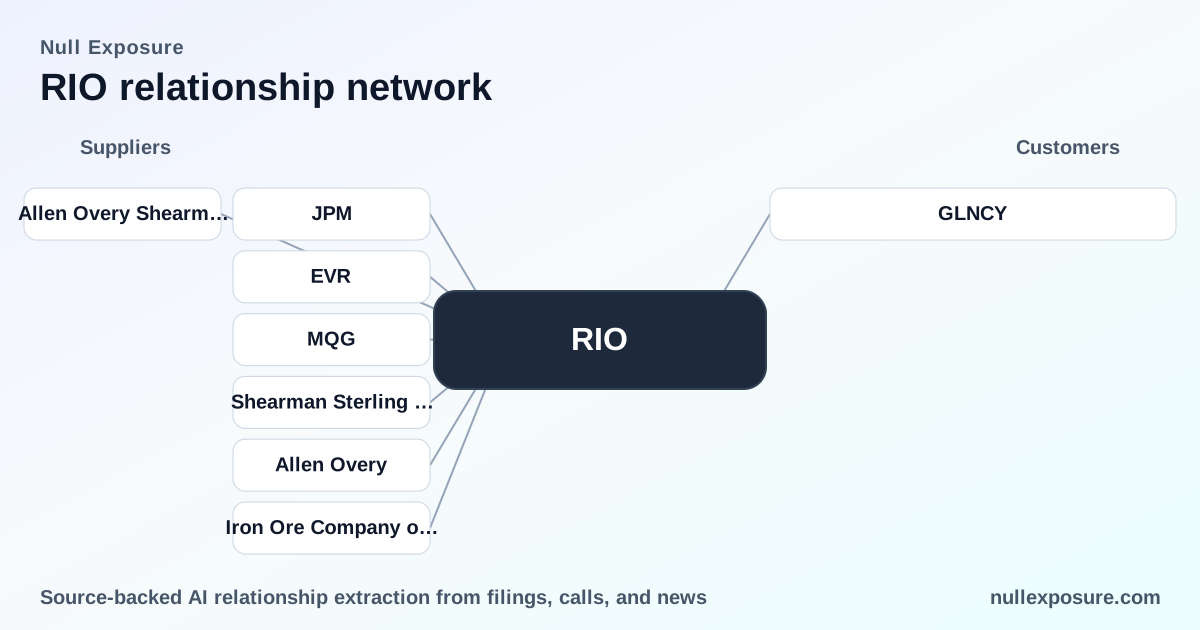
Rio Tinto (RIO) — Customer Relationship Intelligence and Strategic Deal Flow
Rio Tinto operates as a global miner that explores, extracts and processes industrial minerals and metals, monetizing through commodity sales, long-term offtakes and strategic asset disposals and joint-venture realignments. The company’s cash generation comes from integrated mine-to-market operations in iron ore, copper, aluminium and specialty minerals, supplemented by periodic asset sales and stake sales that crystallize value and reallocate capital toward higher-return projects. For a succinct briefing on how these customer and counterparty interactions affect valuation and operational optionality, see Null Exposure for deeper relationship analytics: https://nullexposure.com/.
Why the recent relationships matter for investors
Rio Tinto’s deal flow in FY2026 shows a deliberate skew toward asset rationalization and partner-led development. Buyers and technical partners are concentrated in metals and specialty chemicals sectors—an indication that Rio uses disposals to sharpen its portfolio and capture value where scale is less critical to core margins. Asset monetization is not a short-term liquidity fix but an explicit portfolio-management tool that improves capital efficiency and funds higher-return projects.
Key company-level operating signals:
- Contracting posture: Transactional and opportunistic—Rio is actively marketing non-core assets and negotiating stake sales.
- Concentration: Diversified counterparty base across mining, chemicals and engineering partners, signalling low dependency on any single customer.
- Criticality: Assets sold (boron, uranium, minority stakes) are strategically important to buyers but increasingly peripheral to Rio’s core iron-ore and copper long-cycle cash flows.
- Maturity: Relationships reflect a mature miner that executes structured disposals, JV restructures and technical collaborations rather than early-stage partnerships.
For more on how these relationships compress risk and reshape earnings, visit Null Exposure: https://nullexposure.com/.
Relationship map: bidders, buyers and technical partners in FY2026
WE Soda — strategic buyer interest in boron
WE Soda surfaced among over a dozen bidders for Rio Tinto’s U.S. boron assets, underscoring industrial buyers’ strategic interest in feedstock control for soda ash and related chemistries. WE Soda’s participation signals end-user demand driving asset-level price discovery. (Intellectia news report, May 3, 2026)
Magris Resources — financial bidder for boron assets
Canadian mining investor Magris Resources is listed as a potential bidder for Rio’s U.S. boron assets, representing the financial-sponsor side of competitive tension around non-core specialty minerals. Presence of financial bidders helps sustain valuation for divestments. (Intellectia news report, May 3, 2026)
Uranium Energy Corp. (UEC) — buyer of uranium and Wyoming assets
Uranium Energy Corp. completed multiple asset purchases from Rio Tinto, including an Athabasca Basin project and Wyoming assets such as the Sweetwater plant, with transactions reported across 2024–2025 and referenced in FY2026 coverage. These divestitures show Rio exiting certain uranium and coal legacy positions and transferring operational assets to smaller, specialized producers. (Simply Wall St coverage and IndexBox reporting, Aug–Dec 2024; referenced in FY2026)
Glencore — buyer of Australian mines and strategic counterparty
Glencore purchased some Australian mines from Rio Tinto as part of the broader reallocation of on-the-ground assets, reflecting large diversified miners’ tendency to consolidate regional portfolios. A sale to Glencore highlights strategic rebalancing rather than outright retreat from a commodity sector. (The Globe and Mail, March 10, 2026)
First Quantum Minerals Ltd. — purchaser of Peru copper stake
First Quantum completed acquisition of a 55% stake in the La Granja copper project from Rio Tinto for $110 million, indicating Rio’s willingness to monetize early-stage or non-core copper exposure to mid-tier producers. First Quantum’s buy underscores appetite among mid-tier miners for growth through asset consolidation. (Simply Wall St reporting, Aug 29, 2025, cited in FY2026 summaries)
Sumitomo Metal Mining Co., Ltd. — strategic JV/partner transaction at Winu
Sumitomo agreed to acquire a 30% stake in the Winu copper‑gold project from Rio Tinto for approximately $400 million, demonstrating how Rio leverages partner capital and technical alliances to de‑risk large copper projects. Selling a minority stake to an industrial partner accelerates project funding while preserving upside for Rio. (Simply Wall St reporting, Dec 6, 2025; noted in FY2026)
DDC / Diavik processing flow — downstream diamond processing relationship
A historical SEC exhibit documents that rough diamonds processed at Diavik were split under joint-venture arrangements, with Rio Tinto receiving DDMI’s portion for Antwerp sorting and valuation—an example of integrated processing and downstream revenue capture within JV frameworks. (SEC filing, Exhibit 99-2, FY2017; referenced in FY2026 aggregation)
Western (WRN) — ongoing technical collaboration on Casino project
Western (ticker WRN) formalized an extension of technical collaboration with Rio Tinto for the Casino project, retaining Rio’s geotechnical, processing and engineering input for ongoing design and modeling activities. This reflects Rio’s role as a technical services partner where it elected to preserve project-level influence without full ownership. (MiningNewsNorth, Jan 14, 2026)
What these relationships imply for cash flow and risk
Collectively, the FY2026 relationships demonstrate Rio Tinto’s active capital recycling strategy: monetize non-core or capital‑intensive assets, partner where technical expertise adds value, and keep exposure to key commodities through minority stakes or JV structures. The buyer universe includes producers (WE Soda, First Quantum, Sumitomo), financial investors (Magris), and specialized miners (UEC, Glencore), which supports competitive pricing and reduces counterparty concentration risk.
Key investment implications:
- Earnings quality improves as capital freed from disposals funds projects with higher margins or returns.
- Volume risk is manageable given diversification of buyers and Rio’s focus on core commodity cash cows.
- Execution risk centers on market pricing for asset sales and the company’s ability to redeploy proceeds into accretive opportunities.
Final takeaways for operators and investors
- Rio’s FY2026 relationship set confirms a disciplined asset‑management playbook: sell non-core, partner for development, and capture downstream value where strategic.
- Counterparty mix reduces concentration risk while sustaining negotiation leverage across both industrial buyers and financial sponsors.
- Operational maturity and technical capability allow Rio to monetize selectively without forfeiting strategic optionality.
For deeper relationship-level analytics and to monitor how these counterparties affect Rio Tinto’s cash‑flow profile and valuation, explore targeted intelligence at Null Exposure: https://nullexposure.com/.