Riot Platforms (RIOT): From Bitcoin Miner to Contracted Infrastructure Operator
Riot Platforms operates large-scale Bitcoin mining farms and is actively converting its Texas power and land holdings into contracted high-performance computing (HPC) and AI-ready data center capacity. The company monetizes through three channels today: Bitcoin production and sales, long-term data center leases and services, and engineering services tied to electricity distribution projects. Recent tenant agreements are repositioning a portion of Riot’s revenue mix toward predictable, contractual data-center income alongside the inherently volatile mining business.
For primary diligence materials and subscriber-grade relationship mapping, visit https://nullexposure.com/ for structured insights and primary-source links.
The defining customer relationship: AMD anchors the new data-center line of revenue
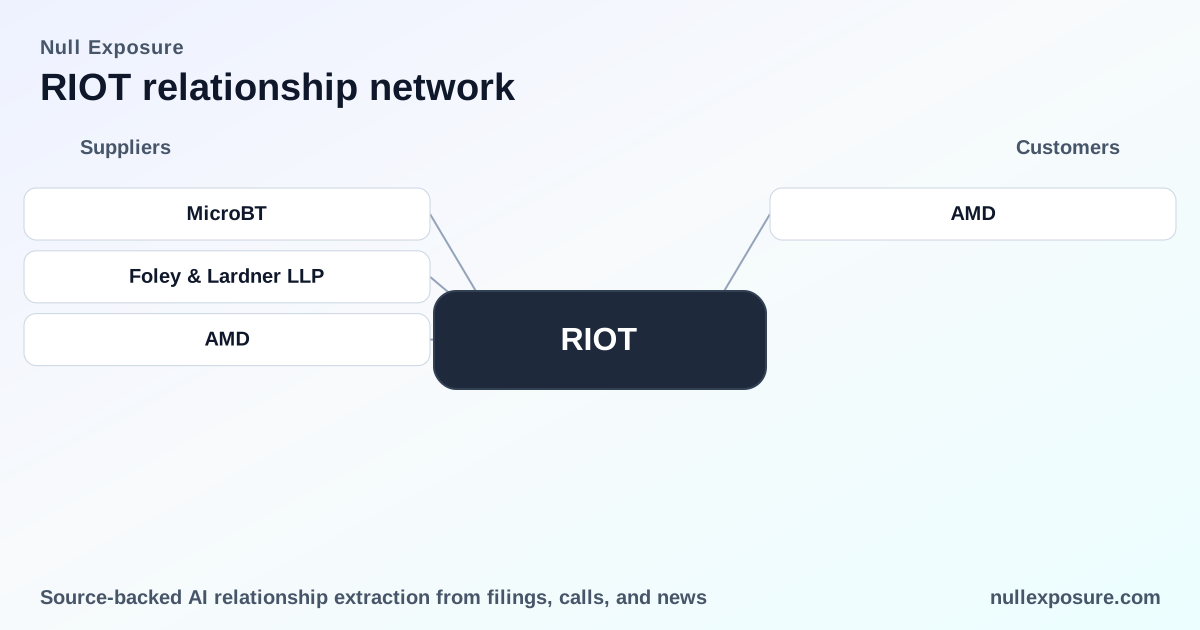
Riot announced a landmark Data Center Lease and Services Agreement with Advanced Micro Devices (AMD) that makes AMD the anchor tenant at Riot’s Rockdale, Texas site. Riot disclosed that the initial agreement provided 25 megawatts (MW) of commissioned capacity beginning January 2026, and AMD exercised an option during Q1 to increase contracted capacity to 50 MW, validating Riot’s operational scale for demanding HPC and AI clients. This leasing activity contributed materially to Riot’s newly reported data-center revenue in Q1 2026 and was cited by management as a strategic proof point. (Source: Riot Platforms press release and Q1 2026 operational update, March–May 2026.)
Multiple market reports contextualize the economics: some coverage cited a 10‑year deal with an estimated contract value of ~$311 million, while other outlets referenced higher aggregate headline figures up to $1 billion in aggregate program potential tied to staged buildouts and optionality; Riot’s own disclosures emphasize the contracted MW and term rather than a single lump-sum number. The initial AMD tenancy already converted Rockdale capacity into recurring leasing revenue, supporting Riot’s pivot narrative from pure miner to hybrid infrastructure operator. (Sources: Riot Platforms investor releases, March–May 2026; industry coverage including The Block and Foley & Lardner advisory release, March 2026.)
Other customer links in the record: OPRA, ERCOT, and MISO
-
OPRA: Riot is referenced in a transcript where a counterpart cited “close relationships with Riot” enabling expanded activity in certain markets; the excerpt is from a third-party earnings report that noted Riot’s industry connections. This suggests Riot is recognized by industry participants as an operational partner for energy and infrastructure initiatives. (Source: InsiderMonkey summary of earnings commentary, March 2026.)
-
ERCOT: Riot reported estimated credits received from participation in ERCOT demand response programs in its Q1 2026 production and operations update, indicating direct commercial engagement with the Texas grid operator’s market mechanisms to monetize flexibility. (Source: Riot’s Q1 2026 production and operations update, April 2026.)
-
MISO: Likewise, Riot disclosed estimated credits from participation in MISO demand response programs, underscoring that grid services and market participation are incremental revenue channels that complement both mining and hosting operations. (Source: Riot’s Q1 2026 production and operations update, April 2026.)
Each relationship above is supported by Riot’s public operational updates or contemporaneous sector reporting from March–May 2026.
How to read Riot’s operating model and customer constraints
Riot’s business model now blends commodity-driven mining with contracted real-estate and power delivery for third-party compute customers. Several company-level signals shape investor risk and reward:
-
Contracting posture: Engineering work described in filings is primarily fixed-price, short-duration (4–12 weeks) project work, which indicates the engineering segment runs on discrete contracts rather than long-term continuous services. This is a corporate-level signal rather than tied to any single tenant. (Source: company engineering disclosures.)
-
Counterparty profile: Riot’s engineering and services business historically targets large enterprises and governmental customers, implying institutional counterparties and procurement processes. This profile supports higher-contract discipline but typically involves longer sales cycles for new projects. (Source: company disclosures on engineering customer types.)
-
Customer concentration: Riot reported that no single customer accounted for 10% or more of consolidated revenue for 2023–2024, a signal of low customer concentration at the company level before the AMD lease became a recognizable anchor. Investors should note that large anchors can change concentration dynamics quickly once they scale. (Source: Riot annual disclosures, 2024.)
-
Relationship maturity and staging: Riot had previously terminated an older data-center hosting program prior to 2024; that fact is a company-level historical signal of shifting strategy in hosting services. The current AMD agreement represents a new, strategic stage for Riot’s data-center business rather than a continuation of the prior hosting program. (Source: Riot’s disclosure on past data center hosting contracts, 2024; subsequent 2026 lease announcements.)
-
Criticality and optionality: Riot’s Rockdale site includes long-term land and power positions with expansion optionality. The AMD lease’s exercisable options (25→50 MW and public reporting of staged expansion) create scalable revenue optionality while also concentrating operational criticality on successful facility conversion and utility interconnection performance. (Sources: Riot investor communications, March–May 2026.)
Investment implications: what drives value and what to watch
-
Value drivers: The most immediate uplift to Riot’s valuation comes from converting idle power assets into contracted, predictable cash flows via long-term leases (the AMD agreement is a primary example). If Riot scales additional long-term HPC tenants, corporate cash flow volatility should decline and asset-backed valuation metrics should rise.
-
Operational risk: Execution against utility interconnection, construction schedule, and tenant onboarding timing is critical—especially for large capacity increases from 25 MW to 50 MW and beyond. Grid-market participation (ERCOT/MISO demand response credits) is additive but not a substitute for delivery of contracted IT load.
-
Revenue mix and earnings: Q1 2026 already showed data-center revenue contributing meaningfully to total revenue (industry reporting placed new data center revenue at roughly 20% of the quarter’s top line in some reports), which will materially shift profitability dynamics if sustained. (Source: The Block and Riot Q1 disclosures, May 2026.)
-
Governance and capital allocation: Watch capital deployment between Bitcoin mining fleet expansion and data-center construction; the AMD lease demonstrates Riot’s willingness to redeploy capital toward higher-contract revenues, which changes the company’s risk profile and opens new valuation comparables (infrastructure REITs and hyperscale colocation peers).
Bottom line for investors
Riot is transitioning from a single-focus Bitcoin miner into a hybrid operator with a contractual revenue stream anchored by AMD and supplemented by grid-market monetization and engineering services. The AMD lease is the strategic inflection point: it converts stranded power and land into recurring cash flow while preserving the option to scale. Risk centers on execution—construction, interconnection, and the company’s ability to sign additional long-term tenants to de-risk aggregate revenue. For a concise, sourced map of Riot’s tenant and grid relationships, see our platform at https://nullexposure.com/.
Key sources: Riot Platforms investor releases and production updates (March–May 2026), The Block (May 2026), Foley advisory release (February–March 2026), and contemporaneous industry coverage cited above.