Rithm Capital (RITM): Customer Relationships That Drive Fee Income and Credit Exposure
Rithm Capital operates as a vertically integrated real estate and credit manager that earns recurring management and servicing fees while retaining balance-sheet exposure through lending and investment portfolios. The company monetizes via four core avenues: origination and servicing fees, asset management fees and incentives, residential transitional lending profits, and direct investment returns from owned portfolios. These customer relationships—ranging from U.S. government agencies to sponsored REITs and institutional borrowers—are central to both fee stability and credit risk concentration.
If you want a quick gateway to our broader coverage on institutional customer mapping, visit the Null Exposure homepage: https://nullexposure.com/
Why customer relationships matter: fees, servicing economics and balance-sheet linkages
Rithm’s business model mixes transactional fee flows (servicing and management) with recurring, subscription-like revenue and direct credit exposure. The servicing business generates steady fee income tied to unpaid principal balances (UPB) and delinquencies, while externally managed vehicles such as Rithm Property Trust create predictable management and incentive-fee economics. On the balance-sheet side, direct lending or loans to sponsored projects translate customer exposure into credit risk.
Below I unpack each customer relationship that appears in public sources and the compact implications for investors.
Government agencies: Freddie Mac, Fannie Mae and Ginnie Mae — backbone of servicing scale
-
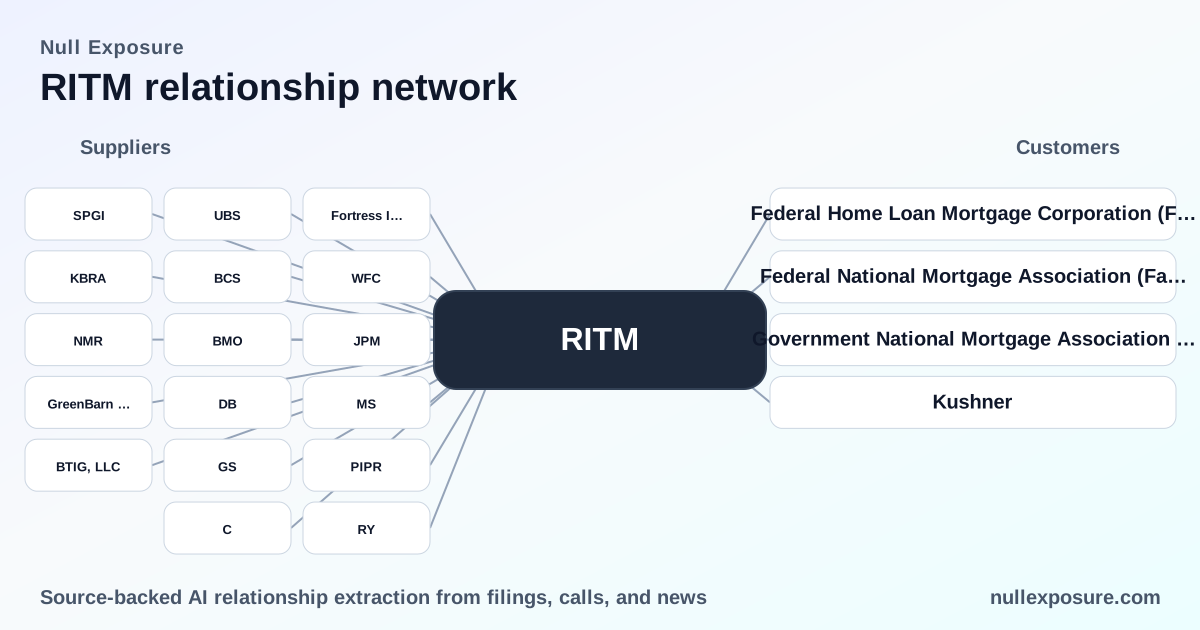
Federal Home Loan Mortgage Corporation (Freddie Mac) — Rithm’s servicing affiliates are approved to service loans on behalf of Freddie Mac, giving the company access to GSE-backed servicing contracts and associated fee streams. According to Rithm’s 2024 Form 10‑K, Newrez and NRM carry approvals to service mortgage loans for Freddie Mac (Rithm 10‑K, FY2024).
-
Federal National Mortgage Association (Fannie Mae) — Rithm’s servicers are also approved by Fannie Mae, providing another channel for high-volume, standardized servicing mandates that support recurring revenue. This approval is disclosed in Rithm’s 2024 Form 10‑K (Rithm 10‑K, FY2024).
-
Government National Mortgage Association (Ginnie Mae) — Newrez holds eligibility to service mortgages in Ginnie Mae pools, which links Rithm to government‑insured loan servicing and the operational requirements that accompany GNMA programs. This relationship is cited in Rithm’s 2024 Form 10‑K (Rithm 10‑K, FY2024).
Takeaway: Approval to service for Fannie, Freddie and Ginnie entrenches Rithm in the core U.S. residential mortgage servicing market and underpins a material, recurring fee base.
Rithm Property Trust (RPT) — managed vehicle and capital conduit
-
Rithm Property Trust (RPT) — Rithm Capital externally manages Rithm Property Trust, supplying a management platform, deal sourcing and operational oversight while benefiting from management fees, incentive income and related-party financing. Multiple sources confirm that RPT is externally managed by an affiliate of Rithm Capital, including market releases tied to preferred stock listings and corporate coverage in early 2026 (MarketScreener, March 2026; Yahoo Finance, May 2026; CityBiz, March 2026).
-
The strategic transactions with Rithm included a $14 million equity investment and a $70 million term loan, and management agreements that reoriented the vehicle toward commercial credit and institutional sourcing (RPT disclosures and Quartr event summaries, 2024–2026).
Takeaway: RPT is both a growth channel for Rithm’s asset-management fees and a source of credit/recourse exposure through sponsored financing and balance‑sheet commitments.
Kushner Companies — sponsored lending exposure
- Kushner — Rithm provided a $112.5 million construction loan to support the retail component of the Monmouth Mall redevelopment, indicating Rithm's role as a lender on large, ground-up commercial redevelopment projects. The financing was reported in March 2026 coverage of the Monmouth Mall transaction (re‑nj.com, March 2026).
Takeaway: Direct construction lending to large developers exposes Rithm to project execution risk and concentration in non‑agency commercial credit, while offering higher-yield return potential.
Altisource (ASPS) — platform inventory and third‑party marketplace exposure
- Altisource (ASPS) — Altisource disclosed that Hubzu inventory attributable to Rithm fell to 7.7% of total inventory as of February 15, 2026, signaling Rithm’s historical supply of REO or listed assets into third‑party disposition channels. This was reported in Altisource’s Q4 and full‑year 2025 results (GlobeNewsWire, March 2026).
Takeaway: Rithm’s use of third‑party platforms for asset disposition is a component of its residential real‑asset liquidation strategy and affects recovery timing and transaction costs.
Sculptor (SCU) — strategic capital and product partnerships
- Sculptor (SCU) — Rithm agreed to provide capital to Sculptor to accelerate growth across sectors and to seed new funds and strategies, underscoring Rithm’s role as a capital partner and allocator in alternative asset platforms (HousingWire report, originally referenced to FY2023 deal terms).
Takeaway: Capital provision to established alternative managers positions Rithm as both investor and distribution partner, adding diversification to fee and return sources.
Great Ajax / AJXA — external management and rebranding relationship
- AJXA (Great Ajax Corp.) — Great Ajax completed an agreement where an affiliate of Rithm became external manager of the REIT, later rebranded as Rithm Property Trust; the transaction followed other strategic maneuvers including a collapsed merger and subsequent management deal (National Mortgage News, FY2024; BizWire, March 2025).
Takeaway: The Great Ajax transaction provided a ready vehicle for Rithm to scale externally managed real‑estate operations and capture management economics.
RITM-P-A (preferred shares) — investor relations and management commentary
- RITM-P-A — Market commentary around Rithm’s preferred shares referenced the company’s external management structure and leadership pedigree, indicating investor attention to governance and the management fee model (MarketBeat alert, Dec 2025).
Takeaway: Preferred‑shareholder communications and market notices emphasize Rithm’s externally managed structure and the importance of management performance to capital markets sentiment.
Constraints that shape how these relationships convert to economics
Rithm’s public disclosures convey a set of company‑level signals that determine contractual behavior, revenue durability and concentration risk:
-
Contracting posture: A mix of short‑term and subscription‑style arrangements underlies fee cash flows. Management fees follow a quarterly subscription cadence while certain incentive and commitment periods can be annual, which creates predictable, calendarized revenue recognition.
-
Counterparty mix: Rithm operates across government (GSEs/GNMA), large institutions and individual investors, giving the company diversified funding and client channels but also exposure to institutional flows and retail housing dynamics.
-
Geography and scale: The firm is global in reach with a heavy U.S. revenue concentration; the operating footprint supports cross‑border sourcing while earnings remain materially North America‑centric.
-
Role heterogeneity: Rithm repeatedly acts as service provider (servicing and asset management) and as seller/lender (loan sales and construction loans), which aligns fee capture with credit exposure.
-
Materiality and competitive context: Customer relationships are material to AUM and earnings, and the asset‑management segment competes intensely for capital, talent and deal flow.
These characteristics explain why investor attention should focus on servicing approvals, sponsored vehicle obligations, and the mix of fee versus balance‑sheet risk.
If you want a mapped dossier of Rithm’s counterparties and contract types for due diligence, see our platform at https://nullexposure.com/ — we maintain linked-source summaries for institutional use.
Final assessment: fee durability vs. credit concentration
Rithm’s customer relationships deliver durable fee streams through GSE servicing approvals and externally managed vehicles, while sponsored lending and direct investments concentrate credit risk in a narrower set of large projects and third‑party disposition channels. For investors, the critical questions are governance of sponsored vehicles, underwriting on construction and commercial loans, and the sustainability of management and servicing economics in a competitive environment.