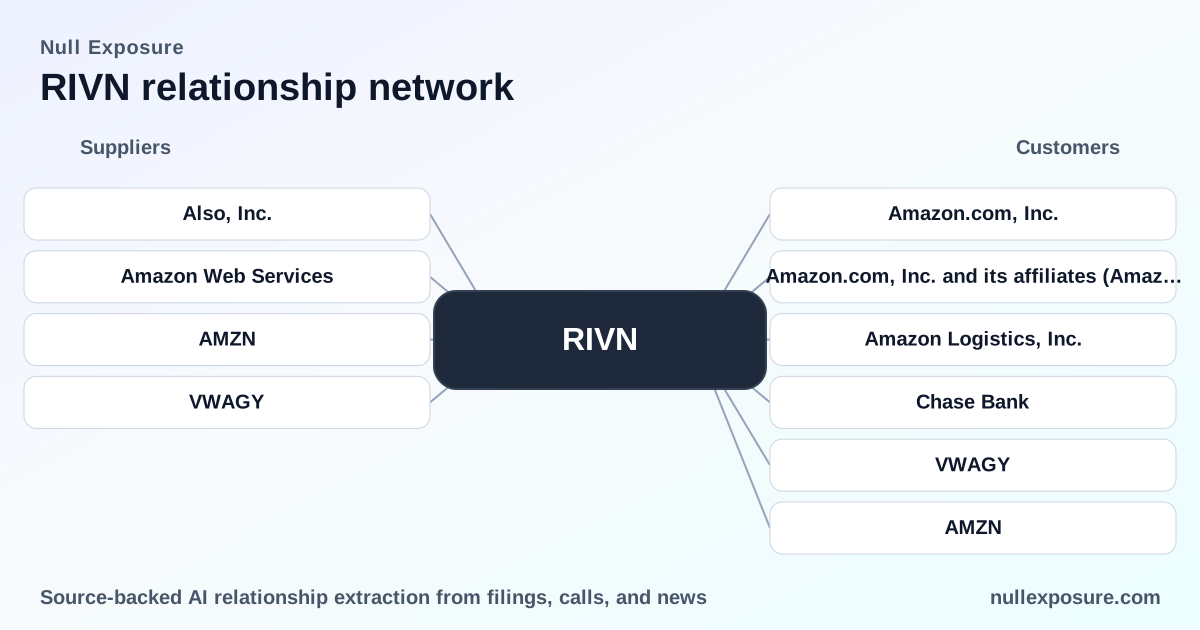
Rivian’s Customer Map: Revenue concentration, strategic partners, and contract posture
Rivian designs, manufactures and sells battery-electric consumer vehicles and commercial vans while monetizing through vehicle sales, recurring software and services (including Connect+), charging infrastructure, and strategic commercial contracts. Revenue today is a mixture of one-off vehicle sales and high-stakes commercial agreements that shift margin mix toward software and services over time. For a concise institutional read on counterparty exposure and contract types visit https://nullexposure.com/.
How Rivian’s customer model actually works — commercial contracts and recurring revenue
Rivian’s operating model combines direct-to-consumer vehicle sales with a concentrated set of large commercial buyers and platform partnerships that deliver higher-margin software and services. Company disclosures and call commentary show a dual posture: transactional sales of core EV products (R1T, R1S, EDV) paired with strategic, long-term commercial arrangements (Amazon EDV, Uber robotaxi commitment, Volkswagen software JV). The business is evolving toward recurring monetization via Connect+ subscriptions, remarketing and JV services, and the company operates its own charging infrastructure (Rivian Adventure Network) to capture ancillary revenue and control customer experience.
Key operating signals:
- Contracting posture: predominantly seller of vehicles (one-off sales) plus a growing set of negotiated commercial and JV contracts that deliver multi-year, milestone-based payments. Evidence of a subscription product (Connect+) indicates development of recurring revenue streams.
- Concentration and criticality: revenues are highly concentrated — a single leasing counterparty (Chase Bank) and Amazon together account for material percentages of automotive revenues in the recent periods, making these relationships strategically critical.
- Geography and maturity: Rivian is global in scope but revenue and assets remain primarily U.S.-centric, suggesting execution and regulatory risk concentrated in North America even as international expansion plans continue.
- Segment mix: core product sales remain primary today, while infrastructure (fast chargers) and software & services (JV with Volkswagen and in-house offerings) are positioned to improve margins over the medium term.
Complete list of customer relationship mentions and concise takeaways
Below are every relationship cited in the collected results, with a one- to two-sentence plain-English summary and the source context.
Chase Bank — large leasing counterparty with immediate revenue impact
Rivian reported that approximately 36% of new EV revenues in 2025 were from sales to Chase Bank, where vehicles are entering leasing arrangements, making Chase a single-source revenue concentration in the near term. This is disclosed in Rivian’s FY2025 Form 10‑K filing. (FY2025 10‑K)
Amazon.com, Inc. — strategic platform customer and EDV co‑developer
Rivian developed the Rivian Commercial Van platform in collaboration with Amazon, identifying Amazon as its first commercial customer and a primary purchaser of EDVs. The FY2025 Form 10‑K explicitly names Amazon in relation to the EDV platform and program development. (FY2025 10‑K)
Amazon Logistics, Inc. — a material source of automotive revenue
Rivian states that a significant portion of automotive revenues has been from Amazon Logistics, indicating Amazon’s logistics arm is a repeat buyer and operational customer. This detail is included in the FY2025 Form 10‑K. (FY2025 10‑K)
Amazon.com, Inc. and its affiliates (Amazon) — multi‑year, material sales figures
Rivian recorded $823 million, $1,040 million, and $900 million of revenue from Amazon and its affiliates in 2023, 2024, and 2025, respectively, primarily tied to EDV sales—clear evidence Amazon is both large and persistent as a buyer. The figures come from Rivian’s Consolidated Statements of Operations disclosed in the FY2025 Form 10‑K. (FY2025 10‑K)
Uber Technologies Inc. — robotaxi supply agreement with milestone funding
News coverage reports a partnership under which Rivian will supply an initial 10,000 fully autonomous R2 robotaxis to Uber, with an option up to 50,000 vehicles and up to $1.25 billion of milestone‑based Uber investment through 2031; the initial tranche includes a $300 million Uber commitment. This characterization is drawn from Sahm Capital reporting in March 2026. (Sahm Capital, March 20–23, 2026)
Uber — commercial demand channel for the R2 platform
Market commentary notes the deal positions Uber as the demand channel while Rivian supplies hardware, making Uber a strategic commercial partner that could scale R2 volume if autonomy and economics validate. Sahm Capital and related March 2026 coverage summarize the arrangement and initial order terms. (Sahm Capital, March 19–25, 2026)
Uber Technologies — phased deployment and city expansion plans
Coverage highlights that the agreement contemplates deployment beginning in 2028 across multiple cities and scaling to several thousand vehicles by 2031 contingent on milestones, underscoring the multi‑year, performance‑conditioned nature of the revenue opportunity. This detail is reported in Sahm Capital’s March 23, 2026 article. (Sahm Capital, March 23, 2026)
Uber Technologies Inc. — investor commentary on strategic valuation impact
Analysts and media noted the $1.25 billion headline and the potential for thousands of R2 vehicles on Uber’s platform, framing the partnership as transformative for Rivian’s growth narrative if execution is successful. This observation appears in Sahm Capital and other March–April 2026 summaries. (Sahm Capital, March–April 2026)
Uber — commercialization framing: demand vs. hardware split
Commentary succinctly summarized industry logic: “Uber brings demand. Rivian brings hardware,” signaling the partnership’s division of responsibilities and the materiality of Uber as a distribution partner for autonomous vehicles. Reported in Sahm Capital coverage. (Sahm Capital, March 20, 2026)
Volkswagen Group — JV as a software & services revenue driver
Rivian disclosed on an earnings call that approximately 60% of its Software and Services revenue was attributable to the joint venture with Volkswagen Group, signaling the JV’s dominant role in that segment. This was stated on the company’s Q4 2025 earnings call. (Q4 2025 earnings call)
Volkswagen — JV kickoff and long‑run software positioning
Market reporting summarized that the joint venture began in November 2024 at a $5.8 billion scope and is expected to implement Rivian software on VW cars by 2027, positioning the JV as a multi‑year pipeline for higher-margin services. This appears in Sahm Capital reporting in February 2026. (Sahm Capital, February 9, 2026)
VWAGY — third‑party coverage of the Volkswagen JV
Third‑party market writeups reiterated the $5.8 billion JV setup and the timeline for Rivian’s software to be embedded in Volkswagen models by 2027, reinforcing the earnings‑call disclosures. This summary is reflected in trading and news commentary tied to the Q4 2025 disclosures and February 2026 reporting. (Sahm Capital & trading commentary, Feb–Mar 2026)
VWAGY — earnings call confirmation of JV contribution to services
The Q4 2025 call restated that the Volkswagen joint venture is responsible for a sizable portion of Software and Services revenue, reinforcing the JV’s contribution to Rivian’s margin profile. (Q4 2025 earnings call)
AMZN (news) — press amplification of automotive segment composition
TradingView coverage summarized that Rivian’s Automotive segment includes consumer vehicles and commercial EDVs developed with Amazon, echoing the company’s 10‑K language and reinforcing Amazon’s centrality to the commercial vehicle strategy. (TradingView, March 2026)
Amazon (news) — broader market reporting on the EDV collaboration
Additional trading and market commentary reiterated that EDV development is a collaborative effort with Amazon, underscoring the outward perception of Amazon as the lead commercial customer. (TradingView, March 2026)
Volkswagen (market writeup) — partnerships as margin lever
Analyst pieces noted Volkswagen and other partnerships as potential sources of higher‑margin software and services revenue, framing the JV as central to Rivian’s path to improved profitability. This perspective is in Sahm Capital coverage from March 2026. (Sahm Capital, March 15, 2026)
What investors should take away
- Concentration risk is real and measurable: Chase Bank and Amazon together represent a material share of recent automotive revenues, creating near‑term dependency on a few counterparties.
- Contract mix is shifting: one‑off EV sales dominate today, but subscription (Connect+), JV services, and milestone‑based commercial deals (Uber, Volkswagen) are converting the business toward recurring and higher‑margin revenue.
- Strategic partnerships are execution bets: the Uber robotaxi and Volkswagen software JV are transformative if milestones, regulatory approvals and integration timelines hold.
For deeper counters and signal tracking across counterparts and contract types, see our platform at https://nullexposure.com/.
Bold strategic relationships and contract types will determine whether Rivian’s revenue concentration converts into durable, diversified profits or remains exposed to a small number of large buyers.