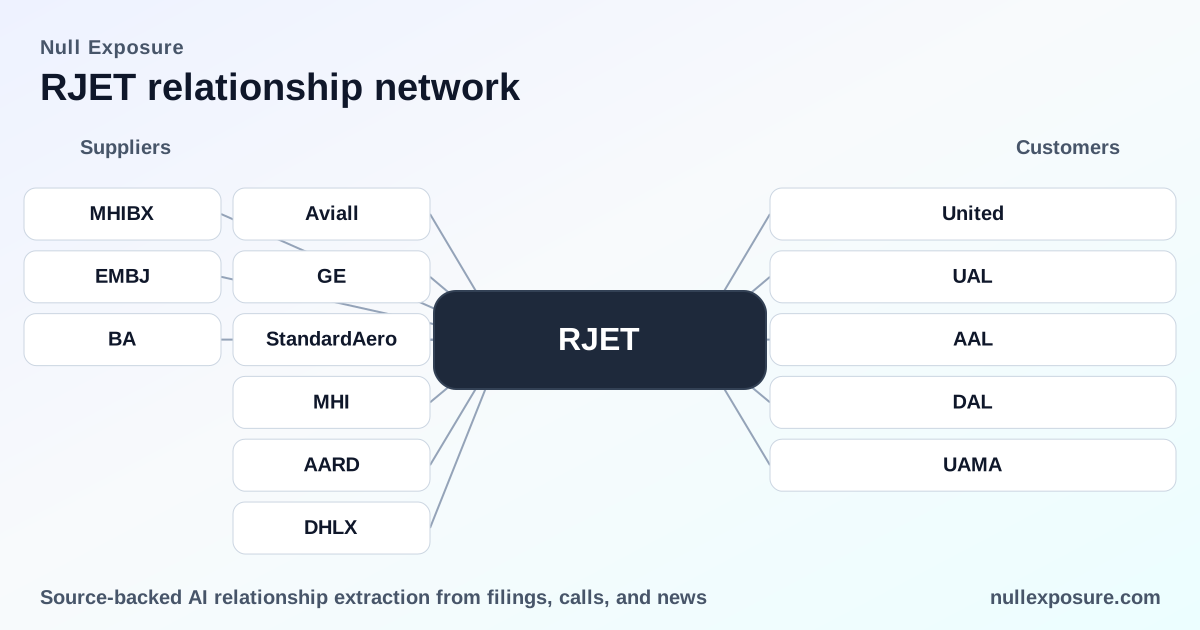
RJET Customer Map: How Republic monetizes flight capacity and where the concentration risk lives
Republic Airways (RJET) operates and monetizes regional flying primarily by contracting its aircraft and crews to major network carriers under capacity purchase agreements (CPAs) that pay guaranteed monthly revenues per aircraft plus fixed fees per flight/block hour and reimbursement of certain direct operating expenses; the company also realizes proceeds from aircraft sales and leases. For investors evaluating counterparty risk, the business is highly concentrated and contract‑driven, with United historically the dominant revenue source and long‑term CPAs setting the cash flow profile. For deeper customer-risk intelligence visit https://nullexposure.com/.
The business model in plain English
Republic functions as a service provider: it supplies aircraft, crews, and operational execution in exchange for predictable contract revenues from major airlines. Revenue streams are dominated by CPAs — fixed monthly guarantees, usage‑linked block‑hour fees and expense reimbursements — and occasional aircraft sale/lease transactions. The FY2024 10‑K documents an Aircraft Purchase Agreement with United (sale of 18 E‑175s) and confirms the CPA structure as the core monetization mechanism (10‑K, FY2024).
- Monetization drivers: guaranteed monthly revenue per aircraft; per‑block‑hour fees for flying; reimbursements of direct operating costs; and asset disposition proceeds.
- Operational posture: Republic is contract‑centric and operates as a captive service provider to its airline partners rather than selling tickets or managing the network.
What the constraints tell investors about risk and resilience
Republic’s operating model produces several disciplined signals for investors:
- Contracting posture — long‑term and revenue‑guaranteed. RJET’s filings document multi‑year CPA amendments with United that extend CPA rate increases and provide guaranteed monthly revenue and block‑hour fee structures (FY2024 10‑K; Sixth Amendment referenced in FY2025 disclosures). This creates predictable cash flow when contracts are intact.
- Concentration — extreme counterparty dependency. United accounted for approximately 97% of consolidated contract revenue in FY2024, a company disclosure that signals single‑counterparty concentration and attendant vulnerability (FY2024 10‑K).
- Criticality — client relationships are business‑critical. The 10‑K states a termination of the United CPA would have a material adverse effect on the company’s prospects and cash flows, underscoring systemic counterparty importance (FY2024 10‑K).
- Relationship role and stage — active service provider under stable CPAs. Republic explicitly positions itself as the flight services provider under the United CPA; the company continues to operate aircraft for its major partners and reports aircraft counts operated under the CPA (earnings call Q4 2025; FY2024 10‑K).
- Geographic footprint and spend scale. The business is North America‑centric (scheduled passenger service across U.S. hubs) and the company recognizes lease and related revenues in the hundreds of millions — a sign of large scale spend and asset monetization ($123.0M recognized lease revenue in FY2024) (FY2024 10‑K).
If you want a short, structured vendor‑risk view of these customer ties, visit https://nullexposure.com/ for further breakdowns.
Relationship roll call — every counterparty documented in the results
United / United Airlines / UAL (variants in sources)
Republic’s largest counterparty is United Airlines under the United CPA: guaranteed monthly revenue per aircraft, fixed per‑flight/block‑hour fees and reimbursement of certain direct operating expenses form the backbone of Republic’s revenue model, and the company sold 18 E‑175s to United on December 31, 2024 as part of aircraft disposition activity. Source: FY2024 10‑K (filed Sep 30, 2024) and related disclosure of the Aircraft Purchase Agreement (FY2024 10‑K).
A later market update and press coverage note that Republic (and its merged counterpart Mesa) operated dozens of E‑175s under the United CPA — the company reported operating 60 large E‑175 jets under the United CPA in a September 2025 quarter summary reported by industry news aggregators. Source: industry news coverage (intellectia.ai / reporting on FY2026 quarter operations, Mar 2026).
United Express
Republic (and related regional operators referenced in the coverage) operate flights under the United Express brand as part of the CPA execution; local business press has characterized Mesa/Republic operations as operating for United Express in earlier reporting. Source: Phoenix Business Journal (news article, Jun 9, 2022).
UAMA / United Airlines, Inc. (documented phrasing in filings)
The FY2024 filing uses alternate legal/ticker‑style references (UAMA / United Airlines, Inc.) in multiple excerpts detailing the same relationship dynamics — aircraft sale, impairment charges, and the 97% revenue concentration tied back to the United CPA for FY2024. Treat these as the same United counterparty documented in the 10‑K. Source: FY2024 10‑K (filed Sep 30, 2024).
American Airlines / AAL / American (variants)
Republic has longstanding partnerships across the major carriers; company remarks and press reporting confirm relationships with American Airlines as a principal CPA partner, with Republic’s fleet diversified across American, Delta and United. Management statements on the Q4 2025 earnings call referenced these long‑standing partnerships explicitly. Source: RJET earnings call Q4 2025 and MarketBeat/Aviation press (Mar–Apr 2026).
Market commentary around 2025–2026 has emphasized that Republic (post‑merger with Mesa in press coverage) will continue to serve American as one of its major partners; news wires reported Republic will keep serving American following corporate transactions. Source: AviationSource/Business Travel Executive reporting (FY2025 coverage, 2025–2026).
Delta Air Lines / DAL / Delta (variants)
Delta is documented as another core CPA partner in Republic’s public remarks and in industry reports summarizing Republic’s service agreements; management and sector press list Delta among the major carriers for which Republic operates under long‑term service agreements. Source: RJET earnings call Q4 2025 and business press articles on the Republic/Mesa merger (FY2025 reporting).
Investment implications and risk checklist
- Positive: Predictable contract cash flows. Long‑term CPAs with guaranteed monthly revenue and block‑hour fees provide predictable revenue when contracts remain in force (FY2024 10‑K).
- Negative: Acute customer concentration. United accounted for ~97% of contract revenue in FY2024; termination or renegotiation of the United CPA would be material to RJET’s cash flow and valuation. Source: FY2024 10‑K.
- Operational leverage and execution risk. As a service provider, Republic’s economics depend on utilization, crew availability and block‑hour performance — items tightly coupled to CPA terms and airline network demand (earnings call Q4 2025; industry press).
- Asset strategy partially offsets risk. Aircraft sales and leases (e.g., December 2024 sale of 18 E‑175s to United) generate discrete proceeds that can shore up balance sheet and reduce fleet risk (FY2024 10‑K).
Bottom line
Republic is a contract‑centric, service‑provider business whose valuation and cash flow profile are overwhelmingly shaped by its CPAs — principally with United — creating both predictability and concentration risk. Investors should underwrite RJET with detailed scenario analysis of CPA continuity, block‑hour utilization, and asset disposition assumptions. For a structured customer‑risk scorecard and further relationship maps, see https://nullexposure.com/.