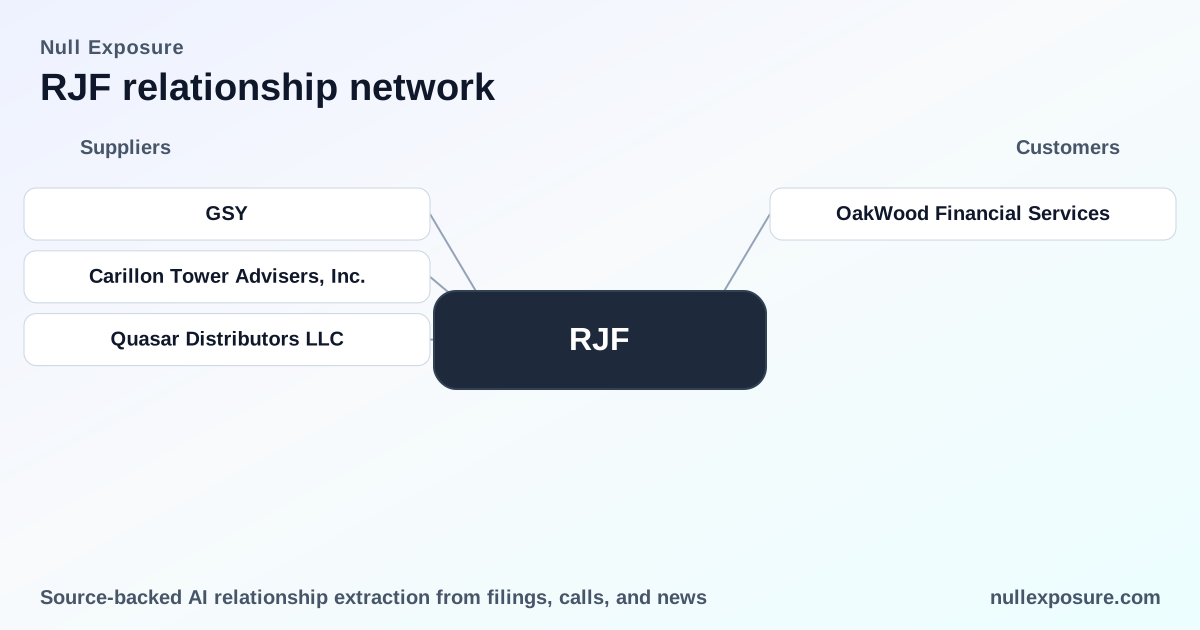
Raymond James Financial (RJF) — customer relationships and dealflow readout
Raymond James is a diversified independent financial services firm that monetizes through advisory and underwriting fees, asset‑based management fees and brokerage/commission income, plus banking interest and fee revenue from corporate lending and custody services. The firm generates recurring asset‑management and transaction fees while supplementing revenues with episodic capital‑markets mandates — a business mix that scales with transaction volumes and assets under administration. For a curated view of RJF client relationships and source links, visit https://nullexposure.com/.
What investors should take away up front
Raymond James operates as an integrated service provider to corporate issuers, financial sponsors, and retail/intermediary clients — acting as underwriter, bookrunner, financial adviser, broker and syndicate participant. The observable relationship set shows a broad capital‑markets footprint across IPOs, secondary offerings, M&A advisory and buyback brokering, and a stable asset‑management/retail franchise that yields recurring subscription‑style fees. No single client drives more than 10% of revenue, indicating low customer concentration but a business that remains transaction‑sensitive to underwriting and advisory activity. Geographic reach is primarily North America with meaningful activity in Canada and Europe, consistent with RJF’s public disclosures.
Constraints and operating‑model signals investors care about
- Contracting posture: The firm earns both recurring asset‑based fees and transactional underwriting/advisory fees; the data shows managed fees that are collected quarterly and are materially tied to account balances — a quasi‑subscription revenue element alongside episodic deal fees.
- Concentration and materiality: Company disclosures explicitly state no client >10% of revenues, signalling diversified counterparty exposure and limited single‑counterparty concentration risk.
- Counterparty mix and criticality: The relationship set spans large enterprise issuers, governments, non‑profits and individual retail clients, confirming RJF’s multi‑segment exposure and dependence on market activity for capital‑markets revenue while its PCG and Asset Management segments provide steady fee income.
- Geography and maturity: Evidence shows RJF operates predominantly in the U.S. with established presences in Canada, the U.K. and parts of Europe, supporting a cross‑border distribution capability for equity and debt offerings.
- Role clarity: The largest signal across relationships is service provider — RJF consistently serves as bookrunner, financial adviser, broker or syndicate manager rather than being a principal counterparty in client businesses.
For more on RJF’s client network and source‑level evidence, visit https://nullexposure.com/.
The relationship list — concise, source‑backed readouts
Below are all relationships observed in the results, one‑line readouts with source context.
- WTTR (WTTR) — Raymond James & Associates sold 1,037,037 shares listed in a Form 424B5 filing (StreetInsider, SEC Form 424B5, 2026).
- American Coastal (ACIC) — Raymond James served as exclusive financial advisor on the Interboro sale and acted as broker for open‑market repurchases completed March 11, 2026 (ReinsuranceNews & GlobeNewswire, 2025–2026).
- First Guaranty Bancshares (FGBIP / FGBI) — Raymond James acted as underwriter for the IPO with co‑managers Keefe Bruyette & Woods and Sterne Agee (MarketBeat, 2014 disclosure / 2025–2026 alerts).
- IO Biotech (IOBT) — IOBT retained Raymond James & Associates as exclusive financial advisor to explore strategic alternatives (company announcement / QuiverQuant, March 2026).
- Blue Owl Capital (OBDC) — Raymond James & Associates acted as co‑financial advisor to the special committee in the Blue Owl merger agreement (PR Newswire / Yahoo Finance, 2026).
- Goldman Sachs BDC (GSBD) — Raymond James participated as a co‑manager on a $400M unsecured notes offering (MarketScreener / FinancialContent, Jan 2026).
- South Plains Financial (SPFI) — Raymond James served as financial advisor and rendered a fairness opinion on the BOH acquisition (Globe and Mail / CityBiz, 2025–2026).
- Lake Shore Bancorp (LSBK) — Raymond James acted as marketing agent for a stock offering and conversion subscription (GlobeNewswire, 2025).
- Hawthorn Bancshares (HWBK) — Raymond James & Associates served as financial advisor on Hawthorn’s acquisition of FSC Bancshares (MarketScreener / GlobeNewswire, 2026).
- MIAX (MIAX) — Raymond James acted as joint bookrunning manager on MIAX secondary public offerings (FXNewsGroup / Futunn / Finviz, 2025–2026).
- Stellus Capital (SCM) — Raymond James & Associates served as lead book‑running manager on a securities offering (Yahoo Finance, 2025).
- New Pacific (NEWP) — Raymond James Ltd. acted as sole bookrunner and co‑lead on an underwritten offering in Canada (PR Newswire / QuantisNow, 2025).
- Nextech/direct preferred (NXDT‑P‑A) — Raymond James Bank provided a short‑term credit facility (company filing via ADVFN, 2021 disclosure referenced).
- Alpine Income Property Trust (PINE) — Raymond James acted as joint book‑running manager on preferred and equity offerings (Yahoo Finance / GlobeNewswire, 2025–2026).
- Capital Product Partners (CPLP) — Raymond James served as financial advisor to a committee in a corporate conversion/simplification matter (Yahoo Finance / Latham & Watkins, 2024–2026 references).
- CTO Realty (CTO) — Raymond James Bank participated among banks providing financing in a syndicated facility (Yahoo Finance, 2025).
- Third Coast Bancshares (TCBX) — Raymond James & Associates acted as financial advisor in a transaction (Yahoo Finance, 2025).
- Veru (VERU) — Raymond James acted as financial advisor in a sale process (Yahoo Finance, 2024).
- SouthState / Independent Bank Group (SSB) — Raymond James served as exclusive financial advisor to SouthState in its acquisition (FortWorthInc / DallasInnovates, 2024).
- PennantPark Floating Rate (PFLT) — Raymond James acted as joint book‑running manager and representative of underwriters on a $200M note issue (press releases / Investing.com, Feb 2026).
- First Hawaiian (FHB) — Raymond James oversaw the transition of FHB’s broker‑dealer platform to Raymond James Financial (MauiNow, 2026).
- Northfield Bancorp (NFBK) — Raymond James & Associates served as financial advisor and delivered a fairness opinion in an acquisition process (Pulse2, 2026).
- Peoples Bank (PEBO) — Raymond James advised Peoples on a branch rebranding following acquisition (RichmondBizSense, 2021).
- Zura Bio (ZURA) — Raymond James served as a co‑lead placement agent on a financing (Markets press release, 2023).
- WesBanco (WSBC) — Raymond James represented WesBanco as financial advisor in a merger transaction (WFIN / press coverage, 2024).
- John Marshall Bancorp (JMSB) — Raymond James initiated coverage on the company’s stock as an investment banking firm (FinancialContent press release, 2026).
- Compass Diversified (CODI / CODI‑P‑B) — Raymond James served as financial advisor on the Sterno divestiture and sale process (GlobeNewswire / QuiverQuant, 2026).
- Microchip Technology (MCHP) — Raymond James hosted/presented Microchip at its Institutional Investors Conference and webcast (GlobeNewswire, Feb 2026).
- CODI‑related (CODI‑P‑B) — Raymond James acted as financial advisor in the Sterno sale disclosure (GlobeNewswire, 2026).
- NeOnc Technologies (DCOMG) — Raymond James & Keefe Bruyette acted as joint book‑running managers on a financing (GlobeNewswire, 2024).
- Casella Waste (CWST) — Raymond James acted as joint book‑running manager on a public offering (GlobeNewswire, 2020).
- Carlyle Secured Lending (CGBD) — Raymond James served as financial advisor to a special committee in a merger (GlobeNewswire, 2024).
- Busey (BUSE) — Raymond James advised Busey and provided a fairness opinion in a strategic transaction (GlobeNewswire, 2024).
- Fidus Investment Corporation (FDUS) — Raymond James served as book‑runner on a $100M notes offering (GlobeNewswire / QuiverQuant, 2025).
- Business First Bancshares (BFST) — Raymond James acted as financial advisor on the acquisition of Progressive Bancorp (GlobeNewswire / CityBiz, 2025–2026).
- First Financial / CedarStone (THFF) — Raymond James advised First Financial on a merger agreement (GlobeNewswire, 2025).
- MV Banking (MVBF) — MVB entered a $20M revolving line with Raymond James Bank (MarketScreener, 2026).
- Farmers National / Middlefield (MBCN) — Raymond James provided advisory services and a fairness opinion, with disclosed fee amounts (MarketScreener, 2026).
- NexMetals (NEXM) — Raymond James Ltd. acted as co‑lead agent on best‑efforts public offerings in Canada (Newsfile, 2025).
- Draganfly (DPRO) — Raymond James Ltd. acted as co‑placement agent on a registered direct offering (StockTitan / QuiverQuant, 2026).
- ACHV (ACHV) — Citizens Capital Markets and Raymond James were listed as underwriters (StockTitan, 2026).
- Tri Counties / TriCo (TCBK) — Brokerage services provided through affiliation with Raymond James Financial Services (Yahoo Finance / TriCo filings, 2026).
- Ligand / Pelthos (LGND) — Raymond James served as financial advisor to Ligand and Pelthos in a combination (Yahoo Finance, 2025).
- Guardian Pharmacy (GRDN) — Raymond James acted as an underwriter on Guardian’s IPO (MarketBeat / Renaissance Capital, 2023–2026).
- Kimbell Royalty (KRP) — Raymond James served as an underwriter on Kimbell’s IPO (MarketBeat, 2026).
- OneWater Marine (ONEW) — Raymond James acted as underwriter for OneWater’s IPO (MarketBeat, 2026).
- NexPoint Real Estate Finance (NREF) — Raymond James served as underwriter alongside peers (MarketBeat, 2026).
- Duluth (DLTH) — Raymond James included among underwriters on Duluth’s offering (MarketBeat / historical press, 2015 & filings).
- Road Construction Partners (ROAD) — Raymond James was an underwriter on ROAD’s IPO (MarketBeat, 2026).
- Ring Energy (REI) — Raymond James acted as exclusive financial advisor in an asset acquisition (CityBiz, 2023).
- AJX / Great Ajax (AJXA) — Raymond James named in underwriting documentation in a 2017 agreement (MarketExclusive historical filing).
- WBI (WBI) — Raymond James & Associates sold shares through a directed share program (SEC filing, 2025).
- Saratoga Investment (SAV) — Raymond James listed among distribution agents in a private placement (Investing.com, 2026).
- Camden National (CAC) — Raymond James served as exclusive financial advisor and provided a fairness opinion for Camden National’s transaction (PenBayPilot, 2024).
- RLJ Lodging Trust (RLJ) — Raymond James Bank participated in credit facilities for RLJ refinancing (CityBiz, 2026).
- Intrepid Potash (IPI) — Raymond James acted as financial advisor in a sale/transaction (Yahoo Finance, 2026).
- ARKO / ARKO Petroleum (ARKO) — Raymond James served as a lead book‑running manager on an IPO for ARKO’s subsidiary (Globe and Mail, 2026).
- OakWood Financial Services — An $800M advisor team joined RJF citing technology and platform access (InvestmentNews / Pulse2, 2026).
- PNFP preferred (PNFP‑P‑B) — Pinnacle partners with Raymond James Financial Services in advisor channel arrangements (InvestmentNews historical, 2024).
- Additional syndicate roles — Across many issuers (AMTB, AMTB co‑managers; CRDL, Cardiol; MNR; GLMD and others) Raymond James appears repeatedly as lead, co‑lead, bookrunner or co‑manager on equity and debt financings (MarketScreener / GlobeNewswire / MarketBeat / historical filings, 2015–2026).
Investor implications and risk factors
- Revenue balance: RJF’s mix of recurring asset‑based fees and one‑off transaction fees cushions revenue volatility but leaves earnings correlated to capital‑markets cycles.
- Low client concentration reduces single‑counterparty risk, while the large number of advisory and underwriting mandates confirms a scalable distribution platform.
- Operational exposure arises from bank lending and syndicate commitments (Raymond James Bank participation), so credit and interest‑rate environments affect non‑fee income.
- Geographic diversification into Canada and Europe supports cross‑border deal origination but adds regulatory and litigation complexity as the firm grows internationally.
If you want the complete, source‑mapped list in tabular form for modeling or diligence, request a downloadable pack at https://nullexposure.com/ and we will prepare a formatted export.