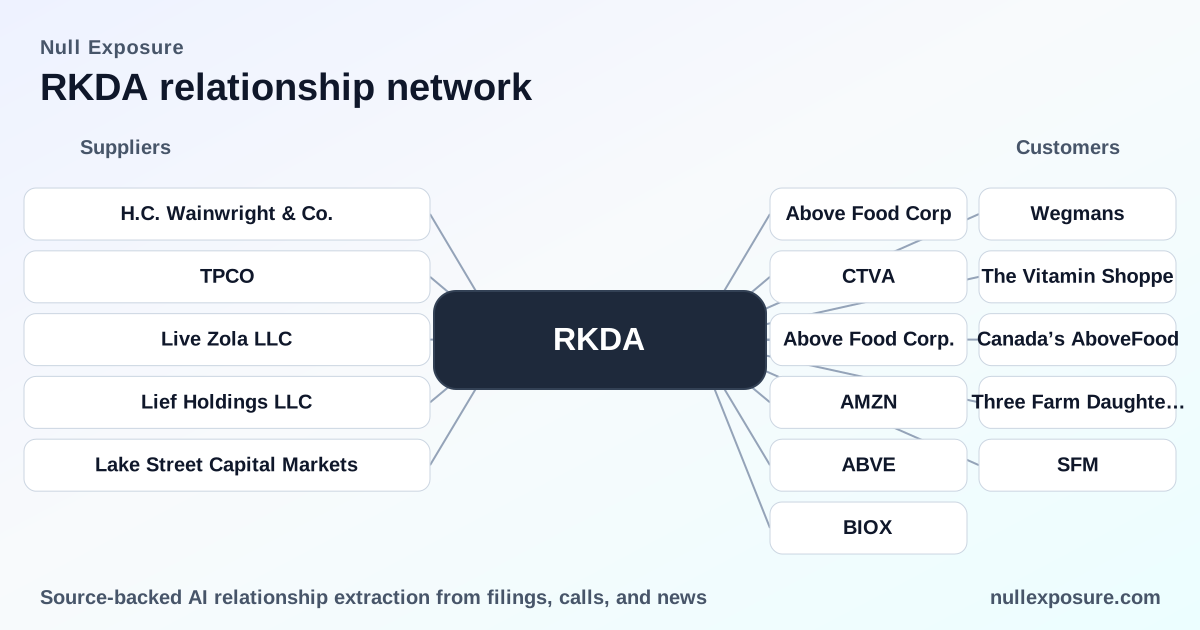
Arcadia Biosciences (RKDA): Customer relationships reshaped by asset sales and selective retail exposure
Arcadia Biosciences operates as a developer and licensor of crop traits and plant-based consumer products, monetizing through a mix of up-front license fees, milestone and royalty income, occasional product sales, and strategic asset dispositions. Over the past two years the company has actively converted intellectual property and consumer brands into cash and equity stakes—transforming its revenue profile from product manufacturing to licensing and one-time monetizations that materially affect earnings and cash flows. For investors and operators evaluating RKDA counterparties, the signal is clear: Arcadia now derives meaningful near-term cash from asset sales while retaining royalty and licensing upside from remaining traits. Learn more at https://nullexposure.com/.
How Arcadia makes money today — concentrated, transactional, and licensing-heavy
Arcadia’s financial statements and news flow show a company in transition. The firm recognizes revenue from product sales on delivery, but license and sale transactions are increasingly prominent: the company records up-front, nonrefundable license fees and recognizes gains on asset sales when completed. The 2024 disposition of the GoodWheat consumer brand was treated as a strategic shift “held for sale” under ASC guidance and is explicitly stated as material to operations. That combination creates a contracting posture that is transactional (spot sales and one‑time disposals) alongside ongoing licensing/royalty arrangements, with geographic revenue concentrated in North America and modest receipts from APAC and LATAM (India, Argentina). Arcadia’s product segment (Zola coconut water and GLA products historically) has been de-emphasized in favor of intellectual property monetization.
Complete roster of counterparties: what each relationship means for RKDA
The following entries cover every counterparty reported in the aggregated results.
-
Corteva Agriscience (CTVA / Corteva) — Arcadia sold a resistant-starch durum wheat trait to Corteva for $4.0 million in a one-time payment, recognized as a gain on sale that materially affected operating results in the referenced periods. This disposition is referenced in multiple company releases and media reports, including Food Business News and Arcadia’s FY2025/2026 filings. (Food Business News, Mar 2026; Arcadia press releases FY2025–FY2026)
-
Above Food / Above Food Ingredients Inc. (ABVE / Above Food Corp / Canada’s AboveFood) — Arcadia sold the GoodWheat consumer brand to Above Food for roughly $3.7–4.0 million in net consideration (May 16, 2024), and continues to hold 2.7 million shares of Above Food Ingredients as partial repayment under a promissory note while pursuing resolution of outstanding balances. The transaction was disclosed in Arcadia’s 2024 Form 10‑K and covered widely in trade press. (Arcadia 2024 Form 10‑K; Food Business News, IGrowNews, Mar 2026)
-
Amazon (AMZN) — GoodWheat consumer SKUs historically reached consumers via Amazon; Arcadia and subsequent press coverage note nationwide availability of GoodWheat Mac & Cheese on Amazon prior to or around the brand sale. That channel provided broad e‑commerce reach for the GoodWheat portfolio. (AI Journ/IGrowNews/Food Business News, FY2024–FY2026)
-
Harris Teeter — GoodWheat Mac & Cheese was distributed into select Harris Teeter stores as part of the retail placement program prior to the asset sale, indicating selective regional supermarket penetration. (AI Journ, FY2024–FY2026)
-
Lowes Foods — Lowes Foods is cited as another select retailer carrying individual GoodWheat Mac & Cheese SKUs prior to the sale, reflecting limited but tangible grocery channel placements. (AI Journ, FY2024–FY2026)
-
Three Farm Daughters — An earlier commercial use of Arcadia’s GoodWheat trait appeared in products from Three Farm Daughters, which leveraged the high‑fiber durum wheat as a formulation ingredient; this is an example of how Arcadia’s traits supported co‑branded or third‑party food product launches. (FoodNavigator‑USA, Mar 2021)
-
Bioceres Crop Solutions Corp (BIOX / Bioceres) — Arcadia recognized a $750,000 gain related to the sale/transfer of certain patents and rights to Bioceres, recorded within fiscal results and described in company releases covering FY2025–FY2026. The Bioceres agreement is presented alongside other IP transfers that produced recognized gains. (Arcadia press release, Nov 2025; GlobeNewswire Mar 2026)
-
Bioseed Research India — Arcadia terminated a license agreement with Bioseed Research India as part of a series of IP and licensing adjustments; the termination was disclosed alongside other IP transfers and had accounting implications reported in FY2025 filings. (Arcadia press release, Nov 2025)
-
Sprouts Farmers Market (SFM) — Following Arcadia’s acquisition of Lief Holdings and related wellness brands, the Provault brand was launched and anchored at Sprouts, demonstrating use of retail partnerships to drive SKU velocity in natural-food channels. (Proactive Investors, FY2021)
-
The Vitamin Shoppe — The Lief acquisition also gave Arcadia access to The Vitamin Shoppe distribution channels as part of a broader retail placement strategy across specialty health retailers. (Proactive Investors, FY2021)
-
Wegmans — Disclosure tied to the Lief acquisition listed Wegmans among the national retail relationships gained through the deal, expanding potential shelf reach for Arcadia’s wellness SKUs. (Proactive Investors, FY2021)
-
Sprouts / Provault brand (SFM / Provault) — The Provault brand product launches and reorder momentum at Sprouts are cited in company reporting, which demonstrates that Arcadia has used brand acquisitions to access structured retail distribution and generate recurring product sales. (Proactive Investors, FY2021)
Each of the above relationship summaries is based on Arcadia’s public filings and contemporaneous press coverage and has influenced reported gains and revenue composition across FY2024–FY2026 (see company 10‑K and GlobeNewswire releases for the most direct accounting context).
Operational constraints and what they signal to investors
Arcadia’s constraint evidence yields several company-level signals about how counterparties and contracts are structured:
-
Contracting posture: licensing and one-off sales dominate. Company disclosures emphasize recognition of up‑front, nonrefundable license fees and milestone payments, and Arcadia has executed several outright asset sales; that points to a business model oriented toward monetizing IP through licensing and strategic disposals rather than large-scale manufacturing commitments.
-
Spot product sales still exist but are secondary. Product revenue recognition on delivery indicates transactional product sales continue (e.g., Zola/GLA historically), but these are not the primary source of the recent material gains.
-
Geographic concentration: North America first, modest APAC/LATAM exposure. Revenue by customer location is heavily skewed to the United States, with small reported receipts from India and Argentina—suggesting limited international operational scale but presence in strategic markets.
-
Relationship criticality and maturity: transitional. The GoodWheat disposal met held-for-sale criteria and materially shifted operations; subsequent shareholdings in counterparties (Above Food stock) indicate transitional settlement mechanics rather than long-term strategic partnerships in all cases.
-
Segment focus: from product manufacturing to core licensing/royalty and brand monetization. The company’s single reporting segment historically centered on product sales, but the recent pattern shows a move toward a licensing‑and‑IP monetization model.
Investment implications and risk map
-
Near‑term earnings will remain lumpy. Gains on asset sales (Corteva, Bioceres, Above Food) have materially affected operating results; predictability depends on the timing and pricing of future IP dispositions.
-
Counterparty credit and settlement risk exists. Arcadia’s partial repayment in Above Food equity and pursuit of outstanding balances illustrate concentration and settlement complexity tied to asset sales.
-
Royalties provide recurring upside but are modest today. Royalty language in filings signals long‑tail revenue potential from retained traits, but current financials show royalties are not yet large enough to offset operating losses.
-
Retail channels remain a value lever for consumer brands. Evidence of placements at Amazon, Sprouts, Harris Teeter, Lowes Foods, Wegmans and The Vitamin Shoppe shows the company can activate shelf presence when holding relevant brands.
For a deeper, source‑level review of counterparties and accounting disclosures, visit https://nullexposure.com/.
Bottom line
Arcadia has repositioned from a product‑centric operator to a company extracting value from intellectual property and selectively monetized consumer brands. Investors should treat RKDA as a licensing/IP monetization vehicle with episodic, material gains and modest recurring product revenues, paying particular attention to counterparty settlement terms and the pace of future license or sale transactions.