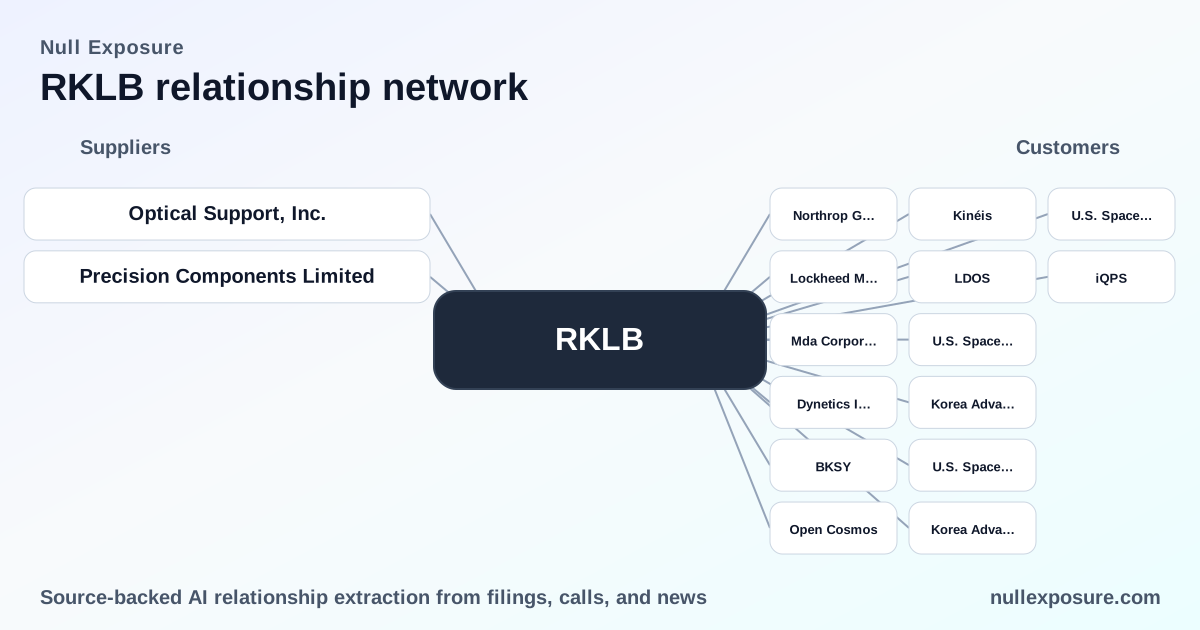
Rocket Lab’s customer map: who pays for Electron, Photon and the space systems stack
Rocket Lab monetizes a dual engine: fee-for-service launches (Electron) and vertically integrated space systems (Photon, components, satellite manufacturing), with an expanding defense backlog that transforms single-ticket launch revenue into multi-year manufacturing and systems contracts. The company sells high-frequency, responsive access to low‑Earth orbit plus spacecraft hardware and on‑orbit services to commercial constellations and national space programs, generating a revenue mix that is service‑heavy but increasingly anchored by large defense awards. For investors evaluating RKLB customer relationships, the mix drives a profile of recurring launch revenue augmented by high‑value, multi‑year defense manufacturing contracts — a combination that supports scale but increases contractual and program delivery risk. Learn more about tracking counterparties and signals at https://nullexposure.com/.
What the customer list tells you at a glance
Rocket Lab’s customer roster spans major defense primes, national space agencies, commercial constellations and academic programs. Government business is material (roughly one‑third of revenues historically) and global commercial partners deliver both recurring launch volumes and one‑off bespoke work. The operating model shows service provider posture (launch and mission integration), manufacturing capability (spacecraft and components) and an active, expanding order book concentrated in a handful of large programs — a structure that supports revenue growth while concentrating program and delivery risk.
Full relationship rollcall — one‑to‑two sentence takeaways
-
Dynetics Inc. — Rocket Lab lists Dynetics as a commercial/industrial customer for satellites and launch services, reflecting engagement with U.S. defense‑oriented system integrators. Source: Rocket Lab FY2024 10‑K (FY2024).
-
Mda Corporation — Rocket Lab’s filings note MDA among international commercial and multinational spacecraft operators that have used its launch services. Source: Rocket Lab FY2024 10‑K (FY2024).
-
Northrop Grumman Space Systems — Large defense primes like Northrop Grumman’s space arm appear on Rocket Lab’s customer list, illustrating the company’s role as a supplier to prime contractor missions. Source: Rocket Lab FY2024 10‑K (FY2024).
-
Lockheed Martin Corporation — Lockheed Martin is named among commercial/manufacturer customers, signaling Rocket Lab’s integration into prime‑level aerospace supply chains. Source: Rocket Lab FY2024 10‑K (FY2024).
-
BlackSky Technology Inc. (BKSY / BlackSky) — Multiple 2026 press releases and Rocket Lab statements confirm a new multi‑launch agreement (four dedicated Electron missions), bringing BlackSky’s total booked missions with Rocket Lab to 17 and reinforcing Rocket Lab as BlackSky’s primary launch provider. Source: GlobeNewswire and Rocket Lab press releases, March 2026; Yahoo Finance coverage (Mar 2026).
-
SDA / U.S. Space Development Agency — Rocket Lab has secured an $816 million SDA contract to build satellites, and public reporting frames SDA business as a major anchor of the company’s backlog. Source: Ad‑hoc News and RollingOut coverage; multiple March 2026 news items.
-
Japan Aerospace Exploration Agency (JAXA) — Rocket Lab completed dedicated Electron missions for JAXA in 2026, demonstrating repeat national agency business in Japan. Source: Rocket Lab mission updates and GlobeNewswire releases, April–May 2026.
-
Open Cosmos — Rocket Lab executed a first‑time dedicated launch for Open Cosmos in early 2026, confirming the company’s ability to attract new commercial constellation customers. Source: GlobeNewswire mission release, Jan 2026.
-
Institute for Q‑shu Pioneers of Space, Inc (iQPS) — Rocket Lab announced a multi‑launch extension with iQPS, positioning Rocket Lab as iQPS’ primary launch provider with additional missions beginning in 2028. Source: Rocket Lab press release and GlobeNewswire, April 2026.
-
Kinéis — Rocket Lab deployed five IoT satellites for French operator Kinéis on an Electron mission, reflecting commercial, international constellation work. Source: ASDNews coverage (June 2024 referenced in 2026 reporting).
-
Synspective — Rocket Lab has executed multiple missions for Synspective, with Rocket Lab citing an 8th mission and continued dedicated support in 2026. Source: Rocket Lab updates and StockTwits reporting, March–May 2026.
-
European Space Agency (ESA) — Rocket Lab completed its first dedicated launch for ESA in March 2026, marking entry into repeat missions for a major international space agency. Source: GlobeNewswire mission release, Mar 28, 2026.
-
NASA — Rocket Lab’s public materials and mission statements highlight NASA as a repeat national program customer, used to demonstrate Electron’s role in national space programs. Source: GlobeNewswire mission announcements and Rocket Lab press material, 2026.
-
U.S. Space Force — Industry reporting in 2026 credits Rocket Lab with a large contract from U.S. Space Force and other US defense entities as part of the company’s defense‑oriented backlog. Source: Intellectia.ai and broader 2026 reporting.
-
Korea Advanced Institute of Science and Technology (KAIST) — Rocket Lab launched an Earth‑observation satellite for KAIST in early 2026, showing university‑led constellation work and regional diversification in Asia. Source: Futunn / Ad‑hoc News reporting, Mar 2026.
-
U.S. Department of Defense (DoD) — Rocket Lab’s public statements and filings reference the U.S. DoD among core government customers, and media coverage reports multiple DoD‑related tasking and test flight agreements in 2026. Source: Rocket Lab FY2024 10‑K and 2026 press coverage.
-
Leidos (LDOS) — Coverage of Rocket Lab’s defense progress references Leidos as a customer on early hypersonic and defense missions, illustrating prime/subcontract relationships. Source: SatNews reporting, Feb–Mar 2026.
-
Kratos Defense (KTOS) — Rocket Lab participates in tasking led by Kratos for hypersonic test flights, with Kratos identified as lead contractor in public reporting on MACH‑TB 2.0 work. Source: StockTwits and March 2026 reporting.
-
KASA — Rocket Lab lists national programs including KASA (Korean Aerospace agency) among successful mission partners in 2026 mission releases. Source: Rocket Lab GlobeNewswire mission materials, Mar 2026.
-
Space Development Agency (alternate listings) — Multiple outlets report SDA awards and Rocket Lab backlog impacts; the company frequently lists SDA among the largest program customers driving backlog growth. Source: 247WallSt, TradingKey, and other March–May 2026 coverage.
(Each relationship above is documented in Rocket Lab press releases, its FY2024 10‑K, and contemporaneous 2026 media reporting referenced in the company’s public updates.)
How these relationships shape Rocket Lab’s operating profile
-
Contracting posture: Rocket Lab operates chiefly as a service provider for launch and mission integration, while simultaneously acting as a manufacturer for spacecraft and components. The company combines transactional launch revenues with programmatic manufacturing contracts, especially on defense work.
-
Concentration and criticality: Government and prime‑contract relationships are material — Rocket Lab reported roughly one‑third of revenues historically tied to U.S. government and prime contractor work, and 2026 headlines show multi‑hundred million‑dollar defense awards anchoring backlog. That creates high criticality around a smaller set of large customers even as commercial volume broadens.
-
Revenue mix and maturity: The business mixes recurring commercial launch volume (BlackSky, Synspective, Kinéis, Open Cosmos, iQPS) with multi‑year, high‑value defense programs (SDA, Space Force, DoD task orders). This hybrid supports scale but increases program management and delivery maturity requirements.
-
Segments: Evidence supports hardware (spacecraft & components), manufacturing, and services (launch, on‑orbit management) as core segments; Rocket Lab’s disclosures and mission activity show active capability across all three.
Investor implications and risk framing
-
Upside: Repeat commercial customers (e.g., BlackSky’s 17 missions) validate Electron as a high‑frequency provider and underpin predictable launch revenue; large SDA/DoD manufacturing awards expand addressable revenue and margin potential.
-
Key risks: Program concentration, delivery execution, and defense program timing are the primary risk vectors. Large government contracts raise revenue visibility but increase exposure to schedule slippage, cost growth and contracting complexity.
-
What to watch next: launch cadence, backlog composition (commercial vs. defense), and execution on SDA and Space Force programs.
For a structured, research‑grade view of counterparties and constraints across RKLB’s customer base, see how we track contracts and program signals at https://nullexposure.com/.