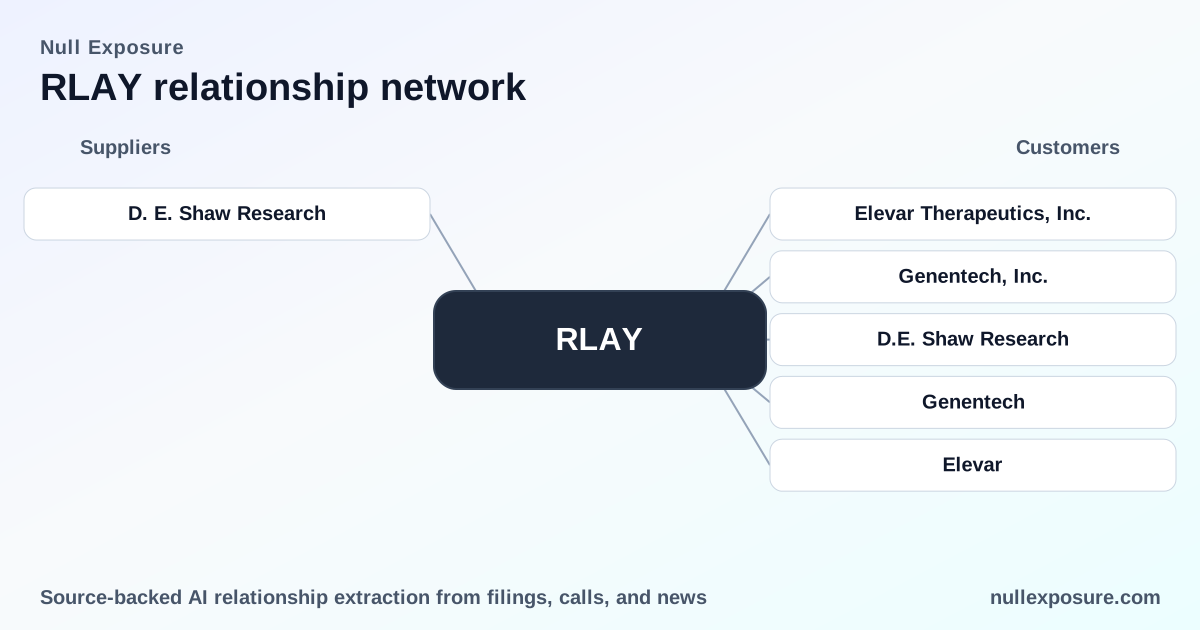
Relay Therapeutics (RLAY): Licensing-driven revenue and partner concentration define near‑term value
Relay Therapeutics operates as a clinical‑stage precision drug company that generates cash primarily through collaboration and licensing agreements rather than product sales. The firm advances discovery‑stage assets and monetizes through out‑licensing selective programs (notably lirafugratinib/RLY‑4008) and collaboration fee structures with large biopharma partners; recent financials show license receipts are the primary revenue line while the company continues to operate at a clinical‑stage expense profile. For primary source detail, see Relay’s FY2024 Form 10‑K and subsequent investor releases on 4Q/Full‑Year 2025 results (March 2026).
For a concise view of relational exposures and commercial posture, visit https://nullexposure.com/.
Licensing, not commercialization: how Relay gets paid today
Relay’s operating model emphasizes discovery and early clinical validation, then monetizing through exclusive licenses and collaboration agreements rather than building a broad commercial engine. The company’s FY2024 filing documents an exclusive license to Elevar Therapeutics for lirafugratinib (RLY‑4008) and a previously executed collaboration and license agreement with Genentech for migoprotafib (RLY‑1971). Those agreements drive the bulk of reported revenue and shape capital allocation: R&D spending remains the cost center while partner payments fund operations. (Source: Relay Therapeutics FY2024 Form 10‑K.)
The company also signals how it accounts for upfront and milestone receipts: upfront payments from licensing arrangements are treated as license revenue rather than financing, reflecting that the transfers compensate past R&D rather than purchase future services. This is a company‑level disclosure about contract type and revenue recognition, not an attribute of any single partner. (Source: Relay Therapeutics FY2024 Form 10‑K.)
What this means for investors: structural constraints and model characteristics
- Contracting posture: Relay is an out‑licensor. Revenue depends on structured license and collaboration terms (upfront, milestones, royalties) instead of recurring product sales. This creates lumpy revenue timing tied to partner milestones and regulatory outcomes.
- Concentration: The partner roster is small and dominated by large biopharma transactions (Genentech) and targeted biotechs (Elevar). A handful of counterparties therefore materially influence reported revenue and near‑term cash flow.
- Criticality: Licensed assets are critical value drivers. The out‑licensed FGFR2 inhibitor and other programs represent the primary assets through which value crystallizes for shareholders.
- Maturity: Relay is clinical‑stage; commercial execution is primarily the partner’s responsibility post‑license. Revenue maturity is early — current receipts are licensing proceeds, not recurring product revenue.
These characteristics create a profile where clinical and regulatory catalysts at partner firms convert into discrete revenue events for Relay, while downside remains linked to program progression and partner execution.
Counterparty relationships and what they imply for revenue
Elevar Therapeutics, Inc.
Relay granted Elevar an exclusive global license for lirafugratinib (RLY‑4008) in December 2024, transferring development and commercialization rights for that FGFR2 inhibitor. This out‑license is a clear example of Relay’s strategy to monetize validated assets through exclusive licensing. (Source: Relay Therapeutics FY2024 Form 10‑K, December 2024.)
An investor update covering fourth‑quarter and full‑year 2025 results confirmed that revenue recognized in current year periods came under the Exclusive License Agreement with Elevar, indicating Elevar payments became a material near‑term revenue source for Relay. (Source: InvestingNews press release on Relay’s 4Q/Full‑Year 2025 results, March 2026.)
Genentech, Inc.
Relay entered a Collaboration and License Agreement with Genentech in December 2020 that licensed migoprotafib (formerly RLY‑1971) to Genentech for development and commercialization. This agreement exemplifies Relay’s approach of partnering with large biopharma to advance select clinical programs. (Source: Relay Therapeutics FY2024 Form 10‑K, referencing the Genentech Agreement, December 2020.)
Investor reporting for 2025 also notes that revenue reported in prior periods was recognized under the Genentech collaboration, underscoring that Genentech represented a meaningful historical revenue contributor to Relay’s financial statements. (Source: InvestingNews press release on Relay’s 4Q/Full‑Year 2025 results, March 2026.)
D.E. Shaw Research
Third‑party reporting characterizes Relay’s revenue model as driven by collaboration and license agreements with partners such as Genentech and D.E. Shaw Research, positioning these entities as contributors to Relay’s funding streams and strategic operations. This naming reflects market commentary that D.E. Shaw Research is among the partners referenced in investor communications as part of Relay’s collaboration mix. (Source: Globe and Mail / Motley Fool reporting summarizing Relay’s business model and partner set, March 2026.)
Investment implications: growth levers and risks
Relay’s value realization is binary‑catalyst driven and partner‑dependent. For investors and operators evaluating customer exposure, prioritize the following:
- Catalyst timeline: Upcoming regulatory decisions, milestone triggers, and Elevar/Genentech program progress will produce lumpy revenue steps; forecast models must treat partner payments as discrete events.
- Counterparty credit and execution: A successful commercial launch or robust development program at Elevar or Genentech materially increases expected royalty streams; conversely, delays or program terminations compress revenue and can force additional capital raises.
- Concentration risk: With revenue dominated by a small number of licensees, adverse outcomes at any single partner cause pronounced financial volatility.
- Accounting clarity: The company’s explicit treatment of license proceeds as revenue (not financing) clarifies near‑term recognition but reinforces the non‑recurring nature of the cash flow line.
Key points for diligence:
- Review license payment schedules and milestone timing within partner agreements where available.
- Monitor partner trial readouts and regulatory filings that unlock license milestones.
- Watch relay’s disclosures for any new collaborations that diversify revenue concentration.
Final takeaways for investors
- Relay is a clinical‑stage innovator that monetizes primarily via exclusive licensing and strategic collaborations. The Elevar and Genentech agreements illustrate the company’s playbook: de‑risk assets through development and capture value through partner transactions. (Source: Relay FY2024 10‑K; InvestingNews March 2026.)
- Revenue is lumpy and partner‑dependent; concentration risk and milestone timing are the dominant valuation variables. Investors should underwrite specific partner outcomes rather than assume steady revenue growth.
- For a streamlined view of Relay’s counterparty exposures and how they affect valuation models, see the relational analysis at https://nullexposure.com/.
If you want a tailored exposure report that maps Relay’s partner payment schedules to cash‑flow scenarios, visit https://nullexposure.com/ for customized analysis and data-driven partner risk scoring.