RLI Corp: Specialty insurer with predictable premium economics and selective InsurTech partnerships
RLI Corp underwrites select property, casualty and surety products through a focused, specialty-insurance model and monetizes by collecting premiums that are recognized ratably over the typical one-year policy term, supplemented by investment income from the float. With roughly $1.9 billion in trailing twelve-month revenue and a 20.8% profit margin, RLI’s economics are driven by underwriting discipline in niche commercial and surety markets and by maintaining an incumbent balance-sheet role for partners that need capacity or fronting. For a concise view of RLI’s product and corporate positioning, visit https://nullexposure.com/.
Financial snapshot and investor context
- Market capitalization: $4.66 billion.
- Revenue TTM: $1.898 billion; Profit margin: 20.8%; Return on equity: 23.2% (latest quarterly data to 2026-03-31).
- Business model: Specialty admitted and excess & surplus lines; three primary operating segments—property, casualty, and surety—focused on U.S. risk and with no material foreign operations.
How RLI’s operating model constrains and defines growth RLI’s operating characteristics are coherent and meaningful for investors evaluating customer and partner exposures:
- Contracting posture (short-term, predictable revenue recognition): RLI writes policies that are short-term in nature and generally earned over a one-year period, producing predictable, ratable premium recognition that insulates near-term revenue from multi-year lock-in risk. This cadence supports underwriting discipline and quarterly visibility in earned premium flows.
- Counterparty mix (mid-market to large enterprise): The company underwrites both small-to-mid-market contract surety coverages and commercial surety for medium to large enterprises, giving RLI a diversified institutional client base across construction, financial, healthcare, energy and renewable sectors.
- Geographic concentration (domestic-focused): All material operations and long-lived assets are U.S.-based; RLI reports no material foreign operations, which reduces cross-border regulatory complexity but concentrates exposure to U.S. market cycles and catastrophe patterns.
- Role and criticality (seller and capacity provider): RLI acts as an insurer/seller and balance-sheet provider for partners and programs—it underwrites specialty lines and provides capacity that other distribution partners leverage. This makes RLI a critical capital partner for InsurTechs and program administrators seeking an admitted or specialty carrier.
- Maturity and materiality signals: The company’s reporting indicates mature segments with established underwriting revenues; foreign expansion is not a material driver. Premiums earned and segment reporting show an operationally mature U.S.-centric specialty insurer.
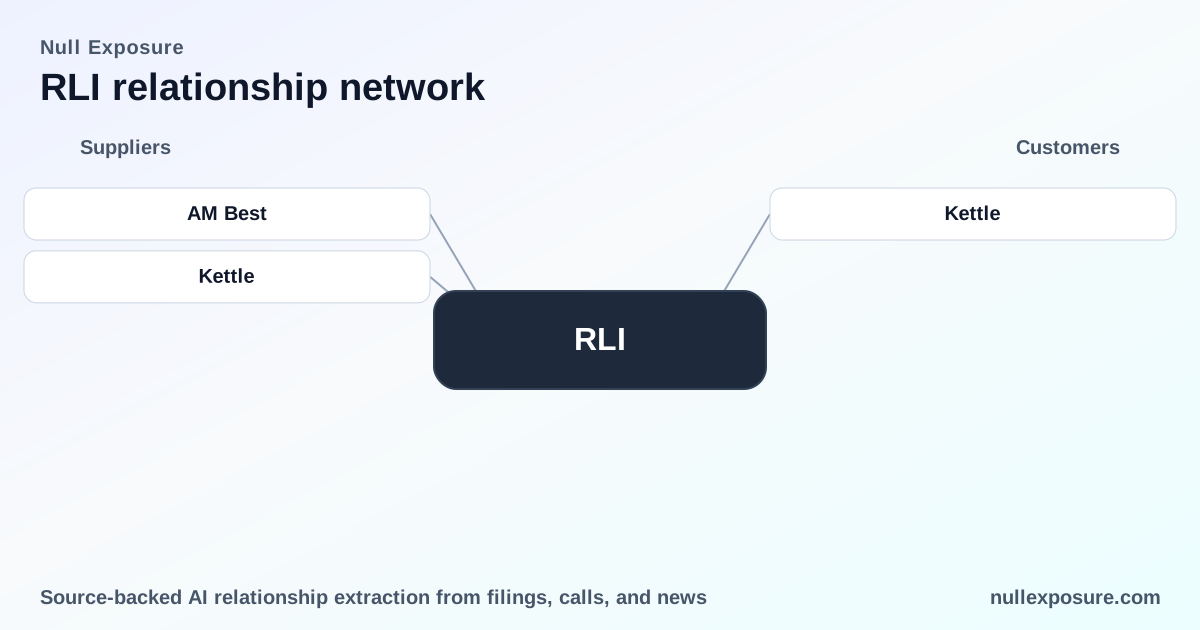
Direct customer and partner relationships: what to know Below I cover every customer relationship identified in the latest market signals and what each partnership indicates for RLI’s strategy and risk profile.
Kettle — wildfire-focused commercial property program
RLI provides underwriting capacity and balance-sheet support to Kettle’s wildfire-focused commercial property offering, combining Kettle’s AI-driven catastrophe modeling with RLI’s underwriting expertise. This is a programmatic partnership where RLI supplies capacity and underwriting governance while leveraging Kettle’s modeling to price difficult catastrophe risk. According to a BeInsure article dated March 10, 2026, Kettle’s CEO described the program as a blend of the insurtech’s modeling and RLI’s underwriting and balance-sheet support (BeInsure, March 10, 2026).
Steadily — nationwide landlord insurance expansion
RLI has partnered with landlord-focused InsurTech Steadily to expand access to landlord insurance across the U.S., providing the specialty insurer role behind Steadily’s distribution. This relationship reflects RLI’s strategy to scale niche product lines via technology-enabled distribution partners while keeping underwriting and capital on its balance sheet. Fintech.Global reported on April 15, 2026 that Steadily partnered with RLI to expand landlord insurance nationwide (Fintech.Global, April 15, 2026).
Strategic and financial implications of these partnerships
- Distribution leverage without distribution cost: RLI’s partnerships with Kettle and Steadily show repeated use of RLI’s balance sheet to scale partner-led distribution. This allows RLI to capture underwriting margin and investment income while partners handle customer acquisition and digital front-ends.
- Selective exposure to catastrophe and concentration risk: The Kettle program places RLI into wildfire-exposed commercial property lines; pricing and modeling sophistication are central to mitigating loss volatility. Given RLI’s domestic concentration and one-year policy structure, catastrophe modeling and reinsurance purchasing become core controls for underwriting adequacy.
- Diversification across partners and segments: Steadily addresses the landlord insurance niche while Kettle targets catastrophe-exposed commercial property—together these relationships indicate diversification across product niches rather than dependence on a single partner or market.
- Capital and underwriting discipline matter: Because RLI recognizes premiums ratably over one-year policies and plays a balance-sheet role, capital allocation and reinsurance strategies will directly determine how aggressive RLI can be in scaling partner programs without degrading combined ratios or return metrics.
Risks and investor considerations
- Underwriting cyclicality: Short-term contracts expose RLI to immediate renewal compression or loss-creep in a given year; underwriting discipline is essential to sustain current margins.
- Concentration to U.S. catastrophe exposure: With no material foreign operations, RLI’s P&C book is sensitive to U.S. catastrophe frequency and severity, increasing the importance of sophisticated catastrophe models and reinsurance.
- Dependence on partner underwriting controls: Program underwriting involves operational reliance on partner data and pricing algorithms; RLI’s risk control is effective only if partner modeling and data governance meet insurer standards.
Conclusion: high-alpha underwriting with measured distribution partnerships RLI operates as a capital-centric specialty insurer that monetizes by underwriting tailored lines, earning ratable premium income over one-year policies, and selling capacity into partner-led programs. The Kettle and Steadily relationships demonstrate a repeatable model: provide balance-sheet capacity and underwriting oversight to technology-native distributors, capture underwriting margins, and preserve capital discipline. For investors assessing RLI’s customer risk, the central questions are how RLI manages catastrophe exposure and how it prices and reinsures partner programs while maintaining ROE and combined ratio targets.
If you want a concise ledger of who RLI is partnering with and why it matters for underwriting exposure, see the firm overview at https://nullexposure.com/. For deeper coverage of RLI’s partner programs and the evolving marketplace for insurer-engineered InsurTech capacity, visit https://nullexposure.com/ for continuing analyst commentary.