RLJ Lodging Trust: portfolio-driven revenues, asset rotations, and transient demand dynamics
RLJ Lodging Trust operates as a publicly traded REIT that owns and operates premium-brand, focused-service and compact full-service hotels across the United States, monetizing principally through room revenue, food & beverage sales, hotel operations and periodic property dispositions. Investors should view RLJ as a hotel-operator/asset-holder whose earnings are driven by occupancy and average daily rate (ADR) variability, supplemented by strategic dispositions of individual assets to recycle capital. For an at-a-glance view of our coverage and sourcing, visit https://nullexposure.com/.
How RLJ’s customer relationships and contracts actually work
RLJ’s commercial model blends short-term transactional customer demand with longer-term contractual arrangements at the asset level. Public filings and commentary establish a mixed contracting posture: the company earns the bulk of revenue from transient individual travelers who book rooms on short stays, while certain ownership structures — notably TRS leases — carry multi-year initial lease terms with multiple renewal options, revealing an institutional-level long-term posture on some assets.
Key company-level signals:
- Contracting posture: TRS leases have initial terms generally of three years with multiple renewal options, indicating institutional long-term arrangements for a subset of assets, while the customer base itself is predominantly short-term transient demand.
- Customer type and criticality: The majority of customers are individual business and leisure travelers, making room revenue the primary driver of cash flow.
- Geographic footprint: RLJ’s portfolio is concentrated in North America — 96 properties across 23 states and Washington, D.C., which concentrates exposure to U.S. travel cycles.
- Revenue concentration: Room revenue represented ~81.9% of total revenues for FY2024, underscoring dependence on occupancy and ADR.
- Role and activity: The company functions both as an operator/service provider (hotel operations, F&B) and as an asset seller when management executes dispositions; property sales commonly occur in the $10m–$100m range.
- Maturity and stage: Substantially all revenue is derived from hotel operations, indicating active, operational relationships with end customers rather than passive investment-only exposure.
These characteristics translate to an operating profile where top-line volatility tracks travel patterns and pricing, and where asset rotations provide opportunistic balance-sheet returns.
What public reporting lists as RLJ’s customer or counterparty relationships
Scenic Capital Advisors, LLC — buyer of Dallas Love Field Embassy Suites
RLJ sold the 248-key Embassy Suites by Hilton Dallas Love Field to Austin-based Scenic Capital Advisors, LLC in a transaction reported in early May 2026, reflecting RLJ’s ongoing asset rotation strategy and willingness to monetize individual properties through outright sale. According to Hotel Investment Today (May 3, 2026), Scenic Capital acquired that asset from an RLJ affiliate for an undisclosed amount.
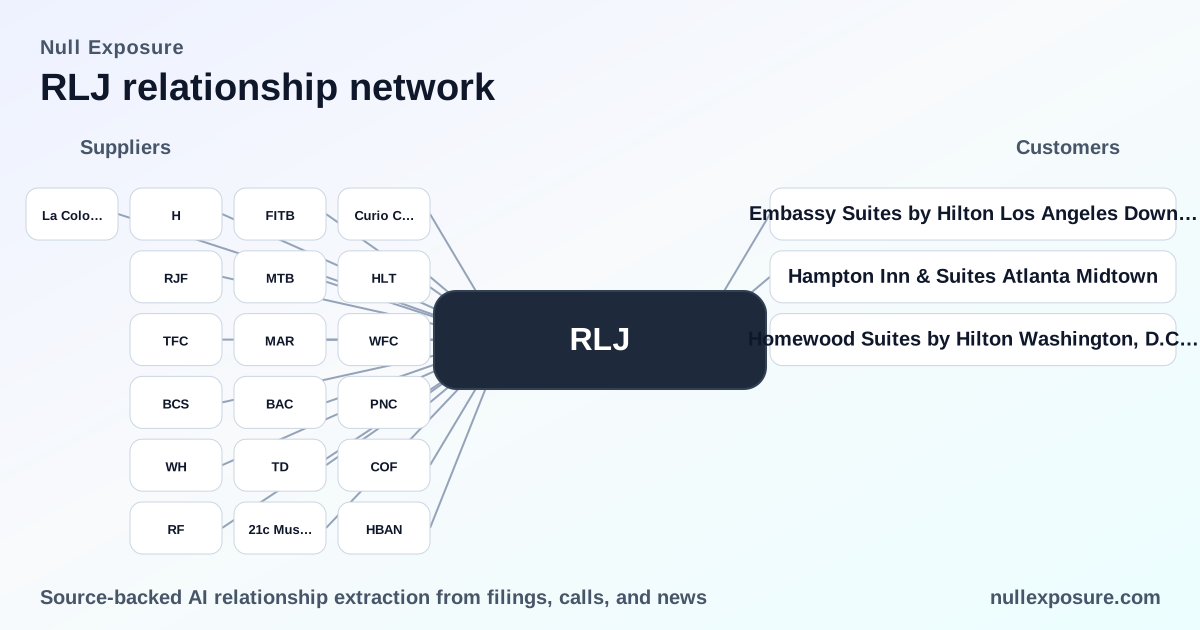
Embassy Suites by Hilton Los Angeles Downey — RLJ-owned, recently renovated all-suites property
TravelNoire highlighted the Embassy Suites Los Angeles Downey as a recently renovated, RLJ-owned all-suites hotel positioned for leisure and cultural travel; that coverage positions the property as part of RLJ’s premium-focused, higher-margin room inventory (TravelNoire, March 10, 2026).
Hampton Inn & Suites Atlanta Midtown — RLJ-owned branded asset in a key urban submarket
TravelNoire lists the Hampton Inn & Suites Atlanta Midtown as owned by RLJ Lodging Trust, describing the hotel’s appeal in Midtown Atlanta and its rooftop amenities; this citation underscores RLJ’s exposure to urban-center business and leisure demand (TravelNoire, March 10, 2026).
Homewood Suites by Hilton Washington, D.C. Downtown — RLJ-owned extended-stay/ suite asset
TravelNoire identifies the Homewood Suites Washington, D.C. Downtown as an RLJ-owned property offering suite-style accommodations with full in-suite kitchens, representative of the company’s exposure to extended-stay and business-traveler segments (TravelNoire, March 10, 2026).
What these relationships imply for investors and operators
RLJ’s cited relationships and transactions together sketch a company operating two simultaneous plays: capture high-margin room revenue from transient and extended-stay guests, and manage the portfolio actively through selective dispositions to optimize balance-sheet metrics. The May 2026 sale of the Dallas Embassy Suites demonstrates the company’s practice of monetizing discrete assets when market or portfolio strategies dictate. The TravelNoire mentions of multiple RLJ-owned branded hotels confirm an operating footprint composed of branded, premium-oriented assets that command higher ADRs and require periodic renovation and brand investment.
Operational and investment implications:
- Revenue sensitivity: With room revenue accounting for the vast majority of sales, RLJ is tightly correlated to U.S. travel demand cycles and ADR trends; operators must prioritize revenue management and distribution strategies.
- Capital recycling: Property sales in the reported range support a strategy of rebasing the portfolio to fund capex or reduce leverage, but also introduce gains/losses volatility.
- Customer mix: The dominance of transient individual customers reduces counterparty credit risk but increases exposure to macro travel shocks and seasonality.
- Geographic concentration: A U.S.-centric footprint concentrates macro/regional travel risk rather than providing international diversification.
Investment checklist — concise takeaways for decision-makers
- Core driver: Room revenue is the single most important revenue source (≈81.9% in FY2024) — performance depends on occupancy and ADR execution.
- Active asset manager: RLJ demonstrates disciplined dispositions (example: Dallas Embassy Suites sale) consistent with a portfolio-management approach rather than a buy-and-hold-only REIT.
- Customer profile: Predominantly individual transient and extended-stay guests, so demand-side shocks translate quickly to P&L.
- Contract mix: Company-level contracts include long-term TRS leases at the asset level alongside predominantly short-term customer stays.
- Scale of disposals: Sales evidence aligns with the $10m–$100m transaction band, indicating mid-cap hotel asset transfer activity.
- Geographic exposure: Concentrated in 23 U.S. states and D.C., making domestic travel trends the key macro factor.
For a consolidated view of RLJ’s customer and portfolio activity, visit https://nullexposure.com/ to see how these patterns compare across peers.
RLJ’s model is straightforward: operate branded, higher-margin U.S. hotels, optimize revenues through rate/occupancy and selectively sell assets to manage returns. That combination defines both the upside during travel expansions and the principal downside during demand contractions — a classic, portfolio-driven lodging REIT profile.