RLJ-P-A: Operator Concentration Underpins Preferred Share Income Thesis
RLJ Lodging Trust operates as an owner-operator REIT that monetizes a portfolio of upscale hotel real estate through long-term management and franchise relationships with global brands, generating stable contract-level cash flows that support preferred dividends. The RLJ-P-A series is a cumulative convertible preferred that delivers income-oriented exposure to those cash flows while preserving upside optionality through conversion features. For investors focused on counterparty risk, the operator roster driving room-revenue and brand distribution is the single most important input to underwrite dividend persistence and franchise-management execution. Learn more at https://nullexposure.com/.
Why operator relationships matter for RLJ-P-A holders
RLJ Lodging Trust’s economics are heavily influenced by the operating and branding decisions made by global chains that manage or franchise hotel assets. When a small number of global operators control the revenue-generating brand and reservation flows, counterparty concentration becomes a direct financial risk—affecting RevPAR, management fee mechanics, and marketing distribution. For preferred-share investors, the key metrics are not the common-equity growth story but the persistence and predictability of cash distributions that feed the preferred dividend.
- Concentration: High concentration under a few operators concentrates execution risk and creates single points of failure for booking, loyalty-program demand, and brand repositioning decisions.
- Contracting posture: RLJ’s relationships with major brands typically consist of franchise or management agreements; these contracts define fee structures, capital-reinvestment obligations, and termination rights that ultimately determine net cash flow to the landlord.
- Criticality: Top-tier global brands are mission-critical to demand capture in upscale segments; operator decisions on brand standards and renovation schedules drive capital cadence.
- Maturity: Partnerships with long-established franchisors create a degree of operational stability and predictability in cash flow timing and predictability.
Snapshot of reported operator concentration
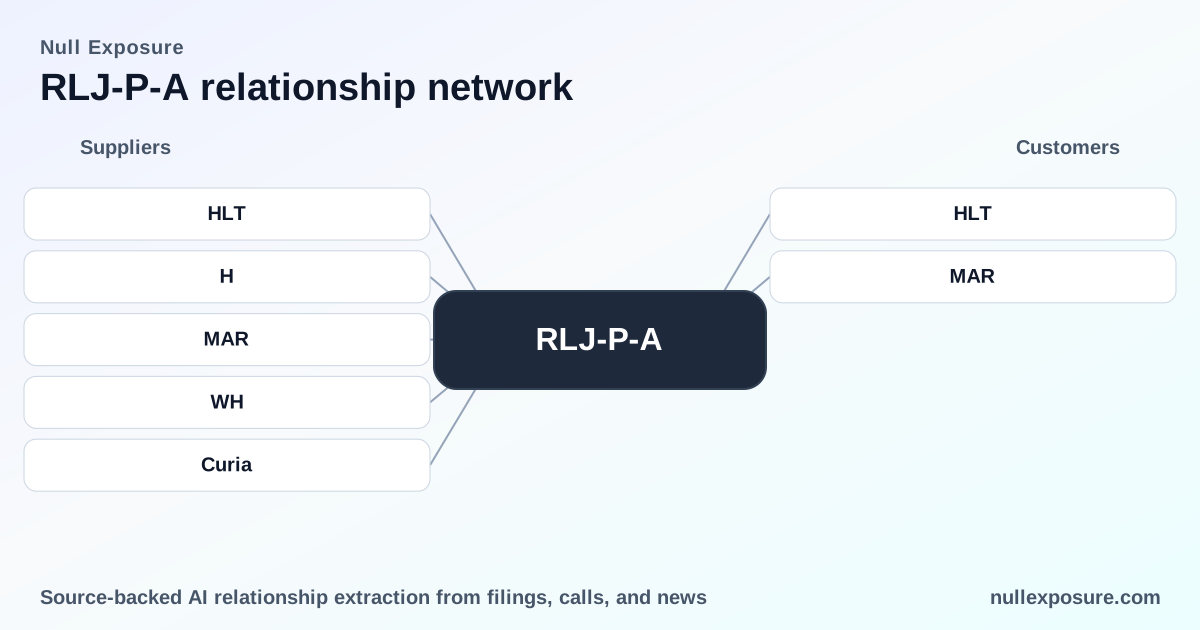
A CityBiz analysis (March 10, 2026) identified operator concentration in RLJ’s portfolio: Hilton accounted for roughly 41% of flagged properties and Marriott roughly 37%, together representing the vast majority of brand-affiliated room inventory described in the article. That split defines the risk landscape for RLJ-P-A holders because two global operators control a large share of revenue channels and distribution.
Visit https://nullexposure.com/ for expanded coverage.
What that split implies in practice
This level of concentration positions RLJ to benefit from global loyalty networks and consistent brand-specific demand characteristics, while simultaneously exposing preferred shareholders to the operational strategies and fee structures of those two companies. Investors must underwrite the durability of brand relationships and the contractual levers (termination rights, capital-reinvestment clauses, management fees) that preserve free cash flow to the landlord.
Relationship-level summaries (every result in the dataset)
-
Hilton — CityBiz (FY2025 / Mar 10, 2026)
RLJ’s portfolio is substantially flagged under Hilton, representing approximately 41% of the operator-flagged inventory noted in the CityBiz article, indicating a high degree of franchise/management exposure to Hilton’s reservation and loyalty system. (Source: CityBiz, March 10, 2026 — https://www.citybiz.co/article/733317/rlj-lodging-trust-beaten-down-hotel-reit-offers-strong-upside/) -
HLT (duplicate entry referencing Hilton) — CityBiz (FY2025 / Mar 10, 2026)
The dataset contains a second, redundant record mapping the same operator exposure to ticker HLT; it reinforces the same point that Hilton-brand properties comprise a material share of RLJ’s flagged inventory. (Source: CityBiz, March 10, 2026 — https://www.citybiz.co/article/733317/rlj-lodging-trust-beaten-down-hotel-reit-offers-strong-upside/) -
Marriott — CityBiz (FY2025 / Mar 10, 2026)
Marriott accounts for roughly 37% of the flagged operator exposure called out in the same CityBiz piece, creating a two-operator construct that dominates RLJ’s brand mix and therefore shapes cash-flow sensitivity to operator-level decisions. (Source: CityBiz, March 10, 2026 — https://www.citybiz.co/article/733317/rlj-lodging-trust-beaten-down-hotel-reit-offers-strong-upside/)
Risk and opportunity framed for preferred investors
- Key risk — operator concentration: With ~78% of flagged inventory tied to two global franchisors, a deterioration in either operator’s reservation flows, brand perception, or fee escalation could compress landlord cash flows and pressure preferred distributions. This is a first-order risk for RLJ-P-A holders and should be priced into yield expectations.
- Key opportunity — brand-driven stability: Conversely, operating under Hilton and Marriott provides consistent demand channels and loyalty-program benefits that support occupancy and RevPAR stability, reducing idiosyncratic demand volatility that smaller independents face.
- Contracts govern cash visibility: The longevity and terms of franchise and management agreements are the principal drivers of cash distribution stability; preferred investors should prioritize diligence on termination clauses, indexation of fees to RevPAR, and capital-reinvestment triggers in management agreements.
Practical next steps for analysts and operators
- Review the company filings and management discussion for explicit contract terms on brand relationships and any concentration disclosures to quantify termination risk and fee outlook.
- Stress-test preferred dividend coverage under scenarios where one operator’s RevPAR underperforms peer sets by 10–20% to understand distribution resilience.
- Monitor operator announcements and loyalty-program changes from Hilton and Marriott as early indicators of booking or fee shifts that will transmit to RLJ’s landlord economics.
Conclusion
RLJ-P-A’s income profile is intrinsically linked to the company’s concentrated relationships with Hilton and Marriott. That concentration creates both a stabilizing force via global distribution and a concentration risk that demands active monitoring. Investors in RLJ-P-A must underwrite contract durability and operator execution as the dominant drivers of preferred-share security. For deeper relationship mapping and ongoing monitoring, visit https://nullexposure.com/.