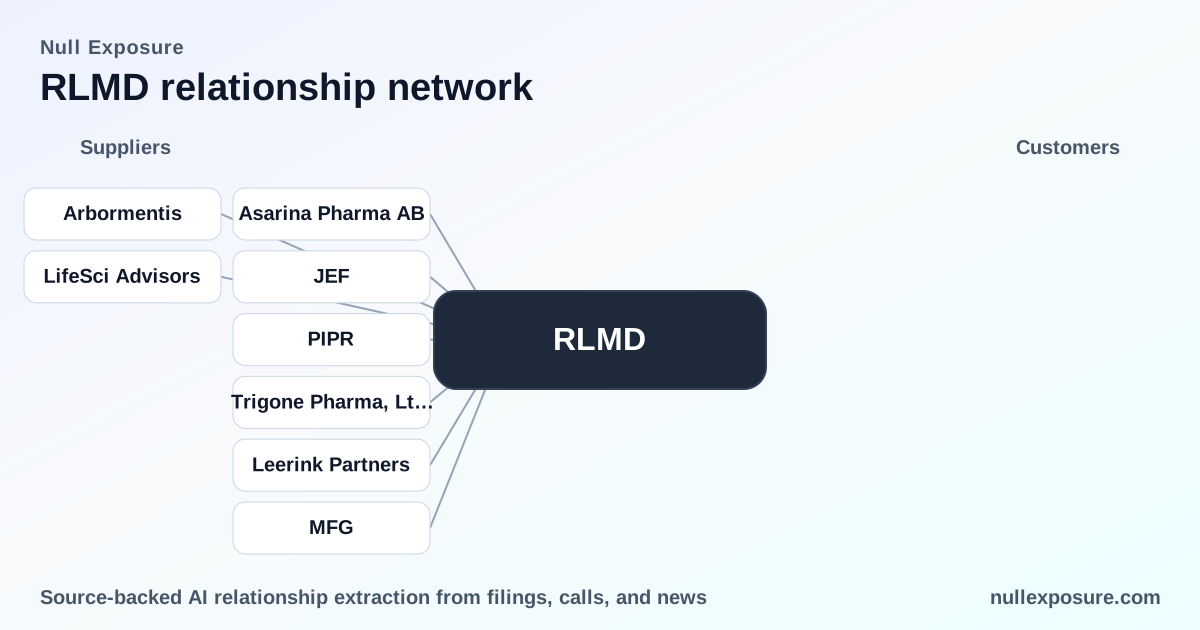
Relmada Therapeutics (RLMD): Capital-driven runway and what the PIPE syndicate signals to investors
Relmada Therapeutics is a clinical-stage biotech focused on CNS therapeutics, monetizing today primarily through capital markets rather than product sales. With no reported revenue in the trailing twelve months and a market cap near $777 million, the company extends its runway by selling equity through private placements and partnerships; its commercial upside depends on successful late-stage development, regulatory approvals, and downstream licensing or product sales. The March 2026 oversubscribed $160 million PIPE is therefore the operational lifeline that underwrites clinical programs and shapes strategic optionality for investors.
If you want a concise view of capital partners and what their participation implies for Relmada’s funding profile, visit NullExposure.
Quick take: what the PIPE syndicate means in plain terms
- Capital-first model. Relmada is a development-stage biotech with zero TTM revenue; financing transactions are the primary mechanism to fund R&D and operations.
- Syndicated institutional support. The oversubscribed PIPE attracted a broad mix of healthcare investors and multi-strategy funds, which reduces single-investor concentration risk while signaling institutional confidence.
- Execution sensitivity. With clinical programs still immature, equity dilution and milestone delivery are the primary value drivers; the investor roster gives the company runway to pursue key catalysts.
The investor relationships behind the $160 million PIPE
Below I list every named participant in Relmada’s March 2026 private placement; each entry contains a one- to two-sentence plain-English description and a source reference.
-
Venrock Healthcare Capital Partners — A healthcare-focused venture and growth investor that participated in the oversubscribed placement, adding domain-specific capital to Relmada’s balance sheet and signaling sector conviction. — Relmada press release on GlobeNewswire (Mar 9, 2026).
-
Commodore Capital — Commodore Capital joined the syndicate, providing additional institutional funding that supports near-term clinical spend. — InvestingNews coverage (May 3, 2026).
-
Janus Henderson Investors — Janus Henderson participated as a mainstream institutional investor, which brings diversified asset management validation to the financing. — Relmada press release on GlobeNewswire (Mar 9, 2026).
-
RA Capital Management — RA Capital, a life-sciences specialist, added targeted scientific and capital-market credibility by subscribing to the PIPE. — InvestingNews coverage (May 3, 2026).
-
Balyasny Asset Management — Balyasny’s participation represents multi-strategy hedge fund allocation to Relmada’s equity round, broadening the investor base beyond pure healthcare funds. — Relmada press release on GlobeNewswire (Mar 9, 2026).
-
OrbiMed — OrbiMed, a leading healthcare investor, joined the syndicate, reinforcing sector expertise on the shareholder register and improving access to industry networks. — InvestingNews coverage (May 3, 2026).
-
Spruce Street Capital — Spruce Street Capital participated in the PIPE, contributing additional institutional capital and trading-market experience. — Relmada press release on GlobeNewswire (Mar 9, 2026).
-
Squadron Capital Management — Squadron Capital’s subscription adds to the syndicate’s international and alternative-investor composition, diversifying funding sources. — InvestingNews coverage (May 3, 2026).
-
Columbia Threadneedle Investments — Columbia Threadneedle participated, representing traditional asset management interest and validating the deal for broader mutual fund investors. — Relmada press release on GlobeNewswire (Mar 9, 2026).
-
Adage Capital Management — Adage’s commitment brings a large-cap asset manager’s endorsement and hints at appetite from long-only and concentrated managers for biotech exposure. — Relmada press release on GlobeNewswire (Mar 9, 2026).
-
Marshall Wace — Marshall Wace’s involvement shows multi-strategy hedge funds allocated to the financing, which can support downstream liquidity in public markets. — InvestingNews coverage (May 3, 2026).
-
Braidwell LP — Braidwell LP joined the syndicate, increasing the number of specialty and alternative managers backing the company. — Relmada press release on GlobeNewswire (Mar 9, 2026).
-
Great Point Partners, LLC — Great Point Partners’ participation adds further healthcare-oriented institutional capital to the round. — InvestingNews coverage (May 3, 2026).
-
Eventide Asset Management — Eventide’s subscription rounds out the syndicate with a values-oriented institutional investor, broadening investor-type diversity. — Relmada press release on GlobeNewswire (Mar 9, 2026).
Each name on this list is recorded in Relmada’s official announcement and corroborated by financial press coverage in early 2026, confirming a broad-based institutional syndicate behind the $160 million placement.
What the investor mix tells you about Relmada’s operating model
Because the company is clinical-stage and reported zero revenue TTM, financing is the primary operational contract Relmada executes; the March PIPE is fundamentally a capital contract rather than a commercial customer relationship. From the investor composition we can infer the following company-level signals (these are not assigned to any individual investor unless explicitly stated in source text):
- Contracting posture: The company engages the capital markets aggressively; transactions are structured to secure immediate runway rather than long-term commercial revenue.
- Concentration and breadth: Investor diversity across healthcare specialists and multi-strategy firms reduces single-counterparty concentration risk, but equity dilution concentrates governance and exit expectations around near-term clinical milestones.
- Criticality of relationships: Institutional backers are critical to operational continuity—without access to institutional capital, the development timeline would compress or programs would be delayed.
- Maturity signal: Participation from top-tier healthcare investors indicates the company has progressed enough in its clinical story to attract experienced biotech allocators, even while remaining pre-revenue.
For a deeper view of counterparty exposures across small-cap biotech, see NullExposure.
Investment implications and risks
Relmada’s capital structure and investor support shift the debate from “will the company survive” to “will clinical readouts and regulatory steps convert institutional confidence into commercial value.” Key risk vectors are execution on clinical milestones, dilution from follow-on financings, and timing to regulatory clarity. The PIPE reduces immediate financing risk, but it does not eliminate clinical or regulatory risk inherent to CNS drug development.
- Positive: Broad institutional syndicate reduces near-term refinancing risk and lends credibility to management’s development plan.
- Negative: Zero near-term revenue and negative EBITDA mean returns are binary and hinge on trial and regulatory outcomes.
Final thought: Relmada’s March 2026 PIPE is a vote of confidence by experienced healthcare allocators and diversified institutional players. For investors sizing exposure to clinical-stage biotech, this financing materially changes runway and optionality—but ultimate value will be decided by clinical execution.
If you want regular, deal-level intelligence on counterparty exposure and institutional participation across biotechs, explore NullExposure for structured views and monitoring.