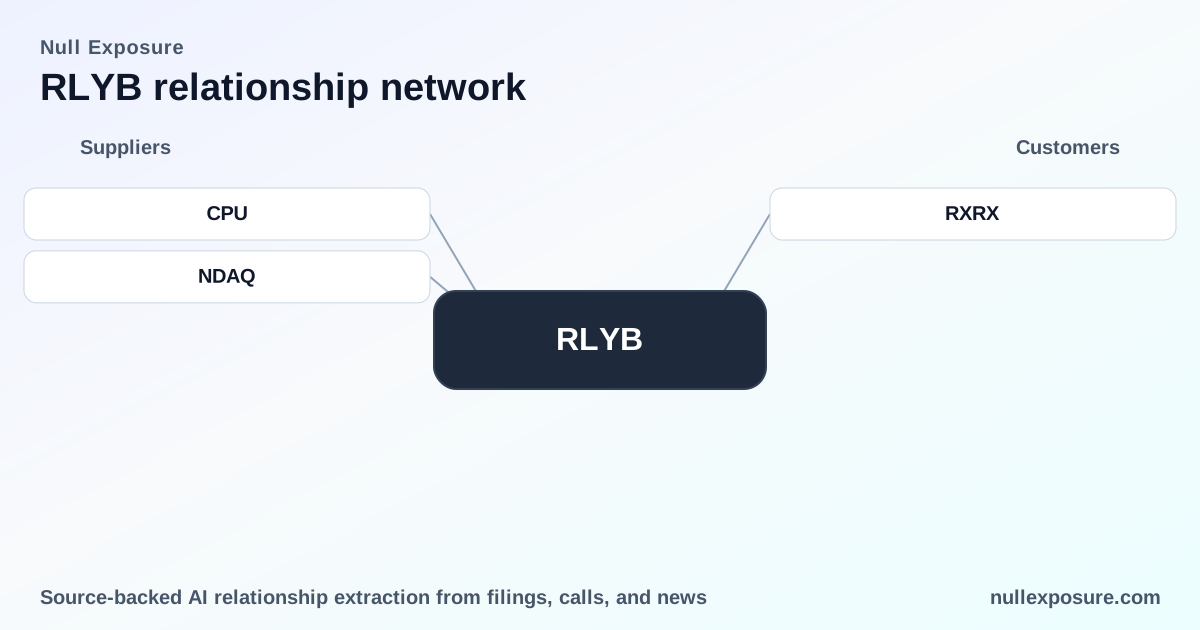
Rallybio (RLYB): Partnership-driven monetization after strategic asset sales
Rallybio is a clinical-stage biotechnology company that monetizes primarily through collaborations, licensing and selective asset sales while it advances a biologics pipeline for rare immunology and hematology indications. Revenue is currently modest and episodic—deliberate licensing deals and the recent sale of REV102 to Recursion are the principal near-term cash inflection points. For investors and operators, the story is about partnership concentration, balance-sheet preservation through asset disposals, and the path to commercial-scale revenue. Learn more about how these relationship signals affect counterparty risk and commercial runway at https://nullexposure.com/.
Executive takeaway: what matters for investors now
- Rallybio is pre-commercial and capital-constrained: FY2025/FY2026 operating data show negligible product revenue and sustained operating losses, making external partnerships and one‑time transactions crucial to liquidity and execution.
- Partnerships drive top-line recognition: Revenue growth is being recorded through collaborations such as the J&J arrangement, not product sales.
- Asset monetization is a deliberate lever: The sale of the REV102 interest to Recursion provides immediate cash and de-risks a preclinical program while preserving optionality via potential contingent payments.
- Concentration risk is high: With limited recurring revenue, individual partner agreements and milestone/royalty structures materially influence Rallybio’s near-term financial profile.
Who Rallybio is dealing with — document-by-document perspective
Finviz report on REV102 sale (March 10, 2026)
Finviz reported that on July 8 Rallybio announced a definitive agreement to sell its interest in REV102 to its JV partner, Recursion Pharmaceuticals. This disclosure frames the REV102 transfer as a completed divestiture intended to simplify the company’s portfolio. Source: Finviz news item, March 10, 2026 — https://finviz.com/news/108689/recursion-pharmaceuticals-acquires-full-rights-to-rev102-potential-oral-therapy-for-rare-bone-disorder-hypophosphatasia
Duplicate Finviz mention (March 10, 2026)
A second Finviz-derived mention restated that Rallybio sold its REV102 interest to Recursion, underlining market coverage of the transaction and reinforcing that the transfer was framed as a definitive agreement. Source: Finviz news item, March 10, 2026 — https://finviz.com/news/108689/recursion-pharmaceuticals-acquires-full-rights-to-rev102-potential-oral-therapy-for-rare-bone-disorder-hypophosphatasia
Hartford Business reporting on deal economics (March 10, 2026)
Hartford Business noted that the REV102 sale to Utah-based Recursion carried headline economics of up to $25 million, including an $7.5 million upfront equity payment, signaling a structured exit that mixes cash and equity to Rallybio’s benefit. This report highlights that Rallybio used the transaction both to raise cash and to reduce programmatic burden. Source: Hartford Business, March 10, 2026 — https://hartfordbusiness.com/article/rallybio-seeks-reverse-stock-split-to-maintain-nasdaq-listing/
Secondary Hartford Business mention (March 10, 2026)
A repeated Hartford Business mention emphasized the same $25 million ceiling and $7.5 million upfront terms, which confirms consistent reporting across local business press and contributes to market understanding about the immediate cash inflow. Source: Hartford Business, March 10, 2026 — https://hartfordbusiness.com/article/rallybio-seeks-reverse-stock-split-to-maintain-nasdaq-listing/
TradingView financial summary referencing J&J collaboration (May 3, 2026)
TradingView summarized Rallybio’s FY2025–FY2026 filings and attributed $0.858 million of total revenue growth year-over-year to recognition tied to the J&J collaboration, indicating that the Johnson & Johnson relationship is the primary source of recognized revenue in the reported period. Source: TradingView coverage of Rallybio 10‑K/annual results, May 3, 2026 — https://www.tradingview.com/news/tradingview:3e933db5ba9e9:0-rallybio-2025-10-k-0-858m-revenue-8-98-m-net-loss/
TradingView note on portfolio rationalization and RECURRENCE consideration (May 3, 2026)
The same TradingView summary also recorded that Rallybio discontinued development of RLYB212 in April 2025 and sold the REV102 interest to Recursion for $20 million with potential future milestone and royalty payments—presenting an alternative reported economics to Hartford Business but consistent in substance: asset sale to Recursion with contingent upside. Source: TradingView coverage of Rallybio 10‑K/annual results, May 3, 2026 — https://www.tradingview.com/news/tradingview:3e933db5ba9e9:0-rallybio-2025-10-k-0-858m-revenue-8-98-m-net-loss/
How these relationships shape Rallybio’s operating profile
- Contracting posture: Rallybio is executing exit/transfer agreements (REV102 sale) and collaboration revenue recognition (J&J), reflecting a posture centered on monetizing non-core assets and leveraging partner development capabilities rather than self-funding multiple late-stage programs.
- Concentration: Company-level signals show very limited recurring revenue, so each partner or transaction carries outsized financial significance for operating liquidity and near-term solvency.
- Criticality: The J&J collaboration and the Recursion transaction are material to cash flow and public narrative; the proceeds and collaboration revenue change the company’s runway and investor perception.
- Maturity: Rallybio is pre-commercial; operating metrics (negative gross profit, operating losses, revenue ≈ $0.86M TTM) confirm the company is in the transition phase from discovery/clinical testing toward a partner‑driven commercial path.
Investment implications and risk profile
Rallybio’s recent activity signals a strategic shift toward capital preservation and partner monetization. The sale of REV102 removes preclinical development burden and generates non-dilutive (or partially dilutive via equity) liquidity; the Johnson & Johnson collaboration is the only clear recurring revenue source referenced in filings and reporting. For investors, that means valuation and downside are tightly coupled to the success and timing of partner milestones and any further asset sales. Institutional ownership (~63%) provides governance stability, but a sub-$100m market cap and persistent operating losses create execution risk until a clear path to sustainable, diversified revenue is established.
If you evaluate counterparties or model Rallybio’s runway, focus on:
- Confirming the exact cash and equity mechanics of the REV102 sale across filings.
- Tracking timing and magnitude of J&J collaboration revenue recognition.
- Monitoring whether Rallybio executes additional asset dispositions or new partnerships that diversify revenue.
For a deeper view of counterparty datasets and relationship timelines used in this analysis, visit https://nullexposure.com/ for a concise provider briefing.
Bottom line
Rallybio is operating a partnership-first commercial strategy while shedding non-core assets to extend runway. The Recursion transaction and the J&J collaboration are the two relationship signals that define near-term cash generation and revenue recognition. Investors should value Rallybio as a small-cap biotech with concentrated partner risk and upside tied to milestone realization and disciplined asset monetization.