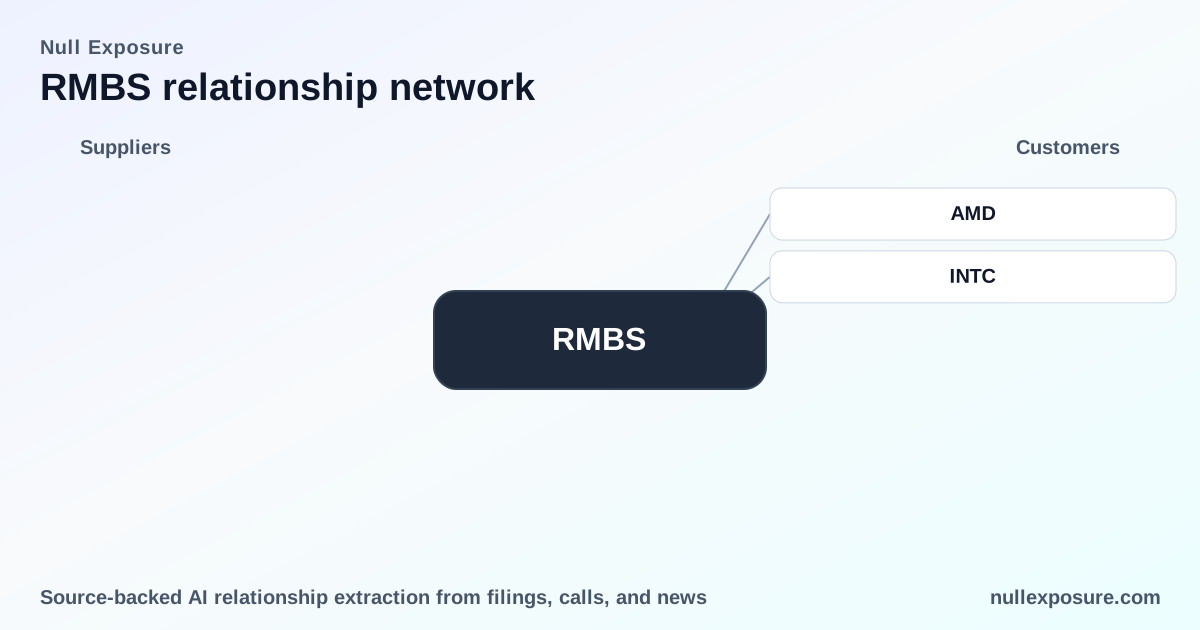
Rambus (RMBS): Customer Relationships Drive Revenue, Concentration, and Timing Risk
Rambus monetizes a two‑pillar model: patent licensing and royalties from a broad portfolio of semiconductor inventions, plus product sales of memory interface and security chips sold through direct and distribution channels worldwide. License agreements generate recurring royalty streams—often structured as fixed, variable, or hybrid payments over multi‑year terms—while chip sales follow short‑term purchase orders that respond to platform launches and demand cycles. For investors, this mix delivers high gross margins and predictable royalty cadence, but also meaningful customer concentration and platform‑timing exposure that determine near‑term revenue visibility.
For a concise industry view, review the company homepage: https://nullexposure.com/
How Rambus actually gets paid — the commercial engine
Rambus collects revenue through two clear mechanisms. First, licensing and royalty flows from its patent portfolio provide durable, contractual cash generation; the company discloses license terms that can extend up to ten years and royalty structures that are fixed, variable or hybrid. Second, product revenue from memory interface and security chips is transacted via short‑term purchase orders and channel sales to module makers, OEMs and hyperscalers. This hybrid model produces a high‑margin revenue base from IP and a more cyclical, volume‑sensitive product business.
Key operating signals to incorporate into any valuation or counterparty assessment:
- Contracting posture: A material portion of revenue is driven by long‑term license agreements and royalties that provide predictable cash flow, while chip sales are executed under short‑term purchase orders that align to platform launches.
- Concentration risk: Rambus reports that its top five customers represented ~62% of consolidated revenue in 2023 and 2024, underlining customer concentration as a central risk and leverage point.
- Global footprint and APAC exposure: Revenue from non‑U.S. companies was 64% of total revenue in 2024, and the company records material tax and withholding exposures in South Korea, indicating substantial APAC revenue and operational engagement.
- Counterparty profile and criticality: Customers are leading semiconductor and systems companies; Rambus’s patented inventions are foundational and licensed to market leaders, making the relationship strategically important to both sides.
- Relationship maturity: Several large licensees have renewed or extended agreements during 2024, signaling both renewal activity and retained franchise value. These company‑level signals frame how individual customer relationships translate into revenue durability and concentration risk.
If you want an investor‑facing summary of Rambus’s customer network and the key citations that support it, see the middle of this post or visit the analysis hub: https://nullexposure.com/
Customer roll call — what the market is saying right now
Below are the relationships called out in recent transcripts and earnings commentary. Each entry contains a 1–2 sentence plain‑English takeaway and the primary source.
Cadence Design Systems (CDNS)
Cadence referenced that it acquired HBM technology from Rambus and subsequently improved it, indicating a transfer of IP and technology assets between the two companies and a commercial relationship that extended beyond a simple license. According to a May 2, 2026 earnings call transcript on InsiderMonkey, Cadence explicitly noted, “HBM, we acquired from Rambus and then we improved it.” (InsiderMonkey, Q1 2026 transcript, May 2, 2026: https://www.insidermonkey.com/blog/cadence-design-systems-inc-nasdaqcdns-q1-2026-earnings-call-transcript-1748853/)
AMD
Rambus’s product rollout and revenue are tied to AMD platform launches, with management discussing attach‑rate assumptions for upcoming AMD platforms (Venice and Diamond Rapids) on the Q1 2026 call; earlier commentary also stated that product rollout “mostly depends on the rollout of the platforms on Intel and AMD.” This links Rambus’s chip revenue cadence directly to AMD’s server and client platform timing. (InsiderMonkey, Rambus Q1 2026 earnings call transcript, May 3, 2026 and Rambus Q4 2025 call transcript, March 10, 2026: https://www.insidermonkey.com/blog/rambus-inc-nasdaqrmbs-q1-2026-earnings-call-transcript-1748857/; https://www.insidermonkey.com/blog/rambus-inc-nasdaqrmbs-q4-2025-earnings-call-transcript-1687924/)
Intel / INTC
Rambus tied product revenue timing to Intel platform launches as frequently as to AMD’s, noting that the rollout of Rambus products “mostly depends on the rollout of the platforms on Intel and AMD.” This underscores platform dependency risk: customer order flow for memory interface products is synchronized with Intel’s platform release schedule and ecosystem adoption. (InsiderMonkey, Rambus Q4 2025 and Q1 2026 transcripts, March 10, 2026 and May 3, 2026: https://www.insidermonkey.com/blog/rambus-inc-nasdaqrmbs-q4-2025-earnings-call-transcript-1687924/; https://www.insidermonkey.com/blog/rambus-inc-nasdaqrmbs-q1-2026-earnings-call-transcript-1748857/)
Note: Intel is referenced under both “Intel” and the ticker “INTC” across transcripts; both entries reflect the same platform dependency dynamic and timing sensitivity.
What these relationships mean for investors — distilled implications
- Revenue visibility is dual‑tracked. Royalty streams from licenses deliver recurring, contractually defined revenue, while product revenue is volatile and tightly linked to third‑party platform launches from AMD and Intel. That combination supports strong margins but produces lumpy top‑line outcomes.
- Concentration amplifies platform risk. With top five customers accounting for roughly 62% of revenue, any slowdown or delayed platform launch at a major customer can compress near‑term results materially.
- Geographic tax and withholding exposures are real. The company records significant withholding tax balances tied to licensees in South Korea, demonstrating operational scale in APAC and potential cash‑tax complexity.
- Contract maturity leans long for IP, short for products. Licensing terms up to ten years provide durable earnings backing; meanwhile product sales still operate on short purchase orders, creating a mixed maturity profile across revenue streams.
- Renewals support franchise value. Public disclosures note multiple license renewals and extensions in 2024, confirming ongoing commercial relevance of Rambus’s IP to leading OEMs and system vendors.
Market positioning and risk checklist
- Positive: High gross margins driven by royalty economics, foundational IP licensed across top semiconductor OEMs, and demonstrated renewal activity.
- Watchlist: High customer concentration, platform‑timing exposure (Intel/AMD), APAC withholding/tax complexity, and short‑term product order cycles that can amplify quarter‑to‑quarter volatility.
If you are evaluating RMBS from an investor or counterparty perspective, focus diligence on customer renewal schedules, the timing of AMD/Intel platform launches, and the company’s disclosures around top customer revenue mix and regional tax exposures. For ongoing tracking and additional relationship intelligence, visit the analysis hub: https://nullexposure.com/
Bold takeaway: Rambus combines durable licensing cash flows with cyclical product revenue, and the company’s near‑term financial trajectory is governed by a small set of large customers and the release schedules of major platform makers.