Rocky Mountain Chocolate Factory: Marketplace Partners Turn Franchises into Omnichannel Revenue Engines
Rocky Mountain Chocolate Factory operates as a confectionery franchisor, manufacturer and retail operator that monetizes primarily through product sales to franchisees and licensees, ongoing franchise royalties, and a fees-for-licenses model. The company is executing a deliberate omnichannel roll-out that routes franchise inventory into third-party marketplaces and corporate catering channels, converting fixed retail footprint into scalable e-commerce and B2B revenue streams. For a closer look at how this customer strategy is being tracked and indexed, visit https://nullexposure.com/.
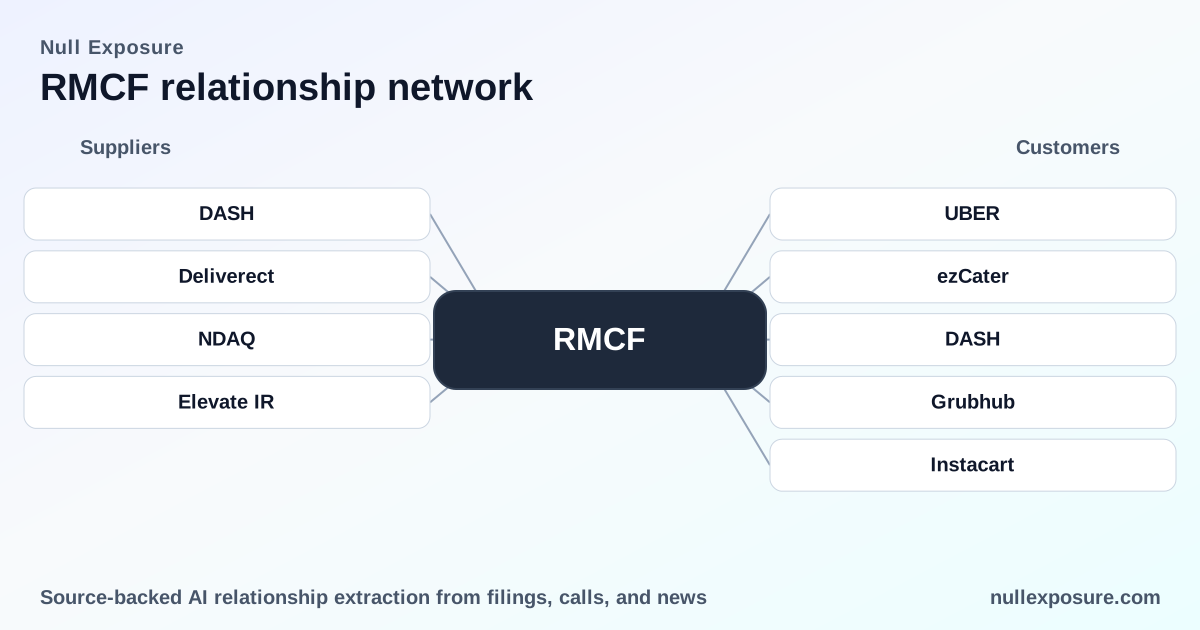
Market move: management announced a systemwide Phase One rollout that centralizes order management with Deliverect and opens franchise locations to major marketplaces and catering platforms, converting brand presence into digital sales without heavy capital expenditure.
Why this matters to investors
- Revenue leverage: selling finished goods to franchisees already accounts for the majority of consolidated revenue; moving those products into marketplaces increases same-store sales potential and average order value while keeping working-capital intensity low.
- Operational leverage: a single order management layer reduces pricing variance across third-party channels and simplifies reconciliation for franchisees.
- Scale without capex: reliance on partner marketplaces and licensing keeps capital requirements modest while enabling national distribution.
The partner map: how Rocky Mountain is wiring its channels
Below I list every partner relationship captured in recent coverage and what each integration means for Rocky Mountain Chocolate Factory’s customer economics.
Uber Eats / UBER
Rocky Mountain announced integration plans that include major delivery marketplaces, explicitly naming Uber Eats as a marketplace partner via Deliverect-managed centralized order routing. According to coverage in Snack & Bakery (March 10, 2026) and a GlobeNewswire release (February 26, 2026), Uber Eats is part of the Phase One marketplace rollout that increases access to on-demand consumers and supports consistent pricing across channels.
DoorDash / DASH
DoorDash is likewise included in the centralized order-management integration; the rollout positions DoorDash as a primary channel for expanding off-premise prepared-goods sales. GlobeNewswire (Feb 26, 2026) and Snack & Bakery (Mar 10, 2026) note DoorDash as a named partner that will help franchise locations capture delivery demand while preserving operational consistency.
Grubhub
Grubhub is named alongside other marketplaces in the Phase One integration using Deliverect, enabling franchisees to receive orders from Grubhub through the same centralized system that aligns with Uber Eats and DoorDash. Coverage in GlobeNewswire (Feb 26, 2026) and Snack & Bakery (Mar 10, 2026) emphasize the inclusion of Grubhub for broad marketplace coverage.
Instacart
Instacart is earmarked as part of the broader marketplace expansion to capture grocery-adjacent consumers and unit sales through quick commerce ecosystems. GlobeNewswire’s systemwide rollout announcement (Feb 26, 2026) and Snack & Bakery reporting (Mar 10, 2026) reference Instacart as a channel to widen distribution beyond traditional storefront and delivery apps.
ezCater
ezCater is explicitly described as the entry point into corporate catering and gifting channels, positioning Rocky Mountain Chocolate Factory for higher average order values and B2B accounts. GlobeNewswire (Feb 26, 2026) and Snack & Bakery (Mar 10, 2026) report that ezCater integration gives the company direct access to corporate meetings, employee recognition, and client gifting—a capital-light path to diversify revenue.
Notes on sources and timing: the marketplace integrations are documented in the company’s systemwide rollout statements in February–March 2026 across GlobeNewswire, Snack & Bakery, and related reporting.
Operating constraints and what they imply for customer economics
The company’s operating model and contract structure generate several clear, investable signals:
-
Long-term franchising posture. Franchise and license agreements have multi-year terms—historically ten years with renewal rights and select contracts up to 20 years—creating durable customer relationships and predictable royalty streams. This contracting structure supports stable recurring revenue and makes technology rollouts (like Deliverect) high-impact because they touch long-lived partners.
-
Domestic concentration. Nearly all revenue is domestic; international exposure is negligible. The business scales within North America and through U.S.-centric marketplaces, so macro performance will be sensitive to domestic consumption patterns rather than international expansion dynamics.
-
Seller and licensee economics. The firm’s primary revenue source is product sales to franchisees and other third parties, supplemented by upfront franchise fees and monthly royalties. That mix biases margins toward manufacturing and wholesale economics rather than retail operating margins.
-
Active, mature relationship base. The company operates over 260 franchised and licensee-owned stores (including kiosks) and collects monthly royalties; the relationship stage is active and systemwide, offering immediate reach for marketplace activations.
-
Core-product and manufacturing orientation. The business is organized around confectionery production sold to the system and third-party customers; marketplace and catering integrations extend the route-to-market for these manufactured goods rather than introducing a new core product.
Investment implications and risk profile
-
Upside vector: Marketplace and catering integrations should materially increase visibility and throughput for franchise inventory with minimal capital—this is a high-return, low-capex growth lever. If executed cleanly, the incremental sales captured through third-party marketplaces and ezCater will lift revenue per store and strengthen wholesale volumes.
-
Execution risk: Centralization via Deliverect requires franchisee adoption and operational consistency on order handling and pricing; failure to maintain uniform pricing or poor onboarding could erode margins or channel trust. The franchising structure mitigates turnover risk because agreements are long-term, but operational execution remains the gating factor.
-
Concentration and scale ceiling: Domestic revenue concentration constrains upside to U.S. consumption trends; marketplace saturation and commission structures will cap net margin unless Rocky Mountain negotiates favorable economics with partners or achieves meaningful scale.
How to monitor progress (practical signals investors should track)
- Track monthly same-store sales and average order value disclosures; marketplace lift should present as improved same-store retail throughput.
- Watch company announcements and franchisee guidance on Deliverect onboarding cadence and platform uptime.
- Monitor mention frequency and partnership language from GlobeNewswire and trade outlets for expansion beyond Phase One (new marketplaces, national accounts on ezCater).
Bottom line: Rocky Mountain Chocolate Factory is converting its franchise footprint into a digitally reachable revenue base by wiring long-term franchise partners into third-party marketplaces and catering platforms. This strategy enhances revenue diversification and unit economics without heavy capex, but value realization depends on disciplined execution across franchisee onboarding, pricing consistency, and marketplace economics. For ongoing coverage of relationship mappings and signal tracking, see https://nullexposure.com/.