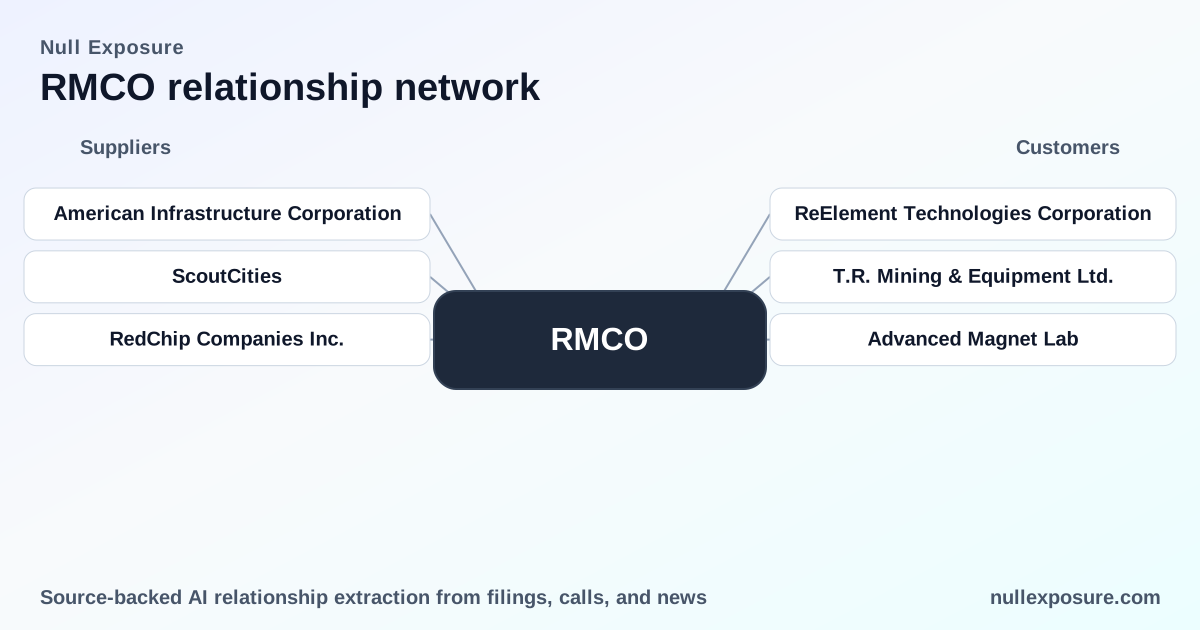
Royalty Management Holding Corporation (RMCO): Customer relationships that drive royalty cashflows
Royalty Management Holding Corporation sources, funds and secures royalty interests in early-stage industrial and technology assets, converting upfront capital into recurring royalty streams and upside on portfolio value. The company monetizes by taking equity-like royalty claims on revenue from partner operators and IP owners — funding development, permitting and R&D in exchange for a percentage of gross sales or contractually defined cashflows. For investors, the critical lenses are contracting posture (royalty-for-capital), portfolio concentration, geography, and the maturity of sponsored projects. Learn more about how RMCO frames those relationships at https://nullexposure.com/.
How RMCO structures its customer relationships — the operating model in plain language
RMCO operates as a capital provider that locks in long-dated revenue rights rather than direct operating control. Contracts are cashflow-focused: RMCO provides development capital and receives a fixed royalty rate or ongoing revenue share. That posture creates a predictable styled revenue stream when counterparties commercialize, but it also creates high dependency on partner execution and permit/technology commercialization timelines.
Key business-model signals:
- Contracting posture: RMCO is a funder-first partner that converts capital into contractual royalty claims rather than taking operating equity. This reduces operating overhead but increases counterparty performance risk.
- Concentration and criticality: The company’s active relationships are concentrated in resource-processing, mining development and advanced materials IP — sectors where a single project’s success materially impacts royalty receipts.
- Maturity profile: Relationships sit at the development/R&D and permitting stages, which makes near-term cashflow visibility limited but provides outsized upside if commercialization succeeds.
- Geographic footprint: As of December 31, 2024, RMCO reports that all revenue-generating activity is undertaken in eastern Kentucky, Indiana, and Limpopo, South Africa, which signals a narrow operational geography despite global ambitions.
Portfolio relationships mapped — what each customer provides to RMCO’s pipeline
ReElement Technologies Corporation — capital for rare-earth processing and a royalty on future sales
Royalty Management holds an active royalty agreement with ReElement and publicly celebrated ReElement’s $200 million private equity financing as a validation of portfolio strength, reinforcing RMCO’s exposure to ReElement’s growth trajectory (Proactive Investors, March 10, 2026). Additionally, RMCO entered a landmark agreement to fund development of patents and technologies for refining rare earths and critical elements, receiving 0.5% of gross sales on elements processed with the new IP (Yahoo Finance, March 2026).
Sources: Proactive Investors report (Mar 10, 2026) and company announcement covered by Yahoo Finance (Mar 2026).
T.R. Mining & Equipment Ltd. — development capital tied to permitting for critical minerals
RMCO provided additional capital to advance T.R. Mining’s operating permit process for its vanadium, titanium, magnetite, and iron ore project currently under development, positioning itself to capture royalties once production and sales commence (Yahoo Finance, March 2026). This is a development-stage exposure where royalties hinge on successful permitting and mine ramp-up.
Source: Yahoo Finance press release coverage (Mar 2026).
Advanced Magnet Lab (AML) — R&D funding exchanged for IP-linked royalties
Royalty Management funded R&D and intellectual-property creation at Advanced Magnet Lab in return for a royalty on all sales of products developed using the new patents, converting R&D spend into a revenue-linked claim on future product sales (Yahoo Finance, March 2026). This relationship is explicitly IP-centric and ties RMCO’s return to the commercial adoption of new magnet technologies.
Source: Yahoo Finance press release coverage (Mar 2026).
What the relationships imply for investors — upside and concentrated risks
Across these customers, RMCO’s strategy is consistent: deploy non-operating capital into high-potential projects and capture ongoing royalties. That creates an asymmetric payoff: limited incremental operational burdens with potentially high returns if ReElement’s technologies, TR Mining’s permit and AML’s IP commercialize successfully.
Primary risk vectors:
- Execution risk at partners: Royalty streams depend on third-party development, permitting and commercialization on schedule and budget.
- Concentration risk: Current disclosed revenue activity is localized (eastern Kentucky, Indiana, Limpopo, South Africa) and focused on a narrow set of commodity and IP plays, which concentrates downside on regional and sectoral shocks.
- Maturity timing: Most agreements are early-stage; revenue realization is contingent on multi-year development paths and requires patient capital.
Constraints and company-level signals to watch
RMCO’s public disclosures and relationship descriptions give clear company-level constraints. The firm’s revenues are generated from a small set of development-stage projects focused on mineral processing, mine permitting, and IP commercialization. Geographic concentration in eastern Kentucky, Indiana and Limpopo, South Africa creates country and permitting risk that investors must price into valuation models. Contracts are structured as royalties rather than equity stakes, which lowers operational exposure but raises dependence on partner cashflows for revenue realization.
Tactical implications for research and operations teams
- For investors, stress-test cashflow scenarios on a project-by-project basis and model delayed commercialization timelines; royalty timing is the dominant driver of valuation.
- For deal originators and operators, RMCO’s contracting posture signals opportunities for counterparties seeking non-dilutive capital in exchange for royalties; structure clarity and enforceability of royalty covenants are essential.
- For risk managers, geographic and sector concentration suggest active hedging or portfolio diversification is necessary before scaling position sizes.
Bottom line and next steps
Royalty Management’s customer relationships reflect a repeatable cashflow-first model: fund early development and lock in long-dated royalties. The portfolio carries attractive upside through rare-earth processing IP and critical-minerals projects, balanced by concentrated geographic exposure and execution risk at counterparties. For a concise view of RMCO’s relationship map and to monitor new customer announcements, visit https://nullexposure.com/.
Key takeaway: RMCO converts capital into contractual revenue claims; the investment case turns on counterparties’ execution and the timeline to commercial sales.