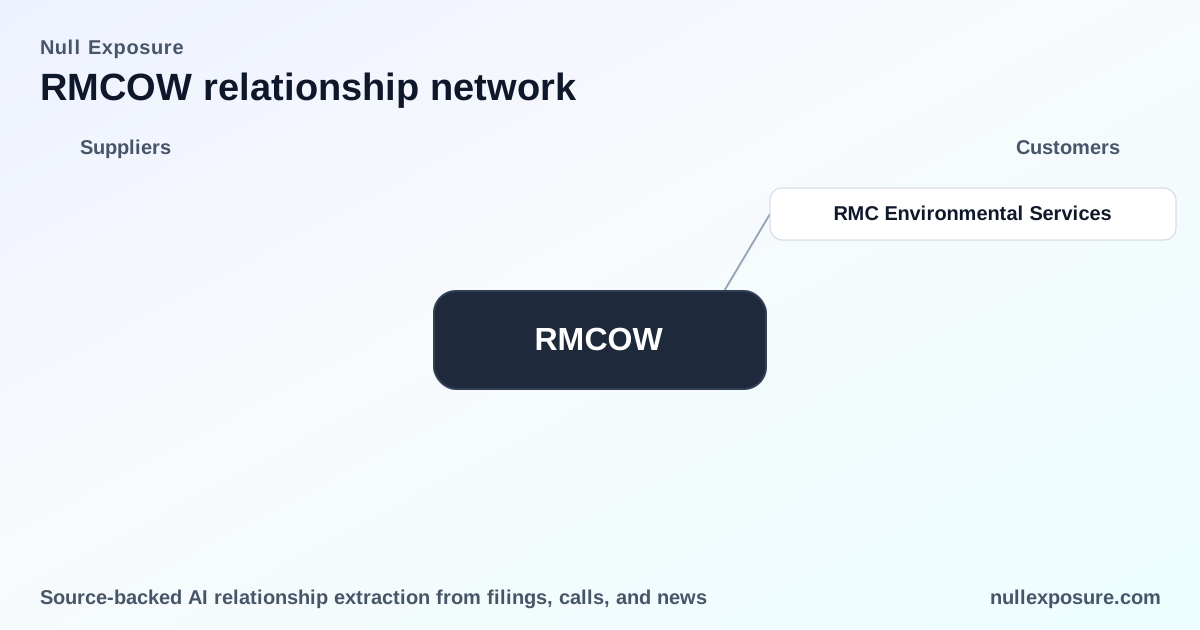
RMCOW: Customer footprint and what a single named buyer tells investors
Royalty Management Holding Corporation (NASDAQ: RMCOW) is a royalty investor that acquires and manages royalty rights across creative and industrial assets and generates cash flow from royalty streams and asset appreciation. The company monetizes through recurring royalty receipts and opportunistic sales of royalty interests, while operating at a small scale: latest company disclosures (latest quarter 2025-12-31) show trailing twelve-month revenue of $4.95 million with negative margins and limited public-market liquidity. For investors evaluating customer relationships, the headline is simple — named customer activity can materially move results in a business of this size. Visit the NullExposure overview for the full signal set: https://nullexposure.com/
Why a single customer mention matters for a royalty investor
Royalty investors trade exposure to third-party economic activity for predictable income. In a small, early-stage royalty vehicle, each customer, partner or revenue source can be consequential for near-term results. RMCOW’s public filings report a TTM profit margin of -14.7% and operating margin of -2.57%, indicating that modest swings in royalty volume or a single counterparty’s activity can shift profitability materially. According to the company’s reported latest quarter (2025-12-31), revenue TTM is $4,949,900 and gross profit TTM is $804,780, underscoring a compact top line where individual relationships matter.
A practical investor takeaway: monitor named counterparties and volume disclosures closely, because concentration risk and limited scale amplify counterparty outcomes into corporate performance. For an annotated relationship map, see the company’s customer mentions captured in public reporting on NullExposure: https://nullexposure.com/
The named customer: what the record shows
RMC Environmental Services
RMCOW’s public coverage includes one explicit customer mention. A market report covering the company’s FY2024 results states that an increase in revenue was driven primarily by additional volume from RMC Environmental Services, indicating that this counterparty contributed measurable revenue growth in that period. The observation comes from a March 2026 article summarizing the company’s quarterly commentary. (Source: QZ, March 10, 2026 — https://qz.com/royalty-management-holding-corp-cl-a-rmco-quarterly-1-1851700688)
How that relationship reads as a risk and an opportunity
- Risk — concentration: With a sub-$5 million revenue base, a single customer increasing or decreasing volume will move the top line and margins. The public name in FY2024 suggests revenue concentration that investors should treat as material.
- Opportunity — predictable volume uplift: The cited increase in volume from RMC Environmental Services demonstrates that RMCOW can secure repeatable, revenue-supporting flows from end-users of assets it monetizes, supporting the royalty model’s intention to capture recurring cash receipts.
Operating posture, counterparty profile and business-model constraints
Because the formal constraints field contains no explicit customer-level contractual disclosures for RMCOW, the following are company-level operational signals derived from public financials and the relationship list:
- Contracting posture: opportunistic and asset-level, not long-term platform contracts. The company’s model is to acquire royalty rights and realize income from usage or production; public records show transactional volume drivers rather than enterprise-wide, multi-year supply contracts.
- Concentration: high. A named counterparty responsible for an FY2024 volume uptick signals concentrated exposure at current scale.
- Criticality: asymmetric — each customer is more critical to short-term P&L than to a large-cap operator because the revenue base is small; this increases cash-flow volatility but keeps downside manageable from a creditor perspective because liabilities are limited.
- Maturity: early-stage / small-cap dynamics are evident — limited analyst coverage, negative EBITDA (-$235,185 reported), and a modest float (6,577,200 shares reported) indicate a capital structure still forming and revenue sources still being sourced and optimized.
These company-level characteristics inform how investors should weight a named customer disclosure: the presence of a named customer is a relevant signal for both portfolio construction and active monitoring.
Quick, direct read on the full relationship list
- RMC Environmental Services — The company explicitly reported that FY2024 revenue increased primarily because of additional volume from RMC Environmental Services, making that counterparty a material driver of fiscal-year performance. (QZ news summary, March 10, 2026: https://qz.com/royalty-management-holding-corp-cl-a-rmco-quarterly-1-1851700688)
No other customer names were disclosed in the public relationship capture for the customer scope. The absence of more extensive, named customer reporting is itself informative: either revenues come from a mix of small counterparties, or disclosure remains limited, so investor diligence should include direct engagement and monitoring of periodic filings for more granular counterparty data.
Practical implications for investors and operators
- For investors: Treat each named customer as material until further diversification or larger-scale revenue is established. Use quarterly commentary and any volume disclosures as leading indicators for next-quarter revenue and margin moves.
- For operators and partners: If you are considering a commercial relationship with RMCOW, recognize you will be a visible driver of reported performance; that creates leverage in negotiations but also raises expectations for consistent volume delivery.
Bottom line: watch named volume, watch volatility
Royalty Management Holding Corporation runs a small-scale, royalty-income model where named counterparties can swing company results. The explicit mention of RMC Environmental Services as a driver of FY2024 revenue growth is a concrete example of that dynamic. Given limited market coverage, negative operating results, and a compact revenue base, investors should prioritize counterparty monitoring and engage directly with management for disclosure on contract terms, volume visibility and concentration mitigation.
For a structured signal feed and to track future disclosures, review the NullExposure profile for RMCOW: https://nullexposure.com/