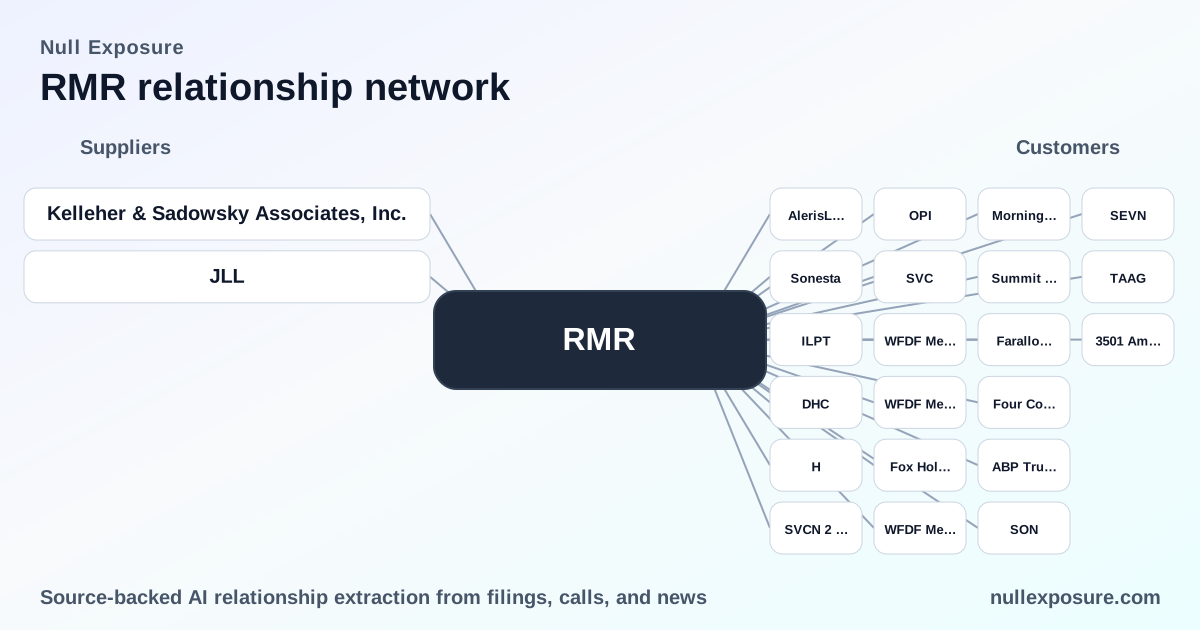
RMR Group: the client map that drives recurring fees and incentive economics
RMR Group Inc. operates as an external manager and property/asset operator for a portfolio of public and private real estate vehicles, monetizing through fixed management fees, performance-based incentive fees and ancillary property‑level services tied to asset-level operations. For investors, the company’s financial profile is defined by long-term management contracts, a concentrated client base of listed REITs and sizeable related‑party revenue, which together produce predictable cash flow but create client-concentration risk. For more on how we source these relationship signals, visit https://nullexposure.com/.
How RMR makes money — a concise operating thesis
RMR provides the personnel, overhead and day‑to‑day operating platform for multiple managed REITs and private clients and is compensated primarily via management and advisory fees plus incentive business management fees when client performance triggers benchmarks. The business model is structurally service‑oriented: RMR supplies labor and operating infrastructure (not just capital), which embeds it in client operations and concentrates revenue into a small number of large counterparties.
Key constraints that shape customer economics
- Long-term, evergreen contracting posture. The company discloses management agreements with its Managed Equity REITs as effectively 20‑year evergreen contracts with significant termination costs, which supports revenue visibility and lock‑in of fee streams (10‑K, FY2025).
- Large enterprise counterparties and concentrated exposure. RMR’s clients are predominantly publicly traded REITs with institutional governance—this is a large‑enterprise counterparty profile (10‑K, FY2025) and explains why RMR’s client mix is both strategic and high‑touch.
- North American geographical footprint. Managed assets and properties are located across the U.S. (48 states plus D.C., Puerto Rico) with some Canadian exposure, so operations and risk cycles follow U.S. real estate dynamics (10‑K, FY2025).
- Materiality and criticality of related‑party revenues. Related‑party revenues comprised over 90% of total revenues by one reported metric and the Managed Equity REITs accounted for 68% of management and advisory service revenue for FY2025, making these client relationships both material and critical to RMR’s financials (10‑K, FY2025).
- Service provider role and active management. RMR supplies staff, offices and operational capabilities to clients that have no employees, making RMR the functional operating backbone of several REITs (10‑K, FY2025).
These constraints together define a business where contractual durability and client concentration create predictability but raise single‑point‑of‑failure risk if a major client relationship terminates or underperforms.
Customer relationships — the complete roster from public filings and press (one‑ to two‑sentence summaries)
Below is a compact, relationship‑by‑relationship review drawn from RMR’s FY2025 10‑K and contemporaneous press coverage. Each entry includes a short plain‑English summary and its cited source.
Diversified Healthcare Trust (DHC)
RMR is the external manager for Diversified Healthcare Trust and earned the largest portion of 2025 incentive business management fees—$17.9 million—under multi‑year fee measurements, underscoring DHC’s material contribution to RMR fee income. Source: RMR public statement and MarketScreener/press coverage (FY2026).
DHCNL
RMR’s management relationship with DHC is repeatedly noted in press coverage outside the U.S. (DHCNL references), reflecting the same client/manager linkage and RMR’s role in investor communications. Source: Stockstotrade / DHCNL press write‑ups (FY2026).
Industrial Logistics Properties Trust (ILPT)
ILPT is a managed REIT under RMR and incurred a $5.7 million incentive management fee for calendar 2025, demonstrating RMR’s ability to capture performance fees across different client property types. Source: Investing.com and MarketScreener press (FY2026).
Industrial Logistics Properties Trust (spelled out)
Multiple corporate releases and analyst notes reiterate that ILPT is managed by The RMR Group, reinforcing ILPT’s status as a core, fee‑paying managed equity REIT. Source: FinancialContent/MarketScreener press (FY2026).
Service Properties Trust (SVC)
Service Properties Trust is externally managed by RMR; the parties amended the Business Management Agreement effective January 1, 2026, to change the benchmark used for incentive calculations and termination assessment — an update that changes future incentive dynamics. Source: The Globe and Mail / MarketScreener (Jan 2026).
SVC (ticker form)
Press and earnings notices repeatedly identify SVC as RMR‑managed, and RMR’s operating platform is central to SVC’s hotel and retail net‑lease portfolio. Source: Various press releases and earnings notices (FY2025–FY2026).
Office Properties Income Trust (OPI)
RMR provides full management services to OPI; external reporting has highlighted near‑term refinancing pressure at OPI, which could influence future management economics and fee stability. Source: RMR 10‑K summary and TheRealDeal analysis (FY2025).
Office Properties Income Trust (spelled out)
Market announcements reiterate that OPI is one of four publicly traded REITs managed by RMR LLC, making it a component of RMR’s concentrated fee base. Source: MarketScreener press (FY2025).
Seven Hills Realty Trust (SEVN)
RMR originated and held loans on its balance sheet that were later sold or contributed to SEVN as seed assets, illustrating RMR’s role beyond pure management to underwriting and balance‑sheet activity used to support clients. Source: SEVN earnings/transcript and InsiderMonkey coverage (FY2026).
SEVN (ticker)
Public transcripts confirm RMR’s involvement in originating and placing loans into SEVN’s portfolio and note planned financing actions tied to SEVN’s capitalization. Source: Investing.com / earnings transcript (FY2026).
ABP Trust
RMR discloses private capital clients including ABP Trust, indicating diversification of the client book beyond listed REITs into private capital mandates. Source: RMR 10‑K report coverage (FY2025).
Sonesta / Sonesta Select (SON)
RMR’s filings reference Sonesta among managed businesses in property lists; local press also references Sonesta Select locations managed through RMR operating arrangements. Source: RMR 10‑K (FY2025) and Port City Daily reporting (FY2024–FY2025).
Sonesta (as standalone mention)
The 10‑K includes mention of Sonesta in revenue‑related disclosures, highlighting commercial hotel management links in RMR’s portfolio. Source: RMR FY2025 10‑K.
AlerisLife
RMR’s 10‑K references AlerisLife in the context of client revenue reporting under GAAP, indicating another client relationship included in RMR’s managed services disclosure. Source: RMR FY2025 10‑K.
Hyatt Place / H
Local reporting lists Hyatt Place among properties managed or overseen by RMR in regional portfolios, showing RMR’s operational footprint in branded hotel assets. Source: Port City Daily (local news, FY2024).
SVCN 2 LLC
RMR was managing a project on behalf of SVCN 2 LLC and declined to comment to local press, indicating RMR’s role as project manager for affiliated legal entities. Source: Port City Daily (FY2024).
Fox Hollow Senior Living
RMR lists Fox Hollow Senior Living among local senior‑living properties it manages, reflecting healthcare/senior housing exposure in its operating portfolio. Source: Port City Daily (FY2024).
Morningside of Wilmington
Local reporting shows Morningside of Wilmington listed among assisted‑living properties managed by RMR, consistent with RMR’s healthcare property management scope. Source: Port City Daily (FY2024).
3501 Amsterdam Way
RMR includes 3501 Amsterdam Way in its roster of managed properties in North Carolina, an example of asset‑level management responsibilities. Source: Port City Daily (FY2024).
Summit Place at Southpark
RMR’s local property inventory includes Summit Place at Southpark, reinforcing the company’s role in multi‑property operational management. Source: Port City Daily (FY2024).
WFDF Med | Roseville Owner LLC
RMR sold Minnesota medical office properties to buyer WFDF Med | Roseville Owner LLC in December 2025, demonstrating asset‑level dispositions sourced through RMR’s platform. Source: Finance‑Commerce (Jan 2026).
WFDF Med I Shoreview Owner LLC
A companion sale listing shows WFDF Med I Shoreview Owner LLC as buyer for RMR‑related medical office assets, again indicating transactional activity at the property level. Source: Finance‑Commerce (Jan 2026).
WFDF Med | Blaine Owner LLC
Finance‑Commerce cites WFDF Med | Blaine Owner LLC as a buyer in RMR‑sourced medical office sales, underscoring RMR’s active asset sales program. Source: Finance‑Commerce (Jan 2026).
Farallon Capital Management, L.L.C.
Farallon (together with Four Corners Properties) purchased a Santa Clara property from RMR in a prior fiscal year, illustrating RMR’s interaction with institutional buyers on asset sales. Source: SimplyWall.st company coverage (FY2023).
Four Corners Properties, LLC
Four Corners, alongside Farallon, acquired the Santa Clara property from RMR, showing third‑party capital partners in RMR’s disposition activity. Source: SimplyWall.st (FY2023).
TA / TAAG
RMR’s 10‑K references contractual revenue definitions tied to TA (through May 15, 2023) and TAAG, illustrating historical client revenue measurement language embedded in filings. Source: RMR FY2025 10‑K.
3501 Amsterdam Way (repeat entry)
The property‑level listing appears more than once in local reporting as part of RMR’s North Carolina management portfolio, reaffirming asset coverage at the municipal level. Source: Port City Daily (FY2024).
Investment implications — distilled for decision‑makers
- Revenue visibility is strong but concentrated. Long‑term evergreen management contracts and significant related‑party revenue provide a predictable fee stream, yet 68% of management/advisory revenue tied to the Managed Equity REITs concentrates risk in a handful of clients (10‑K, FY2025).
- Incentive fees are a meaningful upside lever. RMR collected $23.6 million of incentive business management fees for 2025 across clients, split largely between DHC and ILPT, showing the materiality of performance economics to earnings (RMR press, Jan 2026).
- Operational centrality creates both stickiness and single‑point exposure. By supplying personnel and operational infrastructure to clients with no employees, RMR is deeply embedded operationally — a source of durable economics but also of reputational and operational concentration if client governance shifts.
For a methodical view of RMR’s client signals and to explore the raw relationships underlying this summary, visit https://nullexposure.com/ for more structured intelligence.
Bold takeaway: RMR’s business is a high‑visibility service platform with concentrated counterparty risk — attractive for cash generation if fee contracts hold, and vulnerable to client governance or market shocks that impair managed REIT performance.