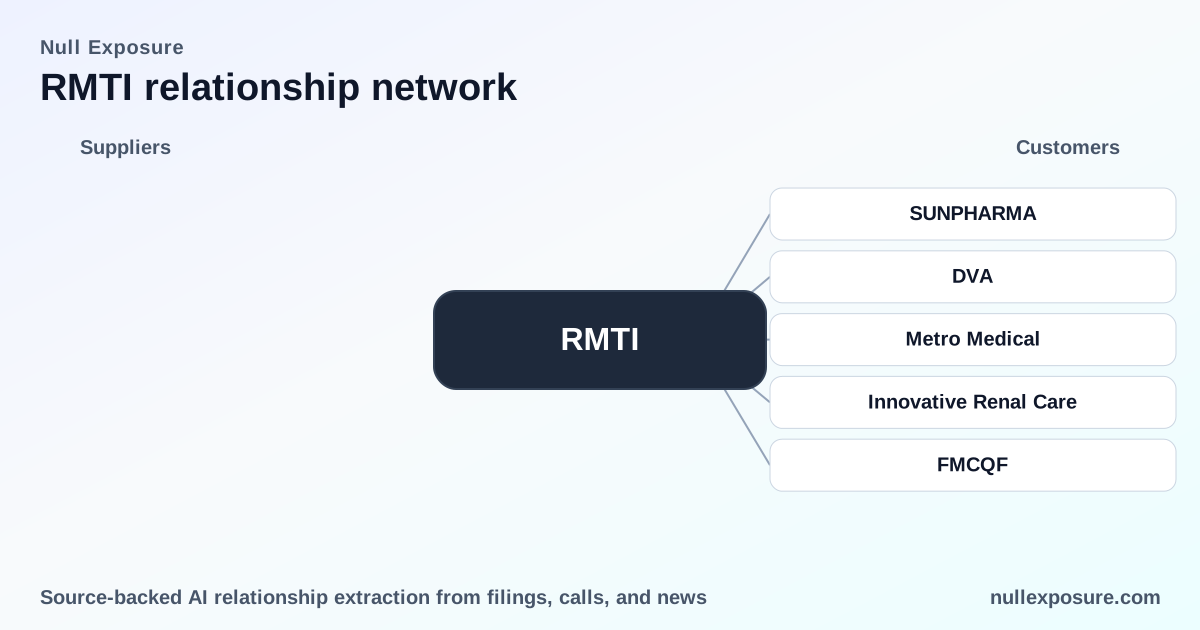
Rockwell Medical (RMTI): Customer relationships that drive revenue and risk
Rockwell Medical is a specialty supplier of hemodialysis concentrates and an iron-replacement therapy (Triferic) that monetizes through product sales to dialysis providers and through selective licensing agreements. Revenues are concentrated in dialysate concentrates sold directly to clinic groups and distributors, while Triferic’s commercialization has been expanded via exclusive licensing and distribution arrangements. Investors should view Rockwell as a manufacturing-and-supply business whose top-line trajectory depends on contract wins with large dialysis providers and select international licensing partners. For deeper company-relationship intelligence visit https://nullexposure.com/.
Key takeaways at a glance
- Customer concentration is real and material: a single customer historically accounted for ~45% of net product sales in 2024.
- Mix of long-term and spot commercial relationships: the company executes multi-year purchase agreements while also recognizing point-in-time product sales.
- Geography is primarily North America with international reach via licensing and distributors.
A set of short investment implications
- Strong multi-year contracts with major dialysis providers support predictable volumes, but loss of a major account would be material.
- International licensing (e.g., for Triferic) diversifies product channels but does not eliminate domestic concentration risk.
- Operational execution—manufacturing, delivery logistics and regulatory compliance—remains the gating factor for revenue retention and expansion.
Commercial constraints and operating model signals Rockwell’s customer evidence points to a hybrid operating model:
- Contracting posture: both long-term purchase agreements and point-in-time product sales coexist, indicating mixed revenue visibility. Evidence in filings describes multi-year purchase agreements while other revenue is recognized at delivery.
- Concentration: material customer concentration exists at the company level, not an isolated relationship; filings disclose one customer representing roughly 45% of net product sales in 2024.
- Criticality: supply relationships to major dialysis operators are operationally critical, given Rockwell’s role as a primary concentrate supplier to many clinics and the logistical complexity of delivering heavy liquid and dry concentrates.
- Geography and maturity: Rockwell is primarily U.S.-facing for hemodialysis concentrates but uses distributors and licensing partners for international reach; the business shows signs of early commercial maturity in concentrates combined with selective licensing maturity for Triferic.
If you want structured sourcing and relationship analytics tailored to diligence, explore further at https://nullexposure.com/.
What Rockwell supplies and to whom — relationship-by-relationship
DCI
Rockwell has a long-term agreement to supply and deliver concentrates to over 80% of DCI’s clinics, positioning DCI as a meaningful institutional customer under contract. This relationship was highlighted in Rockwell’s Q4 2025 earnings discussion and related transcripts in May 2026 (InsiderMonkey; Investing.com).
Innovative Renal Care (IRC)
Since transitioning supply in mid‑2025, Rockwell now supplies roughly 70% of IRC’s clinics with hemodialysis concentrates and provides both liquid/dry concentrates and the DAMX45 dry acid mixer system; the arrangement was described in company disclosures and a 2025 press release (InsiderMonkey; Yahoo Finance, FY2025–FY2026).
Concerto Renal Services (Concerto)
Rockwell reports that it supplies 100% of the facilities where Concerto provides dialysis services, reflecting a full-account relationship in Concerto’s operational footprint per Rockwell’s earnings commentary (InsiderMonkey; Investing.com, FY2026).
DaVita (DVA)
DaVita has been Rockwell’s single largest customer historically—accounting for approximately 45% of net product sales in 2024—but DaVita indicated it planned a transition to another supplier by mid‑2025, although discussions about contract extension and future volume commitments continued into 2025–2026. This concentration and the subsequent transition were disclosed in Rockwell’s 2024 10‑K and referenced during Q4 2025 commentary and market reports (Rockwell 2024 10‑K; Investing.com and QZ coverage, FY2024–FY2026). Notably, Rockwell’s disclosure explicitly links the DaVita relationship to a winding-down stage and materiality risk.
Fresenius Medical Care (Fresenius)
Rockwell entered a product purchase agreement in December 2024 to supply SteriLyte (liquid bicarbonate concentrate) for an initial three years with renewal options, and the company reported consistent supply through 2025 with expectations of growth in 2026. The Fresenius agreement is documented in Rockwell’s 2024 10‑K and reiterated in earnings call transcripts (Rockwell 2024 10‑K; InsiderMonkey/Investing.com, FY2024–FY2026).
Sun Pharmaceutical Industries (Sun Pharma)
For Triferic outside the U.S., Rockwell executed an exclusive licensing and supply agreement with a Sun Pharma subsidiary to commercialize Triferic in India, a deal announced in 2020 and reported in press coverage of the regulatory filing at the time (Economic Times coverage of the FY2020 filing).
Metro Medical (Cardinal Health)
Rockwell appointed Metro Medical (a Cardinal Health company) as an exclusive distributor for Triferic AVNU in the U.S., enabling commercial availability and simplified ordering since the product’s U.S. launch; this distribution arrangement was announced in a 2021 press release (GlobeNewswire, FY2021).
How these relationships shape investment risk and runway
- Revenue concentration is the principal balance-sheet risk. The DaVita concentration described in the 2024 10‑K creates near-term earnings sensitivity; a partial retraction by that customer materially affects volumes.
- Contract diversity moderates but does not eliminate risk. Multi-year agreements such as Fresenius (three-year term with renewals) and long-term supply to clinic groups like DCI and Concerto provide a layer of revenue stability.
- Execution and logistics are differentiators. Rockwell’s business is built on reliable manufacturing and delivery of heavy concentrates; wins of accounts after a rival exited suggest operational execution is allowing share gains in regional pockets (The Globe and Mail, FY2026).
Final read: where upside and vulnerability meet Rockwell has built a repeatable supply model to major dialysis providers and diversified commercialization of Triferic through licensing and distribution partners. Upside depends on converting multi-year agreements into sustained volume growth and replacing or recovering volumes from large clients that have transitioned away, while downside stems from customer concentration and the operational demands of large-scale supply.
For customers-and-contract level diligence and to model concentration scenarios, see more at https://nullexposure.com/.