RNAC (Cartesian Therapeutics): Customer relationships that shape near-term cash and strategic optionality
Cartesian Therapeutics operates as a clinical-stage biotechnology company that monetizes through collaboration and licensing agreements, selective manufacturing supply arrangements, and milestone-based payments tied to development and commercialization steps. Revenue is concentrated in a small set of strategic partners and periodic grants; liquidity events such as equity financings supplement operating cash while collaboration milestones drive episodic revenue recognition. For a concise overview of our research on counterparties and constraints, visit https://nullexposure.com/.
The business model in plain terms: licensing, services and concentrated counterparties
Cartesian’s operating model is partner-centric. The firm licenses intellectual property and development rights to collaborators (a primary revenue lever), provides manufacturing supply services as required, and receives government-sponsored R&D reimbursements where applicable. This structure produces lumpy, milestone-driven top-line performance and makes counterparty relationships critically important to near-term revenue visibility.
- Contracting posture: The company relies on licensing and collaboration agreements that shift development and commercialization risk to partners while preserving upside through milestone and royalty schedules.
- Concentration and criticality: Revenue depends on a handful of collaborators; when milestone recognition occurs in one period, revenue spikes and then declines in following periods if new milestones are not achieved.
- Maturity and stage: Cartesian is clinical-stage; many agreements are development-focused rather than commercial, limiting predictable product revenue.
- Counterparty mix: Relationships include institutional investors in financing rounds and global biopharma partners; government-sponsored research contracts are also part of the mix, supporting reimbursable-cost activity.
These signals imply high sensitivity of revenue to partner activity and financing cadence, and a need for investors to track both the timing of milestone triggers and the health of named collaborators.
Who pays Cartesian today — relationship-by-relationship
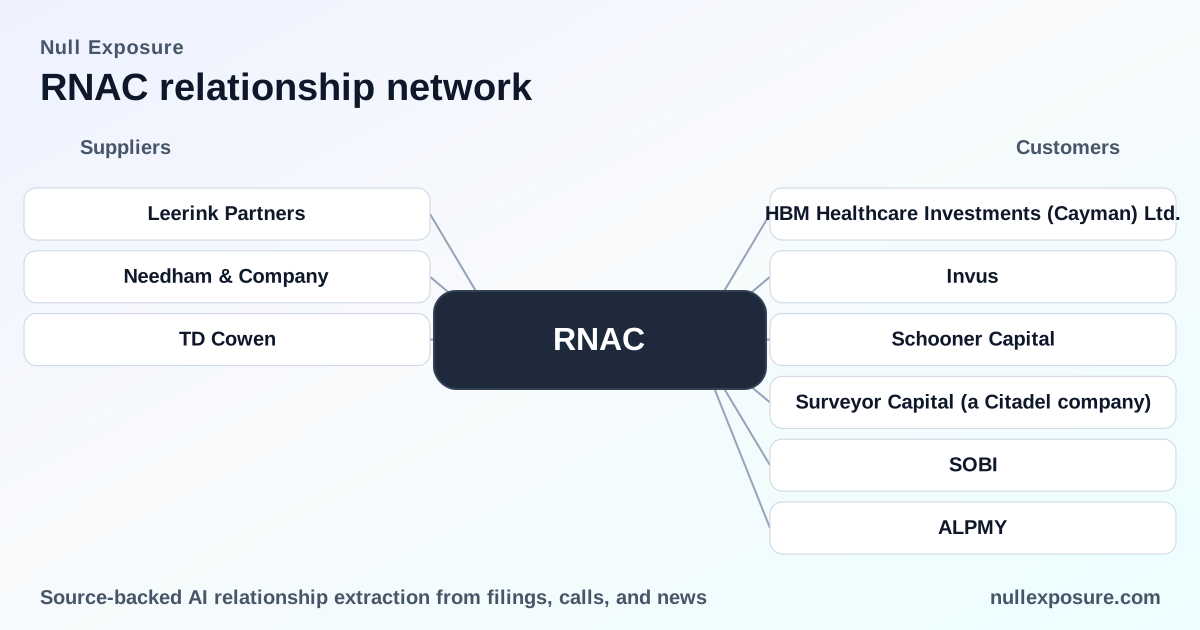
Surveyor Capital (a Citadel company)
Surveyor Capital participated as an institutional investor in Cartesian’s $130 million private placement equity financing. According to the company press release, Surveyor was listed among new and existing investors in the PIPE financing announced July 2, 2024 (GlobeNewswire, July 2, 2024 - https://www.globenewswire.com/news-release/2024/07/02/2907274/0/en/Cartesian-Therapeutics-Announces-130-Million-Private-Placement-Equity-Financing.html).
Invus
Invus also participated in the same private placement; its inclusion signals institutional appetite for Cartesian equity tied to the company’s development program and financing-driven liquidity support (GlobeNewswire press release, July 2, 2024 - https://www.globenewswire.com/news-release/2024/07/02/2907274/0/en/Cartesian-Therapeutics-Announces-130-Million-Private-Placement-Equity-Financing.html).
Schooner Capital
Schooner Capital joined the PIPE round as an investor, reinforcing the capital base that underpins ongoing R&D and the company’s runway to next clinical inflection points (GlobeNewswire press release, July 2, 2024 - https://www.globenewswire.com/news-release/2024/07/02/2907274/0/en/Cartesian-Therapeutics-Announces-130-Million-Private-Placement-Equity-Financing.html).
HBM Healthcare Investments (Cayman) Ltd.
HBM Healthcare Investments (Cayman) Ltd. was a participating institutional investor in the $130 million private placement, demonstrating healthcare-specialist fund support for Cartesian’s strategic plan (GlobeNewswire press release, July 2, 2024 - https://www.globenewswire.com/news-release/2024/07/02/2907274/0/en/Cartesian-Therapeutics-Announces-130-Million-Private-Placement-Equity-Financing.html).
SOBI (Swedish Orphan Biovitrum AB)
Sobi is a named collaborator whose prior milestone recognitions contributed materially to collaboration and license revenue; the company’s revenue mix shifted downward in collaboration income after Sobi- and Astellas-related milestones were recognized in an earlier period, according to a TradingView summary of Cartesian’s FY2025/2026 filings (TradingView summary of Cartesian Therapeutics 2025 10‑K, reported March 2026 - https://www.tradingview.com/news/tradingview:783c3910d2452:0-cartesian-therapeutics-2025-10-k-revenue-2-8m-net-loss-130-3m/). Sobi represents a global licensing counterparty under which Cartesian has recognized milestone revenue.
Astellas
Astellas is another strategic collaborator referenced in Cartesian’s revenue history; collaboration and license revenue declined after milestone recognitions linked to Astellas, as summarized in the company’s filings (TradingView summary of Cartesian Therapeutics 2025 10‑K, reported March 2026 - https://www.tradingview.com/news/tradingview:783c3910d2452:0-cartesian-therapeutics-2025-10-k-revenue-2-8m-net-loss-130-3m/). Company disclosures document that Astellas notified Cartesian of its intention to terminate the Astellas Agreement (notice in March 2024) with the termination effective June 6, 2024; that termination is a material contract-stage event affecting future collaboration revenue.
Key constraints and what they tell investors
Cartesian’s disclosures and transaction history generate actionable constraints that characterize the operating profile:
- Licensing is the primary contract type. Company disclosures explicitly state revenue is generated through collaboration and license agreements, making licensing the dominant commercial mechanism and creating episodic revenue patterns tied to milestone timing. This is a company-level signal tied to how revenue is recognized and forecasted.
- Government-sponsored contracts exist. The company has arrangements with government-sponsored organizations for reimbursable R&D, providing a non-dilutive complement to collaborator-funded work and a partial stabilizer for near-term cash flow.
- Global reach in key licenses. The Sobi license was granted on an exclusive, worldwide basis (excluding Greater China for one program), signaling the company negotiates global rights that can deliver large-scale commercial upside if clinical programs succeed.
- Roles vary between buyer and service provider. Cartesian functions both as a licensor/service provider (manufacturing supply and development support) and as a party sensitive to buyer-side procurement and regulatory scrutiny; this dual role influences contracting terms and compliance exposure.
- Contract stage volatility — terminated agreements matter. The Takeda agreement was terminated effective July 25, 2023, and Astellas terminated its agreement effective June 6, 2024; those terminations are explicit contract-stage events that reduce the pipeline of potential milestone payments and alter portfolio risk. These are named relationship signals drawn from company disclosures.
- Segments include manufacturing and services in addition to core product development. The company evaluates manufacturing supply services as distinct arrangements that can convert development activities into recurring supply commitments; this adds optionality but also operational complexity.
Investment implications and monitoring checklist
Cartesian’s revenue and valuation dynamics are driven by a small set of collaborators and intermittent financings. Key investor actions:
- Monitor milestone windows for Sobi-related programs and any residual payments from terminated partners.
- Track the timing and terms of manufacturing supply commitments that could convert development activity into recurring revenue.
- Watch institutional investor activity and follow-on financings as indicators of capital access and dilution risk.
For an integrated view of counterparties, contracts and risk exposure that helps underwrite a return profile, explore our research portal at https://nullexposure.com/.
Bold takeaways: Cartesian monetizes primarily through licensing and milestone-driven collaborations; revenue is concentrated and episodic; recent partner terminations materially reduce near-term milestone visibility. Investors should price in event-driven revenue volatility and prioritize tracking collaborator milestones and financing cadence.