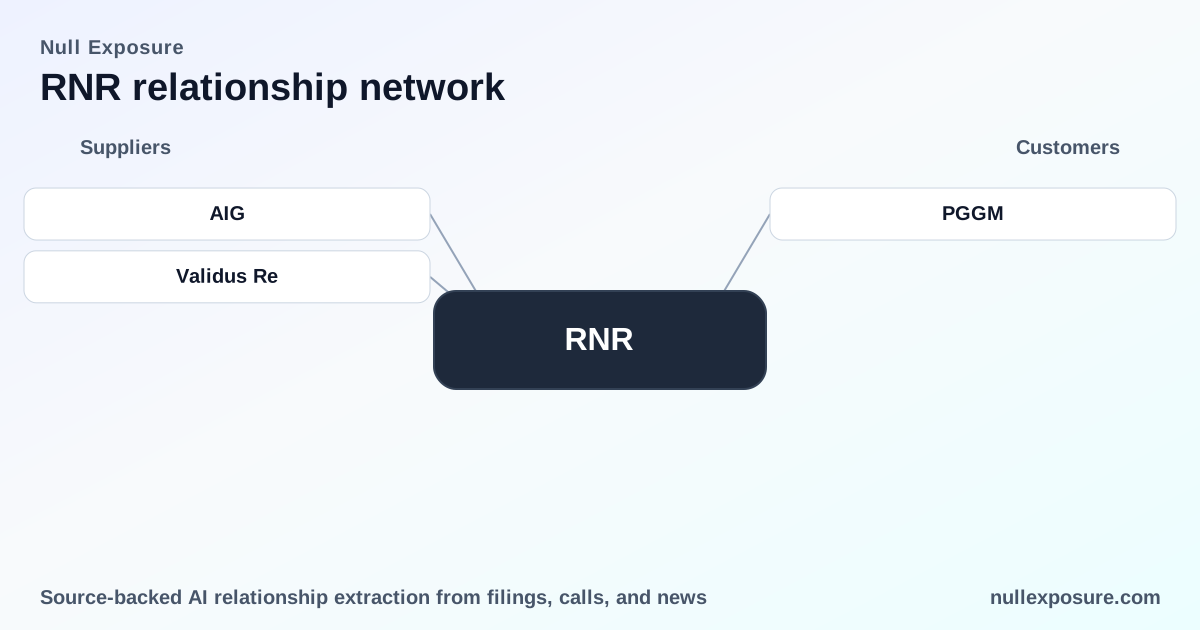
RenaissanceRe (RNR) — Customer Relationships That Drive Fees, Capital Sharing and Reinsurance Recoverables
RenaissanceRe underwrites property, casualty and specialty reinsurance globally while also monetizing capital-management services: the company earns underwriting margins on ceded risk and fee income from managed vehicles and sidecars that deploy third‑party capital. Investors should value RNR both as a traditional reinsurer and as an asset-manager/fee platform — underwriting economics create core profits while joint ventures and ILS-style partnerships generate volatile but material fee and profit‑share contributions.
For a closer look at counterparties and counterparty exposure dynamics, see NullExposure for structured counterparty intelligence: https://nullexposure.com/
How RNR turns underwriting and capital solutions into revenue
RenaissanceRe operates a dual revenue model. First, it sells reinsurance to insurers and intermediaries on either a worldwide or regionally limited basis and realizes premiums and underwriting profit. Second, it sponsors and manages third‑party capital vehicles, JVs and sidecars — collecting management and performance fees and sharing underwriting profits with third‑party investors. That mix explains why fee income and profit‑share flows are material to reported net income, and why investor focus should extend beyond loss ratios to the economics of its managed-capital programs.
Key customer relationships that matter to the P&L and balance sheet
DaVinci — the performance‑fee engine
DaVinci is a managed vehicle that generated $94 million of fee income in the most recent quarter, split into $48 million of management fees and $46 million of performance fees, with incremental upside from deferred performance fees recognized on a return of capital. This positions DaVinci as a clear fee driver for RNR’s non‑underwriting earnings. According to the RenaissanceRe Q1 2026 earnings transcript, fee detail was disclosed in the company’s commentary (RenaissanceRe Q1 2026 earnings transcript, Apr 2026; also discussed in the Q1 transcript coverage published May 2026).
Takeaway: DaVinci materially contributes recurring management fees and lumpy performance fees that amplify earnings volatility but increase ROE when underwriting is favorable.
PGGM — ILS investor and JV profit partner
RenaissanceRe shares underwriting profits with redeemable noncontrolling interests backed by ILS investors such as PGGM. For Q2, RenRe reported sharing $328.3 million of net income with third‑party capital investors driven by DaVinci‑style sidecars and the Vermeer Re JV that PGGM backs, highlighting direct profit transfer to external capital partners as a lever on reported net income. The profit‑share disclosure was reported in Artemis (Mar 2026).
Takeaway: Third‑party capital relationships like the one with PGGM are a core distribution and capital‑efficient underwriting channel that materially affect consolidated earnings allocation.
MKL — concentrated reinsurance recoverable exposure
MKL disclosed that, as of December 31, 2024, the largest reinsurance balance due from RenaissanceRe represented 19% of MKL’s reinsurance recoverables before reinsurance allowances and collateral, indicating a sizable cedant‑level exposure to RNR on MKL’s balance sheet (MKL Form 10‑K, FY2024).
Takeaway: Large cedant recoverables such as MKL’s 19% concentration are a reminder that RNR shows up as a counterparty on material receivables for major insurers — a balance‑sheet linkage that matters in stress scenarios.
What the relationship constraints tell investors about operating posture
RenaissanceRe’s relationship signals combine to paint a coherent operating model:
- Contracting posture — short‑term and renewing: Renewal language tied to the January 1, 2026 renewals indicates a short‑term, annual renewal cadence for substantial portions of the book, consistent with reinsurance market practice. This creates frequent repricing opportunities and cyclical revenue sensitivity.
- Counterparty type — large enterprises: The firm underwrites and deals primarily with large insurers and intermediaries worldwide; its counterparty set is institutional and enterprise‑grade.
- Geographic footprint — global with North American concentration: Coverages are offered worldwide while a meaningful portion of exposure is North America (U.S. & Caribbean line items cited), so regional loss events and regulatory regimes materially impact performance.
- Relationship roles — both buyer and seller: RNR is simultaneously a seller of reinsurance to cedants and a buyer of reinsurance protection to manage its own portfolio volatility, indicating active risk transfer and hedging behavior.
- Segment focus — services and large spend bands: The company’s model blends traditional insurance services with capital‑management services; total gross premiums written run at a scale consistent with the disclosed $11.7 billion figure, placing many customers in a $100M+ spend band.
- Maturity and criticality: Managed funds and JVs are established channels for capital deployment and fee generation, making RNR both an underwriting counterparty and a critical allocator of third‑party capital.
Collectively, these constraints imply a capital‑efficient underwriting franchise that is sensitive to pricing cycles, geographically diversified but North‑America weighted, and increasingly dependent on fee and profit‑share economics from third‑party capital.
Investment implications: concentrated recoverables, fee volatility, and counterparty complexity
- Earnings mix is changing. Fee income — exemplified by DaVinci’s $94M quarter — and profit sharing (e.g., the $328.3M shared with third‑party investors) are significant and will continue to amplify quarter‑to‑quarter volatility in reported net income. Investors should re-weight valuations to account for non‑underwriting earnings drivers.
- Counterparty credit and recoverable concentration are real risks. MKL’s disclosure that a single RNR receivable represented 19% of its reinsurance recoverables underscores potential balance‑sheet linkages that could transmit stress across counterparties in adverse scenarios.
- Renewal dynamics create tactical opportunity and risk. Annual renewals and a short‑term contracting posture let RNR reprice aggressively when market conditions tighten, but also expose revenue to rate deterioration in soft markets.
- Capital alignment with institutional investors is strategic but dilutive to consolidated profit. Partnerships with large ILS investors such as PGGM attract capital but mean RNR shares underwriting upside with external investors — a tradeoff between growth of written premium and retained profit.
What investors and operators should do next
- Review recent earnings transcripts and JV disclosures to quantify recurring fee streams versus one‑offs; track deferred performance fee mechanics reported in Q1 2026.
- Stress test balance‑sheet scenarios for counterparty recoverables, using MKL‑level concentration as a benchmark for material exposures.
- Monitor annual renewal outcomes (January renewals historically critical) for pricing trajectory and portfolio mix changes.
For more structured counterparty profiles and relationship analytics visit NullExposure: https://nullexposure.com/
Bottom line
RenaissanceRe is both a reinsurer and a capital‑management platform: underwriting profits and large premium pools create the base business, while managed vehicles and partnered ILS capital deliver fee income and shared profits that materially affect reported earnings and volatility. Investors should balance favorable underwriting metrics against counterparty concentration on recoverables and the structural effect of third‑party capital partnerships on consolidated earnings.