RenaissanceRe (RNR-P-F): Capital markets, retrocession and a strategic capital-vehicle relationship
RenaissanceRe monetizes through traditional and alternative reinsurance channels: underwriting property and casualty risks, managing investment float, and accessing the capital markets to transfer peak catastrophe exposure. The company leverages structured retrocession and collateralized reinsurance (cat bond) issuance to protect earnings volatility while preserving underwriting capacity — a model that generates underwriting margin and recurring fee income from investment management and capital transactions. For a concise, investor-focused view of customers and partner capital vehicles, visit https://nullexposure.com/.
Why the Mona Lisa Re placement matters for holders of RNR-P-F
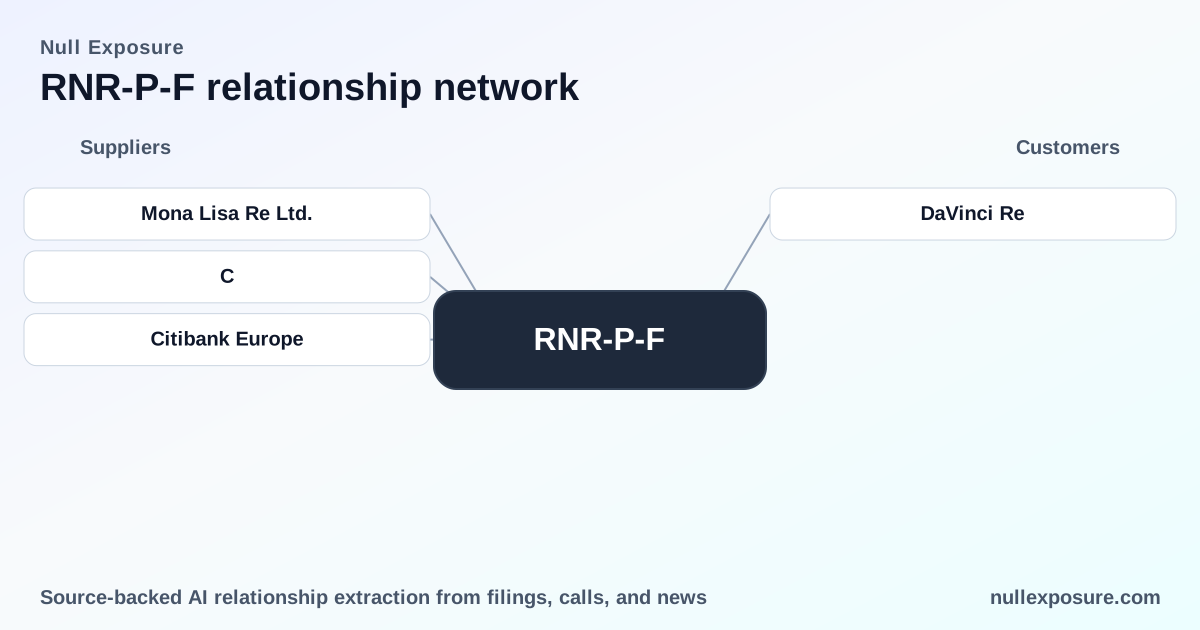
RenaissanceRe’s return to the cat bond market in early 2026 is not a one-off funding exercise; it is an operational lever that reduces tail-risk volatility and complements balance-sheet capital. The Mona Lisa Re 2026-1 transaction was structured as multi-peril catastrophe retrocessional reinsurance intended to cover both RenaissanceRe’s own portfolio and that of its flagship partner capital vehicle, DaVinci Re. The deal was launched with a $200 million target and was upsized to $400 million, demonstrating investor demand for RenRe-sponsored collateralized capacity and the firm’s willingness to move risk into the capital markets rather than retain it on-balance-sheet. According to Artemis.bm coverage in March 2026, the upsized issuance underlines RenRe’s active use of capital markets to shape its risk profile and protect return metrics.
How the operating model shows up in practice
RenaissanceRe’s commercial posture and strategic choices reveal a set of company-level operational signals that matter to investors evaluating preferred shares exposure:
- Contracting posture — portfolio-level hedging and reinsurance-first strategy. RenaissanceRe combines treaty reinsurance with retrocessional placements and cat bonds, signaling a preference for transferring high-severity risk rather than concentrating it on the balance sheet.
- Concentration — diversified but selectively focused. The firm writes global property & casualty reinsurance and supplements with investment management activities; its use of partner capital vehicles like DaVinci Re indicates concentrated, high-value relationships rather than broad retail distribution exposure.
- Criticality — strategic to loss-absorbing capacity. Capital-vehicle partnerships and collateralized reinsurance lines are central to the company’s ability to underwrite large catastrophe layers without impairing statutory capital.
- Maturity — established market presence with repeat capital-market issuance. RenaissanceRe’s history of cat bond placements and retrocessional transactions positions it as a mature sponsor capable of accessing institutional capital reliably.
These operational signals are company-level characteristics inferred from RenaissanceRe’s public posture and the Mona Lisa Re placement; they are not sourced constraints tied to a single counterparty.
Relationship readout: DaVinci Re (concise)
DaVinci Re is RenaissanceRe’s flagship partner capital vehicle for the Mona Lisa Re 2026-1 placement; the transaction covered both RenRe’s portfolio and DaVinci Re exposure and was upsized from a $200 million initial target to $400 million, illustrating a close strategic link between sponsor and vehicle and robust market demand for the structure. According to Artemis.bm reporting on March 10, 2026, the placement was explicitly designed as multi-peril catastrophe retrocessional reinsurance for RenRe and DaVinci Re.
What this relationship implies for investors in RNR-P-F
The RenaissanceRe–DaVinci Re connection is a window into three investment-relevant dynamics:
- Capital efficiency and risk transfer. Using a capital vehicle plus cat bond reduces pressure on statutory capital and supports underwriting throughput without increasing leverage in the conventional sense. That dynamic is credit-supportive for preferred shareholders if underwriting discipline holds.
- Dependency on capital markets. Upsized placements show investor appetite but also indicate that RenRe relies on third-party capital for peak layers. During market dislocations, that channel can tighten and increase cost; however, successful 2026 placement suggests current access is strong.
- Partner alignment and execution risk. The use of a flagship vehicle like DaVinci Re signals long-term collaboration; execution on these structures is operationally complex but critical to RenRe’s loss-mitigation strategy.
Short checklist for analysts and operators
- Confirm frequency and size of RenRe-sponsored capital-market placements over the trailing 3–5 years to gauge reliance.
- Monitor pricing and oversubscription signals on new placements as a real-time liquidity indicator.
- Track partner vehicle performance and collateralisation terms; a flagship vehicle like DaVinci Re is a material counterparty to underwriting outcomes.
Relationship catalogue (all items)
- DaVinci Re — RenaissanceRe returned to the cat bond market with Mona Lisa Re 2026-1 to secure multi-peril catastrophe retrocessional reinsurance for its own portfolio and that of its flagship partner capital vehicle, DaVinci Re; the issuance was upsized from an initial $200 million to $400 million. Source: Artemis.bm, March 10, 2026.
For additional context on how sponsored capital vehicles and collateralized reinsurance affect reinsurance sponsors’ balance sheet mechanics and credit profiles, see the research and client resources at https://nullexposure.com/.
Bottom line for investors
RenaissanceRe’s use of the Mona Lisa Re 2026-1 structure and its partnership with DaVinci Re are evidence of a disciplined capital-markets strategy: transfer tail risk, preserve underwriting capacity, and maintain capital efficiency. For investors in RNR-P-F, the critical takeaways are reliability of risk transfer channels, dependence on institutional capital appetite, and operational maturity in structuring collateralized transactions. These factors collectively support the company’s stable positioning — while also flagging liquidity- and market-access risk as the primary external exposures that require active monitoring.