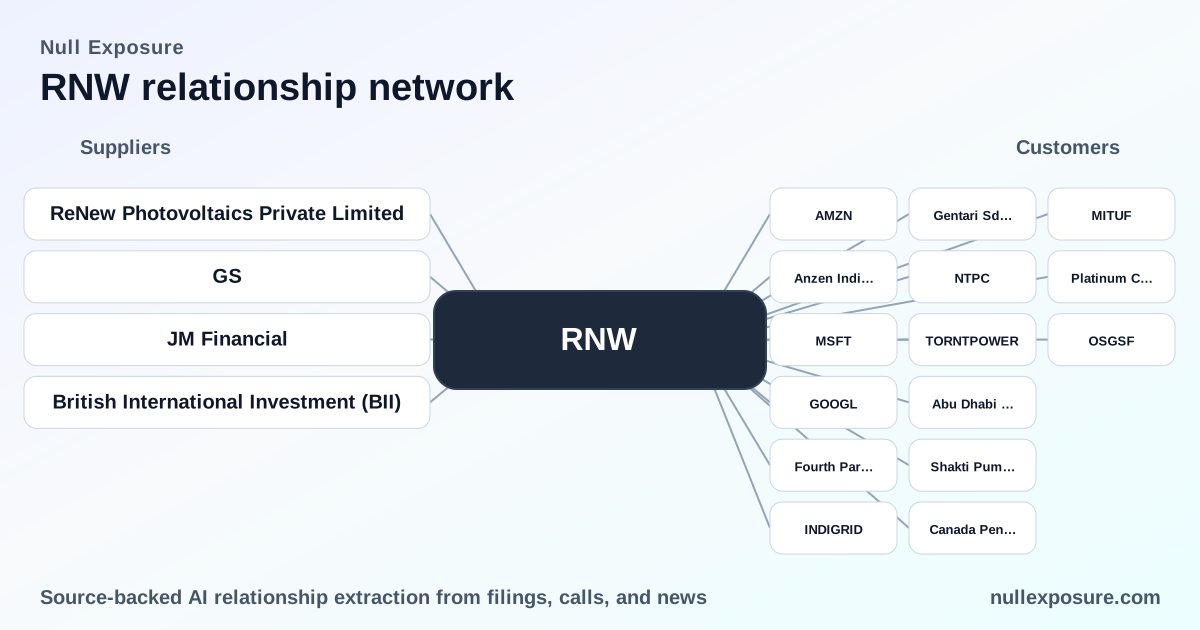
RNW: Customer Map, Commercial Signals, and What Investors Should Know
Renew Energy Global PLC (RNW) builds and sells renewable generation capacity and monetizes through a mix of long-term power purchase agreements (PPAs) with corporate and government buyers, asset sales and portfolio carve-outs to infrastructure investors, and strategic partnerships that unlock capital and distribution. Recent public reporting ties roughly 1.3 GW of capacity to long-term agreements with major technology companies, while separate transactions show active portfolio monetization to yield vehicles and utilities—an operating model that blends contracted earnings with recurring asset rotation to fund growth. For a concise company dataset and relationship dashboards, view NullExposure’s summary at https://nullexposure.com/.
The commercial thesis in one line
RNW delivers predictable cashflow from PPAs with large corporate counterparties while accelerating growth through strategic disposals to infrastructure buyers, creating a cash-rotate-and-build cycle that supports aggressive capacity additions without fully relying on balance-sheet funding.
Why these counterparties matter to returns and risk
- Contracting posture: RNW’s revenue stream is anchored by long-term agreements with global technology firms and government agencies, producing stable forward cashflow and lower merchant exposure.
- Concentration and criticality: The presence of a handful of large corporate customers increases the importance of a small set of counterparties for a material tranche of capacity; that amplifies counterparty concentration risk but also raises the value of RNW’s contracted portfolio.
- Maturity & capital strategy: Frequent asset sales and partnerships with pension/infrastructure buyers signal a mature capital recycling strategy—monetize operating assets to fund new project development.
- Counterparty mix: RNW’s buyers span global tech, domestic utilities, infrastructure funds and specialized yield vehicles, which improves exit options for assets and provides diversified pathways to monetize projects.
Explore RNW relationship analytics on NullExposure for a compact view: https://nullexposure.com/.
Counterparties and what each relationship signals
Microsoft
ReNew reports roughly 1.3 GW of capacity secured under long-term agreements that include Microsoft as a headline corporation, indicating multi-year contracted volume with high-quality credit supporting RNW’s cashflow profile. Source: SolarQuarter, Mar 17, 2026; Intellectia.ai, May 2026.
Google is cited alongside Microsoft and Amazon in RNW disclosures as a long-term offtaker for approximately 1.3 GW of capacity, underscoring institutional-grade corporate PPAs in RNW’s portfolio. Source: SolarQuarter, Mar 17, 2026; MarketScreener, Dec 2025/Mar 2026.
Amazon
RNW has both historical and ongoing supply relationships with Amazon, including a disclosed 210 MW solar supply agreement (FY2022) and inclusion in the cohort forming ~1.3 GW of corporate PPAs, demonstrating repeatable scale sales to major cloud retailers. Source: SolarQuarter (May 11, 2022); Economic Times (FY2025 coverage).
Solar Energy Corporation of India (SECI)
A material portion of RNW’s project pipeline has historically been contracted to central government agencies such as SECI, reflecting tender-driven, government-backed revenue that complements corporate PPAs. Source: IPO-Edge (transaction summary, FY2021).
NTPC Limited
RNW lists NTPC among its significant public-sector partners, illustrating strategic collaboration with India’s central utilities for large-scale projects and industrial partnerships. Source: IPO-Edge (FY2021); SolarQuarter (May 20, 2025).
Anzen India Energy Yield Plus Trust
RNW completed a sale of an operational 300 MW solar asset to Anzen India Energy Yield Plus Trust for approximately USD 176 million, highlighting RNW’s use of yield vehicles to crystallize value on operating projects. Source: Times of India, FY2024.
Fourth Partner Energy
RNW sold a 138 MW rooftop solar portfolio to Fourth Partner Energy (TPG-backed), demonstrating domestic rooftop monetization and third-party distribution of assets to specialist operators. Source: Economic Times (FY2025).
IndiGrid
RNW sold a combination of transmission and a 300 MW solar project to KKR-sponsored IndiGrid (acquisition described at ~Rs 2,100 crore), showing RNW’s access to listed infrastructure platforms for bulk disposals. Source: Economic Times (FY2025).
Gentari Sdn. Bhd.
Gentari agreed to acquire a 49% stake in a 403 MW project from RNW, indicating regional strategic partnerships and minority stake sales as part of RNW’s capital-management toolkit. Source: SimplyWall.St (transaction history, FY2021).
Torrent Power
Media reports link Torrent Power with discussions to acquire up to 1.1 GW of RNW capacity, reflecting RNW’s engagement with large private utilities as potential buyers or offtakers. Source: SimplyWall.St (FY2021 reporting).
Shakti Pumps
RNW has cited partnerships with industrial equipment companies like Shakti Pumps, which supports industrial and distributed-energy relationships that underpin some project commercial terms. Source: SolarQuarter (May 20, 2025).
Abu Dhabi Future Energy Company (Masdar)
Masdar appears in non-binding proposals around ownership stakes in RNW, showing strategic interest from international sovereign energy investors in RNW’s asset base. Source: SimplyWall.St (FY2021 coverage).
Canada Pension Plan Investment Board (CPP Investments)
CPP is reported among investors that put forward acquisition proposals for RNW minority stakes, signaling large-institution interest and potential sources of long-term capital. Source: SimplyWall.St (FY2021).
Mitsui
Mitsui is reported as a bidder for RNW’s commercial and industrial portfolio, illustrating Japanese strategic investor appetite for RNW’s corporate-supply franchises. Source: SimplyWall.St (FY2021).
Platinum Cactus A 2019 Trust
Platinum Cactus appears in listed bidders alongside CPP and Masdar in non-binding transaction proposals, which indicates private-trust investor participation in potential RNW ownership changes. Source: SimplyWall.St (FY2021).
Osaka Gas
Osaka Gas is reported as a bidder for RNW’s commercial & industrial assets, reflecting utility-scale interest from energy incumbents in RNW’s C&I pipeline. Source: SimplyWall.St (FY2021).
Sembcorp
RNW sold 300 MW of solar projects to Sembcorp in a transaction referenced at roughly $190 million, demonstrating cross-border corporate purchases from Singapore-based utilities as an exit route. Source: LiveMint, FY2026.
Operational constraints and business-model signals
The dataset contains no discrete constraints entries; however, RNW’s relationship set itself yields clear operating characteristics: RNW runs a contract-first development model anchored by long-term PPAs with high-credit counterparties and active portfolio rotation to institutional buyers. This combination implies:
- A conservative contracting posture for revenue-bearing assets (long-dated PPAs reduce merchant volatility).
- Concentration risk concentrated around a small group of large corporate and government buyers for meaningful tranches of capacity.
- High commercial maturity—the company routinely executes asset sales to yield investors and infrastructure funds, showing repeatable monetization channels.
- Strategic optionality due to a diversified buyer universe (tech corporates, utilities, infra funds, sovereign investors).
These are company-level operating signals derived from the documented counterparties and transactions.
Implications for investors
- Upside: Long-term PPAs with Microsoft, Google and Amazon, plus institutional takeouts (IndiGrid, Sembcorp, Anzen), support valuation through durable contracted cashflows and repeatable monetization events.
- Risk: Counterparty concentration and reliance on asset sales to recycle capital expose RNW to negotiation and timing risk in exit markets; regulatory developments in core markets remain a watch item.
- Catalysts to monitor: Announcements of additional corporate PPAs, pace of asset disposals to institutional buyers, and any binding offers from strategic investors like Masdar or CPP.
For a focused view of RNW counterparties, deal chronology and exposure analysis, visit NullExposure’s relationship dashboard at https://nullexposure.com/.