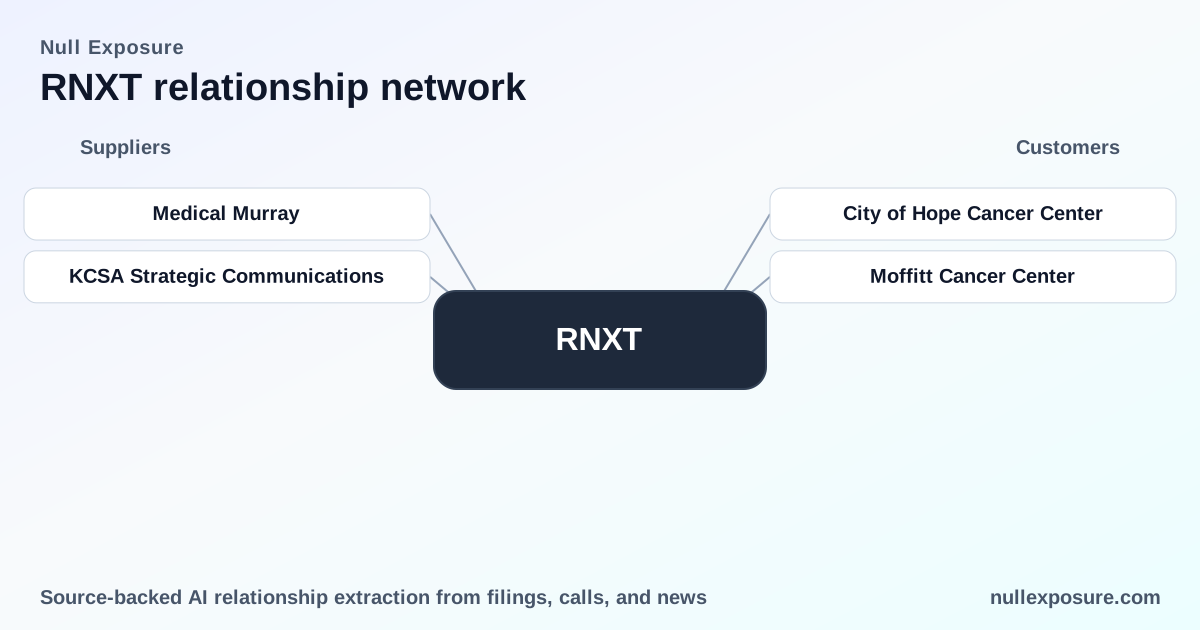
RNXT Customer Brief: RenovoRx’s early commercial traction with leading cancer centers
RenovoRx operates as a clinical-stage oncology company that has transitioned from purely investigational activity to direct device sales of its RenovoCath delivery system, monetizing through unit sales to hospitals and cancer treatment centers in the United States. The commercial strategy is concentrated and tactical: sell RenovoCath as a standalone, FDA-cleared hardware product to high-volume cancer centers while clinical development continues to underpin future demand for drug–device combinations. Investors should value RNXT as a small, US-centric medical-hardware commercial roll‑out layered on a broader therapeutic development pipeline.
Learn more about how we capture and interpret these customer relationships at https://nullexposure.com/.
How RenovoRx makes money and how the commercial motion looks in practice
RenovoRx’s revenue engine today is straightforward: sell RenovoCath devices directly to hospitals and cancer centers and scale deployments into high-throughput oncology centers that can integrate the device into interventional oncology workflows. The company reported initial commercial orders late in 2024 and recorded a modest initial revenue contribution in that quarter; full-year trailing revenue remains small relative to enterprise valuation, reflecting an early-stage commercial ramp combined with ongoing R&D spend.
- Business model driver: Unit sales of an FDA-cleared delivery system positioned for targeted solid tumor interventions.
- Customer profile: Large hospitals and cancer centers (enterprise healthcare buyers) in the U.S.
- Stage: Early, ramping commercial adoption with limited historical spend per customer.
What the customer relationships tell investors
RenovoRx’s customer signal comes from public reporting and media coverage of commercial availability and account additions. The company’s approach to contracting and sales is indicative of a U.S.-only, hospital-focused commercialization posture with an emphasis on scaling a small number of high-value clinical adopters.
- Contracting posture: Company-level evidence indicates sales occur via purchase orders and potentially governed by master sales agreements and standard terms and conditions, consistent with a framework contract approach to institutional buyers.
- Concentration and counterparty type: Customers are large enterprise healthcare organizations—hospitals and specialized cancer centers—implying longer sales cycles, internal procurement governance, and higher strategic value per account.
- Criticality and spend: Current spend per account is small in absolute dollars (initial revenues were sub-$100k), but accounts are strategically important as early adopters that validate clinical utility and create referral visibility.
- Geographic focus and maturity: All revenues and assets are U.S.-centric, and commercialization is at an early ramp stage following a late‑2024 launch.
Relationship roll call: who’s adopting RenovoCath
Below are the customer relationships surfaced in public reporting. Each entry includes a concise, plain-English summary and a source reference.
City of Hope Cancer Center — commercial access expanded in FY2026
City of Hope in Duarte, California was added to the list of active commercial cancer centers eligible to order and use RenovoCath as RenovoRx expanded its commercial footprint. According to Investing News on March 10, 2026, RenovoRx increased the number of active commercial centers from five in September 2025 to nine, with City of Hope among the newly added centers. (Investing News, March 10, 2026: https://investingnews.com/renovorx-expands-renovocath-r-commercial-adoption-to-nine-active-cancer-centers-including-city-of-hope-cancer-center-and-moffitt-cancer-center/)
Moffitt Cancer Center — another strategic oncology adopter in FY2026
Moffitt Cancer Center in Tampa, Florida was identified as one of the centers newly eligible to order and use RenovoCath under RenovoRx’s expanded commercial program. Investing News reported on March 10, 2026 that Moffitt was part of the expansion that raised the active commercial centers to nine. (Investing News, March 10, 2026: https://investingnews.com/renovorx-expands-renovocath-r-commercial-adoption-to-nine-active-cancer-centers-including-city-of-hope-cancer-center-and-moffitt-cancer-center/)
What these relationships imply for commercial risk and upside
The two named relationships are high-signal, high-value endorsements because both City of Hope and Moffitt are prominent cancer centers with strong referral networks and research pedigree. Their adoption converts clinical credibility into commercial optionality, but the current revenue impact is small relative to RNXT’s valuation.
Key implications:
- Validation over volumes: Early signings at prestigious centers prioritize clinical validation and downstream referral economics over immediate revenue scale.
- Procurement friction: Large cancer centers operate with institutional procurement processes and contracting standards, which supports the company-level signal that sales will rely on purchase orders and master agreements.
- Concentration risk: With a small number of active commercial sites, revenue concentration and customer dependence introduce volatility until the account base broadens beyond a handful of centers.
Constraints as company-level operating signals
Public disclosures and earnings commentary reveal constraints that shape RenovoRx’s go-to-market profile:
- Framework contracting likely governs sales — the company references purchase orders governed in some cases by master sales agreements and standard terms. This implies predictable legal terms but slower onboarding.
- Customers are large enterprise hospitals and cancer treatment centers, requiring clinical evidence, administrative approvals, and tailored support during adoption.
- Geographic concentration in the U.S. is explicit: all assets and revenues are U.S.-derived, constraining near-term international upside but simplifying regulatory and reimbursement strategy.
- Commerciality is early and ramping — revenue history is limited (initial Q4 2024 RenovoCath revenue was approximately $43k), placing the company in a validation-to-scale transition.
- Core product is hardware-centric today, sold as a standalone device, which produces lower recurring revenue unless tied to consumables or integrated therapeutic regimens.
- Current transaction scale is small (sub-$100k spend band) — useful for validating workflows but insufficient to materially reposition top-line metrics until adoption broadens.
Risks and operational focus for operators and investors
- Execution risk dominates near term. Converting high-profile centers into repeat buyers and expanding the account base are the immediate operational priorities.
- Commercial cadence is slow but strategic. Expect long institutional sales cycles and episodic revenue recognition as centers place orders and integrate the device.
- Clinical-program synergy is essential. Upside depends on converting device adoption into drug-device combination opportunities that drive larger, recurring revenue streams and higher margin economics.
For investors and operators tracking customer-level momentum, watch announced additions of Tier 1 cancer centers and any evidence of repeat orders or center-to-center referral acceleration as the clearest leading indicators of commercial scale.
Learn about how we map and analyze these commercial relationships at https://nullexposure.com/.
Bottom line
RenovoRx has executed a disciplined, U.S.-focused commercial entry for RenovoCath targeted at large cancer centers that provide clinical validation and potential referral pathways. The addition of City of Hope and Moffitt to the active ordering list is material from a credibility and adoption standpoint, but revenue impact remains small and concentrated. Investors should value RNXT on a hybrid basis: early hardware sales that de‑risk implantation and follow-on commercial potential tied to the broader therapeutic pipeline.