Construction Partners (ROAD): customer profile, contract posture, and counterparties that matter
Construction Partners, Inc. operates as a vertically integrated civil infrastructure firm that builds and maintains highways across the Sunbelt and monetizes through long‑term construction contracts, materials sales (hot‑mix asphalt, aggregates, liquid asphalt cement) and ancillary site‑development services. Revenue is recognized over time as projects progress, giving the business predictable near‑term revenue visibility from backlog while exposing it to public funding cycles and execution risk. For a concise snapshot of the firm and sources used in this note, visit https://nullexposure.com/.
Where revenue comes from and what that implies for investors
Construction Partners generates the majority of its revenue from publicly funded projects and third‑party materials sales, with state departments of transportation (DOTs) concentrated in its customer mix. According to the company’s FY2025 Form 10‑K, projects for various DOTs accounted for 43.4% of consolidated revenues in fiscal 2025, and publicly funded projects plus third‑party sales represented roughly 65% of fiscal 2025 revenues. The company recognizes revenue over time for long‑term construction contracts, and at September 30, 2025 it reported $2.19 billion of unsatisfied or partially unsatisfied performance obligations, with approximately $1.77 billion expected to be earned in fiscal 2026 and the remainder thereafter (FY2025 10‑K). These facts create high near‑term visibility from backlog but concentrate execution and political‑funding risk in the public sector.
Bank counterparties: financing that underpins expansion
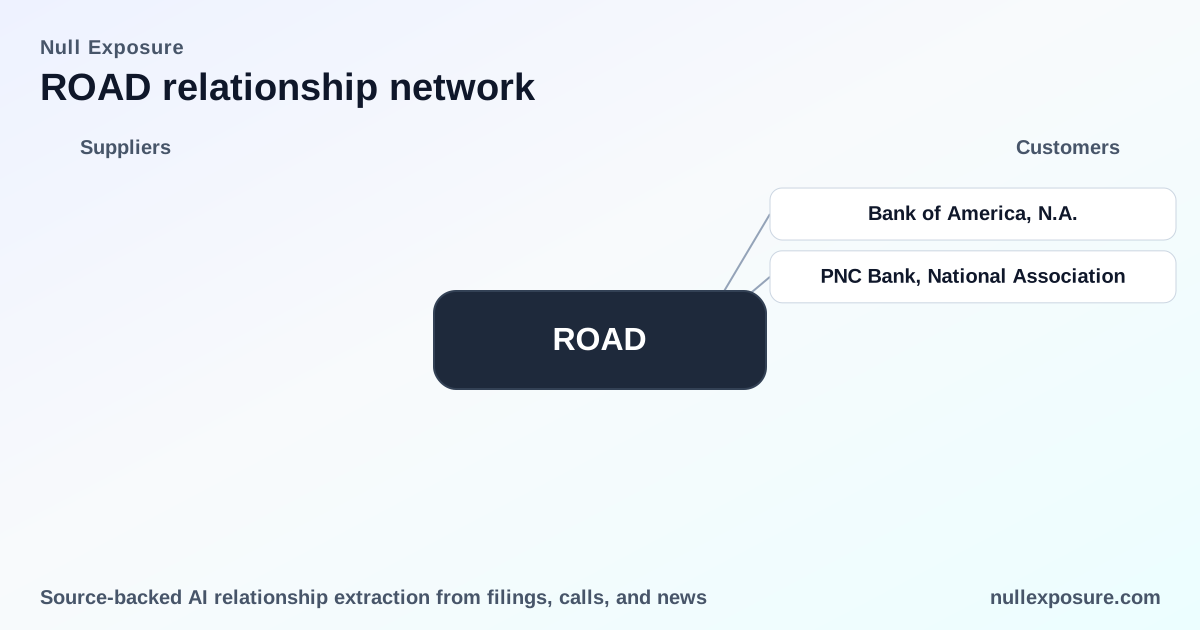
Bank of America, N.A.
Construction Partners entered a senior secured first‑lien term loan facility of $850 million in November 2024 with Bank of America serving as administrative agent and lender. This facility provides substantial committed long‑term financing that supports acquisitions, capex and balance‑sheet flexibility. (Source: FY2025 Form 10‑K, filed for fiscal year ended September 30, 2025.)
PNC Bank, National Association
In June 2025 the company executed an amendment to its Third Amended and Restated Credit Agreement with PNC Bank as administrative agent and lender, reflecting ongoing refinements to its syndicated bank financing package. This relationship signals active treasury management and lender engagement as the firm scales. (Source: FY2025 Form 10‑K, filed for fiscal year ended September 30, 2025.)
Humana (HUM) — news match anomaly
A news‑sentiment entry linked a May 2026 earnings transcript referencing partnerships involving Ro and WeightWatchers, published via The Globe and Mail; the excerpt does not describe a customer or contractual relationship between Construction Partners and Humana, and does not substantively pertain to ROAD’s business lines. Treat this item as a non‑substantive news match rather than a business counterparty. (Source: The Globe and Mail transcript, May 2026; news_sentiment entry.)
How the company’s operating model shapes commercial risk and opportunity
Construction Partners’ disclosures establish a clear contracting posture and operating profile:
- Contracting posture — long‑term, over‑time revenue recognition. The company recognizes revenue as it satisfies performance obligations on long‑duration construction contracts, which gives project‑level margin visibility but concentrates exposure to project execution and input cost swings.
- Counterparty concentration — government customers are material. Public customers (federal, state DOTs, municipalities) account for a large share of revenue, with DOTs alone representing above 40% in FY2025; public funding is therefore a central demand driver.
- Customer diversification — no single customer exceeds 10% of revenues. Despite the DOT concentration, the firm reports that no single customer accounted for more than 10% of revenue in FY2025, indicating broad geographic and account diversification within the public sector.
- Vertical integration — manufacturer, distributor and service provider roles. The company manufactures and distributes hot‑mix asphalt and liquid asphalt cement, mines aggregates for internal use and third‑party sale, and performs paving and site development services — a structure that reduces raw‑material supply dependence but increases capital intensity.
- Geographic focus — Sunbelt states (AL, FL, GA, NC, OK, SC, TN, TX). The regional footprint concentrates exposure to state budget cycles and weather patterns that drive paving seasonality.
- Maturity of relationships — active, revenue‑bearing backlog. With $2.19 billion of unsatisfied performance obligations and $1.77 billion expected in the next fiscal year, current contracts are active and material to near‑term revenue.
These signals combine to create an operating model that offers stable near‑term cash flow driven by backlog and public works while leaving the firm sensitive to public budget shifts, commodity inputs (asphalt, aggregates), and execution on multi‑year contracts.
Financial context that investors should weigh
Construction Partners is trading with a premium multiple profile (trailing PE ~56.9; EV/EBITDA ~21.0 per company summary) and solid recent growth — revenue TTM roughly $3.06 billion with EBITDA around $459 million — which prices in both execution and backlog conversion. The $850 million term loan and the amended credit facilities reflect an elevated capital structure that funds expansion and acquisition activity but also increases fixed obligations. Key investment considerations:
- Positive: high backlog visibility, vertical integration that protects margins, and strong regional market share in targeted Sunbelt states.
- Negative: public funding concentration (DOTs >40% of revenue), input commodity exposure, and elevated leverage metrics relative to peers.
Analyst consensus at the time of the reporting period set a target price near $139 and the company’s market capitalization was approximately $7.08 billion, framing expectations embedded in current valuation. (Company overview and analyst consensus, FY2025–FY2026 disclosures.)
For a more structured review of counterparties and contractual exposures, our platform provides document‑level access and investor‑grade relationship summaries — learn more at https://nullexposure.com/.
Bottom line: where ROAD’s customer relationships place it in a portfolio
Construction Partners delivers predictable, contract‑backed revenue from long‑duration public projects, supported by materials sales and a vertically integrated footprint that cushions input procurement. The primary risk vector is concentrated exposure to public funding and execution on sizable, active contracts, while lender relationships and recent financing activity provide capital to scale operations. Investors should prioritize monitoring state DOT budget cycles, backlog conversion rates, and commodity cost trends as the key drivers of near‑term earnings variability.
If you are evaluating ROAD for assignment, acquisition, or credit exposure, focus on contract pipeline quality, the composition of the unsatisfied performance obligations by state and project type, and covenant headroom in the amended credit agreements — those are the variables that will determine whether the current valuation premium holds.