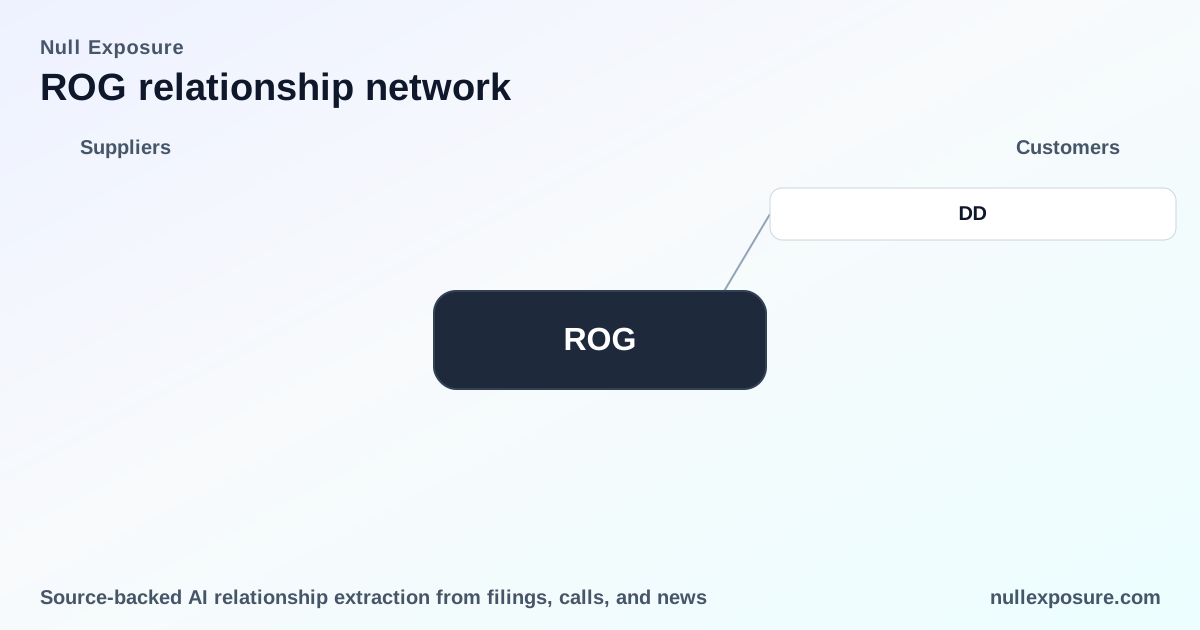
Rogers Corporation (ROG) — customer relationships and what investors should know
Rogers Corporation designs and sells engineered materials and components to OEMs, converters, fabricators and distributors, monetizing through direct sales of specialized materials and customized manufacturing contracts that drive margins when scale and product differentiation align. The company’s revenue sits at roughly $821M TTM, with a global sales footprint across North America, EMEA and APAC; operating characteristics—short-term purchase orders, low single-customer concentration and a large base of small customers—frame both revenue resiliency and limited near-term visibility. Explore deeper signals and relationship intelligence at https://nullexposure.com/.
The operating profile that defines customer risk and upside
Rogers’ public disclosures and the relationship signals combine to paint a clear commercial posture:
- Contracting posture: short-term, order-driven sales. Rogers reports that many sales are recognized at a point in time under short-term purchase orders that can be rescheduled or cancelled without substantial penalty. This creates limited forward revenue visibility and makes near-term topline sensitive to end-market cycles.
- Geographic diversification but exposure to global cycles. Management sells through direct channels in North America, EMEA and APAC, with revenue reported by those regions. Geographic diversification reduces single-region concentration risk but links performance to cyclical demand patterns in electronics and industrial markets across multiple geographies.
- Low customer concentration. Rogers discloses no customer accounted for more than 10% of accounts receivable as of the latest filing, signaling no single customer dependency and implying diversified counterparty credit exposure.
- Role and product stickiness. The company operates as a manufacturer and seller whose AES and specialty products are sold to distributors and OEMs; some products are customized to a degree that limits easy reallocation to other buyers, supporting pricing power for specialized lines.
- Implication for investors: predictable margins on engineered products, but revenue volatility driven by short-term order book dynamics; working capital and production planning are key value levers.
Customer relationship log — what the recent results captured
Below I cover each relationship entry returned in the customer sweep and cite the original reporting. Each item is presented as recorded in the relationship results.
DD (listed as DD) — DuPont deal termination reported
A news item recorded under the symbol DD notes that DuPont terminated its proposed $5.2 billion acquisition of Rogers after failing to obtain necessary regulatory clearances. This was reported in a Delaware Online piece covering the November 2022 termination. (DelawareOnline, Nov 2, 2022 — https://www.delawareonline.com/story/money/business/2022/11/02/dupont-deal-to-buy-rogers-off-after-regulator-hurdles/69613669007/)
DuPont — same Nov 2022 coverage of acquisition collapse
The same Delaware Online story appears again under the name DuPont: it documents DuPont’s announcement that it was ending the purchase agreement to acquire Rogers for $5.2 billion due to regulatory hurdles. The DuPont transaction and its termination are a discrete corporate-event citation captured by the relationship feed. (DelawareOnline, Nov 2, 2022 — https://www.delawareonline.com/story/money/business/2022/11/02/dupont-deal-to-buy-rogers-off-after-regulator-hurdles/69613669007/)
RPRX — Royalty Pharma transaction referenced in news capture
A May 3, 2026 news item recorded under RPRX describes Royalty Pharma acquiring the final portion of a royalty interest in Roche’s Evrysdi for $240 million upfront, with up to $60 million in potential milestones. The capture reflects media coverage of a biotech royalty transaction, as published on Investing.com. (Investing.com news, May 3, 2026 — https://www.investing.com/news/insider-trading-news/urist-marshall-evp-at-royalty-pharma-sells-815k-in-shares-93CH-4445889)
REPL — Replimune notes collaboration and supply agreement with Roche
A February 3, 2026 press release captured under REPL states that a clinical trial is being conducted under a collaboration and supply agreement with Roche. The entry comes from a corporate financial newswire item about Replimune’s fiscal quarter update. (GlobeNewswire via The Manila Times, Feb 3, 2026 — https://www.manilatimes.net/2026/02/03/tmt-newswire/globenewswire/replimune-reports-fiscal-third-quarter-2026-financial-results-and-provides-corporate-update/2270579)
How to interpret these relationship records as an investor
The relationship log contains both clear Rogers-specific events and media captures that are ancillary to Rogers’ core customer ledger. The DuPont entries document a material strategic event — a proposed $5.2B acquisition and its subsequent termination — and are directly relevant to investors assessing past strategic interest in Rogers and potential M&A comparables (DelawareOnline, Nov 2022). The Royalty Pharma and Replimune items are news captures that surfaced in the customer sweep and should be read as media mentions rather than evidence of major, listed customer contracts with Rogers; they are useful for monitoring broader industry noise but do not, by themselves, indicate material revenue exposure in Rogers’ reported customer book (Investing.com, May 2026; GlobeNewswire/ManilaTimes, Feb 2026).
Materiality, concentration and maturity — what the constraints tell us
Treat the constraint signals as company-level operating signals rather than relationship-level claims:
- Short-term contract bias reduces revenue visibility but enables rapid responsiveness to demand fluctuations. That contracting posture requires robust working-capital management and flexible capacity planning.
- Geographic revenue spread across NA, EMEA and APAC provides balanced exposure to multiple growth centers but leaves the company sensitive to synchronized downturns in electronics and industrial markets.
- Immaterial customer concentration (no customer >10% of receivables) is a structural positive for credit and cashflow stability; insurance of receivables is less concentrated risk-wise.
- Manufacturer/distributor/seller roles and product customization indicate a mixed go-to-market combining direct OEM relationships and distribution channels; customized manufacturing creates lock-in for certain product lines while also raising the bar for incremental sales reuse.
- Segment maturity note: Rogers manufactures highly engineered products and reports some products configured to unique customer specifications; this supports higher margins on differentiated lines but limits rapid redeployment of capacity.
Investor takeaway: Rogers combines diversified demand with short-term sales cycles; the balance of customization and geographic scale supports margin upside, while order-driven revenue increases volatility and requires active supply-chain and working-capital management.
Key risks and watchpoints
- Revenue visibility: short-term purchase orders can compress predictability—monitor order intake and backlog metrics in quarterly reports.
- Cyclicality: exposure across North America, EMEA and APAC ties performance to global electronics and industrial cycles.
- Event risk / strategic interest: the terminated DuPont acquisition is a reminder that Rogers is a target for strategic consolidation; any renewed interest or bid activity would reprice strategic value rapidly. (DelawareOnline, Nov 2022)
For investors focused on customer-driven credit and revenue risk, tracking region-by-region bookings, OEM order patterns, and any signs of reconcentration will be decisive.
If you want integrated, transaction-level customer intelligence and ongoing relationship monitoring for Rogers and comparable industrials, visit https://nullexposure.com/ for service options and subscription details.