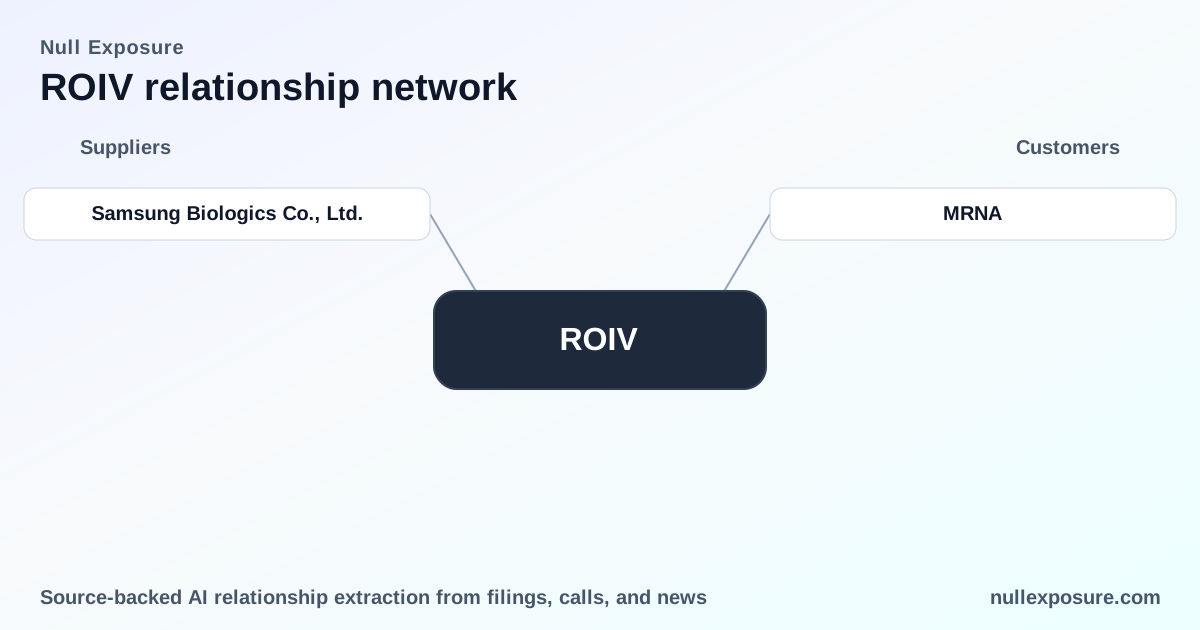
Roivant Sciences (ROIV): Customer and partner relationships that move value
Roivant is a hybrid biopharma holding company that builds and spins out focused operating units (“Vants”), monetizing through IP licensing, divestitures, litigation settlements, and recurring software/subscription fees from its healthcare-technology businesses. For investors, Roivant’s cash generation is driven less by product sales today and more by strategic exits, licensing outcomes, and monetizable technology assets — a model that concentrates event-driven upside and counterparty-dependent cash flows. Learn more about how we track these partner-linked events at https://nullexposure.com/.
Why partnerships are the operational lever for Roivant investors
Roivant’s operating model produces two distinct revenue channels: transactional, high-impact events (asset sales, settlements, licensing) and recurring, lower-margin technology revenue. That combination defines the company’s contracting posture: agreements are often structured as licenses or settlements that transfer substantial value at discrete points, while subscription and service contracts deliver ratable, predictable revenue. The result is an earnings profile where a few counterparty outcomes can materially swing the valuation multiple.
Recent customer and partner developments — a concise roster
Below I list every relationship referenced in the source material and summarize the commercial implication for Roivant.
Organon (OGN) — Dermavant divestiture
Organon agreed to acquire Dermavant Sciences Ltd. from Roivant and others for approximately $1.2 billion. This transaction represents a classic asset monetization event for Roivant that crystallizes value from a dermatology platform. (Reported by Simply Wall St, FY2026.)
Moderna (MRNA) — $2.25 billion global settlement (market reaction)
Markets reacted to a $2.25 billion settlement involving Moderna, Arbutus and Roivant, with Moderna shares rising on the clearance of litigation and downstream pipeline uncertainty. The settlement is a large, one-time cash and risk-transfer event that materially affects Roivant’s legal and licensing exposure. (Coverage: 247WallSt, Mar 4, 2026.)
Moderna / Genevant — Non‑exclusive LNP license to Moderna
Genevant Sciences, a Roivant subsidiary, granted Moderna a non-exclusive license to its lipid nanoparticle (LNP) delivery technology for infectious-disease applications, creating a defined licensing revenue and royalty pathway for the Genevant asset. This is a structurally important IP license that converts technology ownership into monetizable rights. (Reported by Bitget News, Mar 10, 2026.)
Moderna — Settlement economics (upfront and contingent payments)
Public reporting itemized the Moderna settlement terms as $950 million upfront with an additional $1.3 billion contingent on a favorable appellate ruling, underlining that Roivant’s near-term cash recognition depends on litigation outcomes and contingent consideration. This split between upfront and contingent payments illustrates how contract structure drives both realized proceeds and residual contingent value. (Reported by Investing.com / AU edition, May 3, 2026.)
Arbutus Biopharma (ABUS) — Co‑defendant in patent litigation resolution
Arbutus participated in the global settlement alongside Genevant/Roivant and Moderna, making the agreement a multilateral resolution of patent disputes that eliminates material legal overhang for the parties and centralizes value transfer through the settlement pool. For Roivant, shared settlements reduce litigation expense and unlock monetization of IP contributions. (Reported by Investing.com / AU edition, May 3, 2026.)
Immunovant (IMVT) — Potential follow‑on financing relationship
Roivant disclosed that it may provide additional financing to Immunovant via equity, debt, or loans, signaling a retained exposure to subsidiary financing and illustrating Roivant’s role as both operator and capital provider within its Vant ecosystem. That posture increases balance-sheet concentration risk while preserving upside from subsidiary growth. (Reported by TS2.Tech, FY2025.)
What the constraints tell investors about Roivant’s business model
The public constraints extracted from Roivant’s filings and disclosures indicate several company-level operating realities:
- Licensing is a core revenue mechanism. Multiple disclosures show that Roivant recognizes revenue from IP licenses when control transfers, which is consistent with the recent Genevant license and past divestitures. This makes Roivant’s revenue profile lumpy and event-driven.
- Subscription and service fees provide a secondary, ratable revenue stream. Roivant’s healthcare-technology Vants generate subscription revenue that’s recognized over contract periods, offering some steady-state cash flow even as the core product pipeline remains development-stage.
- Counterparty mix includes government and large enterprise payors. Filings emphasize dependence on payor coverage and relationships with major biopharma firms, indicating that reimbursement policy and enterprise contracting cycles are material to commercialization economics.
- Global market exposure. The business is positioned to sell both medicines and technology services globally, so regulatory and reimbursement variability across jurisdictions is an operational input to revenue realization.
- Segment mix: core biotech plus software. Management runs a single reporting segment focused on discovery, development and commercialization while also operating technology Vants — a hybrid mature/immature portfolio that requires both R&D depth and productized software sales capability.
Investment implications and risk checklist
- Event-driven upside; settlement and licensing flows are the primary value triggers. Recent deals underscore that Roivant’s valuation re-rates with successful monetizations and legal resolutions.
- Counterparty and concentration risk. Large counterparties and reliance on a handful of transactions magnify single-counterparty influence on cash flow.
- Balance-sheet exposure to subsidiaries. Potential follow-on financing (Immunovant) is a reminder that capital allocation decisions at the holding level can meaningfully affect Roivant’s leverage and dilution profile.
- Recurring tech revenue moderates but does not replace event risk. Subscription income improves baseline visibility but is not yet a dominant earnings driver.
If you’re evaluating Roivant for position sizing or partner risk, focus on upcoming license milestones, appellate timelines attached to contingent settlements, and the cadence of any planned asset divestitures.
For further diligence on partner events and to track counterparty developments, visit https://nullexposure.com/ for our transaction-driven monitoring and summaries.