Rockwell Automation (ROK): Customer relationships that drive recurring value and industrial lock‑in
Rockwell Automation sells industrial automation hardware, software and lifecycle services under brands including Allen‑Bradley and FactoryTalk, monetizing through a mix of product sales, recurring service contracts, and growing software/subscription revenue. The company blends one‑time sales of intelligent devices with higher‑margin software and recurring lifecycle services, creating durable customer lock‑in across manufacturing, logistics and utilities.
If you want a concise commercial view for underwriting exposure or competitive due diligence, start from the operating mix: a heavy distributor channel, concentrated but diversified end‑market traction, significant U.S. revenue, and an explicit push into digital twin, SaaS and managed services. For deeper signals on counterparties and use cases, see Null Exposure’s customer mapping at https://nullexposure.com/.
How Rockwell converts customers into cash flow
Rockwell’s business model is threefold: Intelligent Devices (hardware sold at a point in time), Software & Control (including digital twin and subscription revenue recognized over time), and Lifecycle Services (recurring managed support and professional services). The combination creates a revenue profile with both spot transactions and growing recurring components that increase lifetime value per customer. The company recognizes more than half of its solutions and services revenue from contracts of one year or less, while SaaS arrangements are recognized over the subscription period, and product sales are recognized at delivery. These facts indicate a contracting posture that is mixed short‑term/transactional for hardware, transitioning to subscription and managed relationships for software and services (Rockwell fiscal disclosures, FY2025–FY2026).
- Key commercial strengths: Installed base economics, cross‑sell into operations technology (OT) and IT, and growing digital twin/SaaS revenue streams.
- Key structural risks: Distributor concentration (approximately 65% of sales transacted through independent distributors and roughly 20% of sales attributable to its two largest distributors), and a revenue base where the United States accounts for over half of sales (FY2025 disclosures).
What the relationship list tells investors about product-market fit
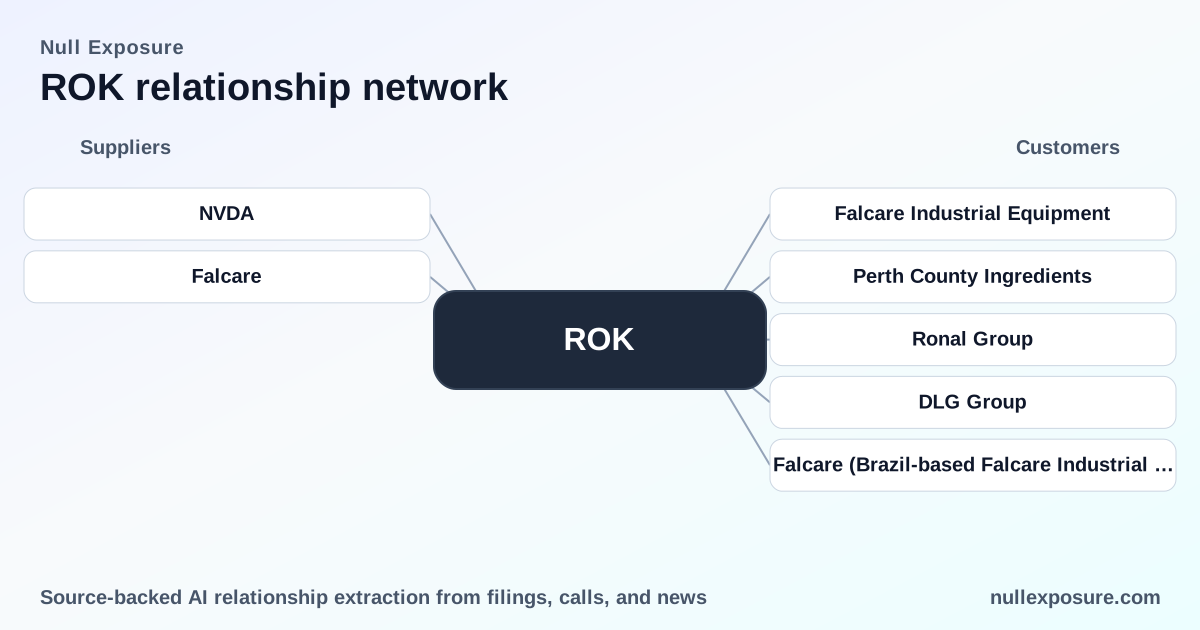
Rockwell’s recent media coverage highlights customer deployments that reflect three commercial realities: (1) digital twin and cloud integrations with hyperscalers and large logistics operators, (2) operational efficiency wins through CMMS and lifecycle services, and (3) regional commercial activity across EMEA, APAC and LATAM. Below I run through each named customer relationship from public reporting and what it signals for revenue quality and exposure.
Amazon / Amazon Web Services (AWS)
Rockwell’s Emulate3D digital twin software is being demonstrated with Amazon’s Global Engineering Services team to model fulfillment and industrial environments, reflecting integration with cloud infrastructure and hyperscaler engineering teams. According to PR Newswire and contemporaneous press (May 2026), Amazon uses Rockwell’s Emulate3D to create digital twins of fulfillment environments — a clear commercial reference for large‑scale logistics customers and cloud‑centric deployments.
DLG Group
Rockwell announced a Fiix CMMS deployment at DLG Group that is targeted to cut downtime roughly 10% by improving maintenance workflows, demonstrating Rockwell’s ability to convert service and software offerings into measurable savings for industrial customers. This was reported in industry coverage in March 2026 (Finviz; SimplyWallSt), and underscores Lifecycle Services traction in asset‑intensive customers.
Falcare Industrial Equipment (Brazil)
Rockwell’s digital twin technology accelerated project delivery and reduced costs for Falcare in Brazil, signaling local implementation capacity in LATAM and the sales motion of software paired with engineering services. The March 2026 coverage (Finviz) highlights the company’s ability to export digital twin use cases into emerging manufacturing markets.
Perth County Ingredients
A Canadian supplier using Rockwell’s Fiix CMMS realized maintenance cost reductions, illustrating the software/services play at small‑to‑mid sized industrial customers and Rockwell’s distribution reach into food‑processing supply chains. This deployment was reported in March 2026 coverage tied to Rockwell’s EMEA/EMEA customer experience center announcement (Finviz).
Ronal Group
Ronal Group will modernize remote access with a new centralized system delivered by Rockwell, reflecting cybersecurity, remote access and systems modernization revenue streams that sit at the intersection of hardware, software and services. The deployment was announced in March 2026 press coverage (Finviz).
NCT / Intercont
Intercont (NASDAQ:NCT) announced an ESG collaboration with Rockwell Automation in 2024 that the company pushed publicly in 2025, demonstrating Rockwell’s ability to participate in sustainability and ESG‑oriented industrial programs in maritime and logistics customers. The partnership was described in a GlobeNewswire release (April 2025) highlighting joint ESG initiatives.
(Each relationship summary above is drawn from public press and industry reporting in FY2025–FY2026 as cited.)
What the commercial constraints tell investors about risk and optionality
Rockwell’s public disclosures surface several company‑level signals that matter for counterparty risk and revenue durability:
- Contracting posture: A mixture of short‑term contracts and subscription arrangements — more than half of solutions and services revenue comes from contracts of one year or less, while SaaS is recognized over time as subscription revenue. This indicates a recurring revenue strategy that is still anchored in short duration commercial cycles (Rockwell FY2025 disclosures).
- Revenue mix and margins: Hardware product sales are predominantly recognized at a point in time and remain an important cash generator; software and lifecycle services are higher margin and provide recurring revenue that increases customer stickiness.
- Geographic exposure: Rockwell is global, doing business in over 100 countries, but North America (and specifically the U.S.) accounts for over half of total sales, with EMEA, APAC and LATAM material but smaller contributors (FY2025 disclosure).
- Distribution and concentration: Approximately 65% of global sales flow through independent distributors, and the two largest distributors accounted collectively for around 20% of sales across recent years — a concentration that creates channel risk but also scale advantages.
- Segment maturity: The Software & Control segment includes digital twin and simulation products that are strategic growth vectors; Lifecycle Services is explicitly recurring and professionally delivered, indicating a deliberate shift toward higher‑margin, service‑led revenue.
Investment implications and what to watch
Rockwell’s customer relationships show the firm is executing a hybrid monetization strategy: strong installed‑base economics and distributor reach for hardware sales, combined with accelerating software and managed services that improve revenue visibility. For investors and operators evaluating counterparty exposure, focus on:
- Renewal rates and average contract length in Software & Lifecycle Services, which determine how fast recurring revenue grows.
- Distributor concentration and any signs of pricing pressure or inventory destocking in the Intelligent Devices business.
- Hyperscaler integrations and large logistics references (for example, AWS/Amazon) that validate digital twin use cases and accelerate enterprise adoption.
For a structured look at counterparties and how they map to Rockwell’s revenue model, visit Null Exposure’s customer intelligence page: https://nullexposure.com/.
Bottom line
Rockwell converts transactional device sales into longer‑term revenue through software, digital twin and lifecycle services, with clear commercial references across hyperscalers, food processors, OEMs and logistics operators. The investment case rests on continued migration from point‑in‑time device revenue to higher‑margin, recurring software and services, balanced against channel concentration and U.S. revenue dependence.