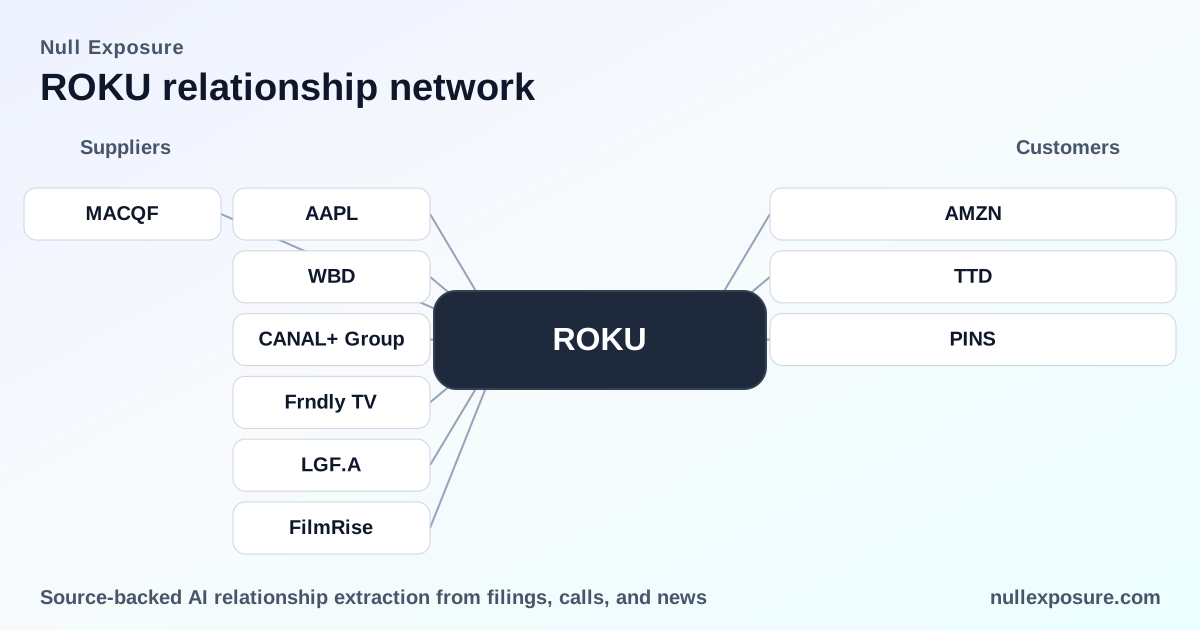
Roku's customer map: platform scale, OEM exposure, and advertising leverage
Roku operates a two-sided TV streaming platform that monetizes through platform services (advertising and distribution fees, subscription revenue shares) and devices (streaming players and Roku-branded TVs sold via retailers and distributors). Revenue mixes increasingly tilt toward platform economics—ad spend and content distribution—while device relationships anchor hardware distribution and reach. Investors should value Roku as a high-growth platform business with concentrated OEM distribution risk and diversified advertising counterparty exposure. For a concise investor briefing and ongoing screening of partner risk, visit https://nullexposure.com/.
How to read Roku’s customer relationships: what matters for valuation
Roku’s operating model combines recurring monetization (advertising and service revenue) with cyclical hardware sales. That duality creates a specific contracting posture: long-term ad-selling relationships and subscription splits on the platform, coupled with transactional OEM and retail distribution contracts for devices. Geographically, Roku is heavily North America–centric, so U.S. ad and device markets drive near-term cash flows. The company serves a broad counterparty base — large enterprises, mid-market advertisers, and SMBs through self-serve ads — which reduces single-buyer concentration but leaves material exposure to OEM partners that supply Roku TVs. These are company-level signals drawn from Roku’s disclosures and market reporting.
- Contracting posture: Mix of subscription/revenue-share for platform partners and wholesale/retail agreements for devices.
- Concentration and criticality: Platform ad customers are broad; OEMs like TCL/Hisense are more concentrated and critical for TV distribution.
- Maturity: Platform advertising is mature and scaling; devices remain cyclical and lower-margin.
- Geography: Primary revenue generation is in North America, limiting diversification today.
The full roster of customer relationships investors should track
Below are the relationships reported in the collected coverage. Each entry is a plain-English investor summary with the source cited.
TTE Technology Inc. (TCL North America)
TCL’s Roku-equipped TV lines are a key OEM relationship, but recent litigation has introduced operational risk. A class-action filing alleges that certain Roku-powered TCL TV software updates bricked devices across multiple series, naming Roku Select and Roku Plus models and a range of TCL 3–6 series models (CordCuttersNews, May 3, 2026: https://cordcuttersnews.com/roku-and-tcl-hit-with-class-action-lawsuit-over-alleged-defective-roku-tv-software-updates-that-brick-smart-televisions/).
TCL (public markets references)
Market commentary highlights renewed OEM agreements with TCL as supportive of Roku’s TV distribution strategy. Analysts cited TCL renewals when reiterating coverage and ratings (Investing.com summary, May 2026: https://m.investing.com/news/insider-trading-news/roku-ceo-anthony-wood-sells-498-million-in-stock-93CH-4558852?ampMode=1).
Hisense
Hisense is another major OEM partner for Roku-branded TV distribution and factored into analyst optimism about device reach. Coverage referenced renewed agreements with Hisense as a positive for Roku’s TV strategy (Investing.com, May 2026: https://m.investing.com/news/insider-trading-news/roku-president-sells-310k-in-shares-93CH-4542788?ampMode=1).
JD (Joybuy / Coocaa)
Roku has distribution and brand partnerships outside the U.S.; Coocaa Roku TV models launched on Joybuy in the UK represent Roku’s device and platform distribution via third‑party retailers. A JD corporate announcement noted Coocaa Roku TV availability exclusively on Joybuy in the UK (JD corporate blog, Mar 10, 2026: https://jdcorporateblog.com/jd-com-announces-joyexpress-a-new-delivery-service-for-europe/).
Amazon / Prime Video
Amazon is both a source of ad spend flowing through Roku’s demand-side channels and a distribution partner for Roku’s own subscription product, Howdy, which Roku expanded onto Prime Video as a subscription channel. Jefferies and market write-ups call out growing spend from Amazon via DSP channels, and Roku has added Howdy as a Prime Video channel to extend off-platform distribution (TS2 Tech analysis, Mar 10, 2026: https://ts2.tech/en/roku-stock-jumps-on-fresh-analyst-upgrades-is-nasdaqroku-setting-up-for-a-2026-breakout/; SahmCapital, Apr 2026: https://www.sahmcapital.com/news/content/is-roku-roku-turning-howdys-off-platform-expansion-into-a-more-profitable-platform-strategy-2026-04-03).
The Trade Desk
The Trade Desk is identified as a growing programmatic demand source that could materially increase ad spend routed to Roku’s platform. Analyst commentary cited The Trade Desk ramp as a contributor to potential upside in Roku’s platform revenue (TS2 Tech, Mar 10, 2026: https://ts2.tech/en/roku-stock-jumps-on-fresh-analyst-upgrades-is-nasdaqroku-setting-up-for-a-2026-breakout/).
Pinterest is mentioned as part of Roku’s expanding commerce and shoppable-content partnerships that broaden distribution and monetization channels. Market coverage lists Pinterest among services expanding Roku’s commerce-related reach (SahmCapital, Jan 23, 2026: https://www.sahmcapital.com/news/content/rokus-expanding-fast-and-commerce-partnerships-could-be-a-game-changer-for-roku-roku-2026-01-23).
LVO (LiveOne)
LiveOne’s OTT app is available on Roku, underscoring Roku’s platform distribution role for niche streaming services and the long tail of content partners. Press releases and market pieces list LiveOne as available across Roku devices and other OTT platforms (Bitget news, May 3, 2026: https://www.bitget.com/amp/news/detail/12560605276082; GlobeNewswire, Apr 22, 2026: https://www.globenewswire.com/de/news-release/2026/04/22/3278891/0/en/liveone-nasdaq-lvo-eliminates-15m-short-term-liabilities-delivering-13m-in-cash-savings-expands-stock-conversion-program-to-15m-at-7-50-per-share-with-8m-completed.html).
IQ (iQIYI)
iQIYI’s channel availability on Roku devices in North America broadens Roku’s content offering and international content distribution on its platform. iQIYI announced its Roku channel roll-out for Canada and the U.S. to reach diaspora and global viewers (PR Newswire, Mar 10, 2026: https://www.prnewswire.com/news-releases/iqiyi-launches-on-roku-streaming-players-and-roku-tv-models-bringing-variety-of-entertainment-from-across-asia-to-fans-in-canada-and-us-301512414.html).
GAIA
Gaia distributes its wellness and lifestyle streaming app via Roku, reflecting Roku’s position as a distribution channel for subscription streaming services. GAIA’s filings and press material list Roku among the platforms where Gaia is available (GlobeNewsWire, Mar 2, 2026: https://www.globenewswire.com/news-release/2026/03/02/3247843/0/en/Gaia-Reports-Fourth-Quarter-and-Full-Year-2025-Results.html).
BODI
BODI discloses that a portion of customers access its products via OTT services like Roku, indicating Roku’s role as a distribution touchpoint for health/wellness and connected-media companies. The SEC filing notes that some customers access offerings through Roku and other OTT platforms (SEC filing body, 2022 FY disclosure archived: https://www.sec.gov/Archives/edgar/data/1826889/000095017023008487/body-20221231.htm).
What investors should watch next
- OEM litigation and operational risk: The TCL class-action alleging bricked devices directly threatens device goodwill and distribution dynamics; OEM relationships are strategically important and concentrated on a handful of partners.
- Ad revenue diversification: Roku serves a wide advertiser base — large enterprises down to SMBs via Roku Ads Manager — which is a strength; watch the balance of large advertisers vs. self-serve growth to assess revenue stickiness.
- Off‑platform expansion: Roku’s move to distribute Howdy via Prime Video and broaden commerce partnerships (e.g., Pinterest integrations) shows deliberate monetization expansion beyond the home screen, improving revenue optionality.
- Geographic concentration: North America drives most revenue, so macro ad cycles in the U.S. will disproportionately affect Roku’s near-term platform performance.
For a deeper partner-risk scorecard and ongoing monitoring of Roku’s customer exposures, visit https://nullexposure.com/ for our platform-level intelligence and watchlists.
Bold takeaways: Roku is a platform-first company with hardware reach; OEM concentration and U.S.-centric advertising cycles are the principal risks, while diversified advertising demand and new distribution channels provide upside.