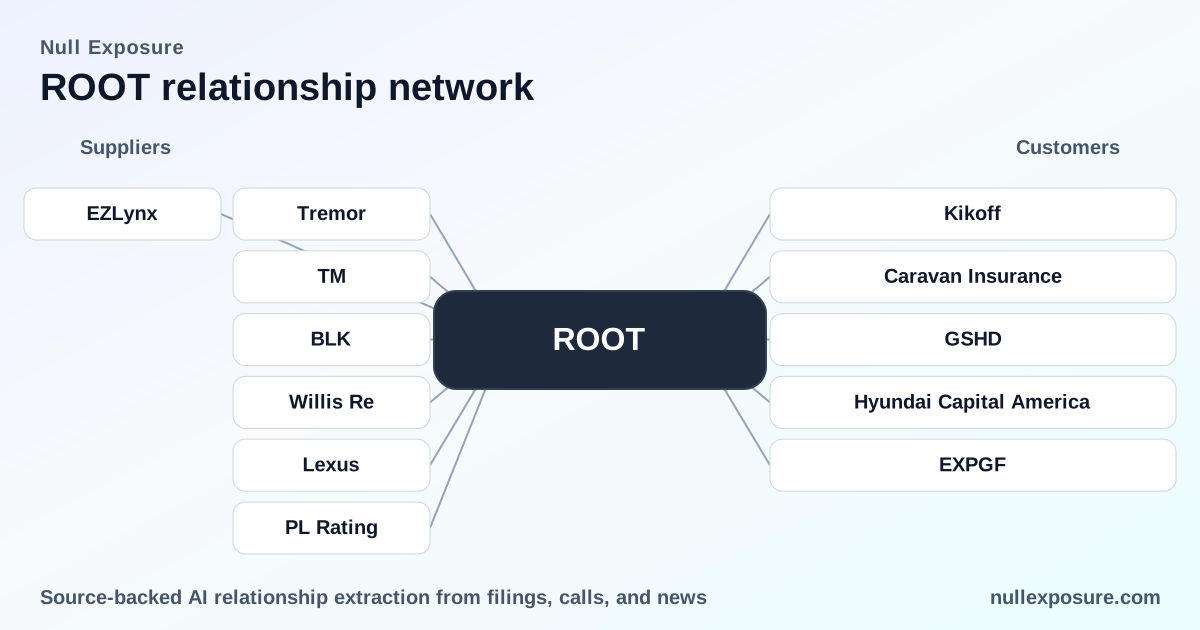
Root Inc. — Embedded insurance relationships that underwrite growth
Root sells auto and renters insurance through a technology-first, direct-to-consumer app and partnership model, monetizing via premiums, underwriting margins, and scaled embedded distribution. The company combines telematics-driven pricing and partner integrations to acquire policyholders at the point of vehicle purchase or financing, then seeks to retain them through app-based servicing and cross-sell. For a focused read on Root’s relationship map and what it signals for revenue concentration and distribution strategy, visit https://nullexposure.com/ for full coverage and datasets.
Why partnerships are the commercial lever, not an experiment
Root operates as a seller with two primary channels: direct mobile acquisition and a partnership / embedded insurance channel that places quotes and bind flows into third-party customer journeys. The company’s reported new-writings mix and multiple public announcements show partners are a material customer acquisition engine rather than a marketing adjunct. Embedded deals convert distribution cost into a potentially lower marginal acquisition cost and accelerate scale when paired with high-volume partners.
- Distribution concentration is visible: public commentary and filings identify a set of large partners that accounted for a sizable portion of new writings in recent quarters, which means partner performance is a direct driver of top-line volatility.
- Contracting posture is distribution-first and platform-oriented: Root integrates insurance quoting and bind flows into partner platforms; those partnerships are commercially critical because they place Root in the shopping moment.
- Geography and product scope are U.S.-centric and insurance-focused: Root’s operating entities and product set are concentrated in North American personal lines auto and renters.
If you want a concise feed of relationship-level intelligence and implications for underwriting exposure, check https://nullexposure.com/ for the full investor workflow.
Company-level operating signals and constraints
The available company excerpts deliver consistent operating signals:
- Root is direct-to-consumer, mobile-first, with the majority of personal insurance customers acquired through apps. This is a company-level signal indicating high digital distribution reliance.
- The firm’s domicile and operating focus are North America / U.S. auto insurance, with multiple Ohio- and Florida-domiciled insurance companies and a Cayman reinsurance entity referenced in filings; this confirms regulatory and actuarial concentration in U.S. personal lines.
- Root describes itself as a seller of auto and renters insurance via website, app, and a partnership channel; the commercial posture is predominantly distribution and underwriting.
- Customer engagement is active and app-driven — once purchased, policy management is handled in-app, indicating a mature digital service model rather than manual servicing.
- Root positions itself as a services/technology insurer that prices primarily on behavior (telematics) rather than demographics.
These signals together imply a highly scalable customer acquisition model that is dependent on partner flows, moderate concentration risk when large partners dominate new writings, and a mature app-based servicing model that reduces per-policy servicing costs.
The customer relationships: who Root is working with and what each means
Freeway Insurance — embedded coverage expansion
Root expanded integrated coverage options with Freeway Insurance, positioning Root as the embedded insurance technology behind a retail insurance broker network; this is a growth-oriented distribution tie. Source: Finviz news summary highlighting a Root–Freeway partnership (May 2026) — https://finviz.com/news/142456/root-inc-root-a-bull-case-theory.
Kikoff — embedded insurance inside a personal finance app
Root integrated its auto policy quoting and purchasing directly into Kikoff’s app, extending Root’s distribution into a personal-finance audience and demonstrating the firm’s strategy of embedding insurance at contextually relevant moments. Source: Sahm Capital reporting on the Root–Kikoff embedded partnership (Mar 2026) — https://www.sahmcapital.com/news/content/did-cash-strain-and-a-new-kikoff-partnership-just-shift-roots-root-investment-narrative-2026-01-15.
Goosehead Insurance — partner-driven new-writings contribution
Goosehead was cited among partners that, together with other integrations, accounted for a large share of new writings in Q2 2025, underscoring the role of brokerage and agent partnerships in Root’s distribution mix. Source: Insurance Journal coverage of Q2 2025 new-writing composition (Aug 2025) — https://www.insurancejournal.com/news/national/2025/08/07/834923.htm.
Hyundai Capital America — point-of-sale financing integration
Hyundai Capital America is listed among partners that materially contributed to new writing volumes in Q2 2025, indicating Root’s access to OEM/finance-originated points of sale and a path to scale via vehicle purchase and financing events. Source: Insurance Journal reporting on partner contributions to new writings (Aug 2025) — https://www.insurancejournal.com/news/national/2025/08/07/834923.htm.
Caravan Insurance — channel diversification through partnerships
Caravan Insurance was cited alongside other partners in Root’s reported new-business mix, illustrating Root’s hybrid model that blends direct and third-party produced business. Source: Insurance Journal snapshot on partner contributions (Aug 2025) — https://www.insurancejournal.com/news/national/2025/08/07/834923.htm.
Carvana Co — large-scale embedded program and volume milestone
Root’s program with Carvana "Built with Root" surpassed 200,000 policies sold, confirming that Carvana is a high-volume distribution partner translating platform reach into measurable policy counts. This represents a material scale signal for Root’s embedded business. Source: Sahm Capital reporting on Carvana–Root milestone (Apr 2026) — https://www.sahmcapital.com/news/content/why-carvana-stock-is-revving-up-on-friday-2026-04-17.
Carvana — cited as a notable example among 20+ embedded partners
Analyst commentary referenced Carvana as one of over 20 major companies using Root’s embedded insurance platform, framing Root as a leading player in the embedded personal auto insurance segment. Source: Finviz analyst summary citing Root’s partner roster (May 2026) — https://finviz.com/news/142456/root-inc-root-a-bull-case-theory.
Hyundai — cited among major embedded platform partners
Hyundai was similarly cited in market commentary as one of the major partners leveraging Root’s embedded insurance capability, reinforcing OEM and finance channel penetration as a strategic priority. Source: Finviz analyst summary referencing Root’s embedded partnerships (May 2026) — https://finviz.com/news/142456/root-inc-root-a-bull-case-theory.
EXPGF (Experian) — partner named in new-writings composition
Experian (reported under the EXPGF ticker in the feed) was listed among partners that contributed to 44% of new writings in Q2 2025, which highlights the importance of data and referral partners in Root’s acquisition mix. Source: Insurance Journal reporting on partner-driven new writings (Aug 2025) — https://www.insurancejournal.com/news/national/2025/08/07/834923.htm.
Experian — data/partner alliance reflected in new business
Experian’s inclusion in the list of significant partners confirms that Root leverages large upstream data and referral relationships to boost quote volumes and conversion in key quarters. Source: Insurance Journal coverage of Q2 2025 partner contributions (Aug 2025) — https://www.insurancejournal.com/news/national/2025/08/07/834923.htm.
What investors should take away
- Partner concentration is a double-edged sword. Embedded partners accelerate scale and reduce direct marketing spend, but a handful of large partners materially influence quarterly new writings and therefore top-line variability.
- Root’s commercial model is platform-driven and mature on the servicing side. App-based policy management reduces friction and supports retention, shifting the battleground to cost-effective partner acquisition and underwriting discipline.
- Distribution diversification is in progress. Partnerships span OEM/finance, brokers, online marketplaces, and fintech apps; that breadth reduces single-counterparty dependency but requires execution across multiple integration and commercial models.
For a structured investor briefing and ongoing monitoring of how these partner flows translate to premium and retention, visit https://nullexposure.com/ for institutional-grade relationship feeds and trend analysis.